
Insights for work and life.
Suspending an Employee During a Misconduct Inquiry
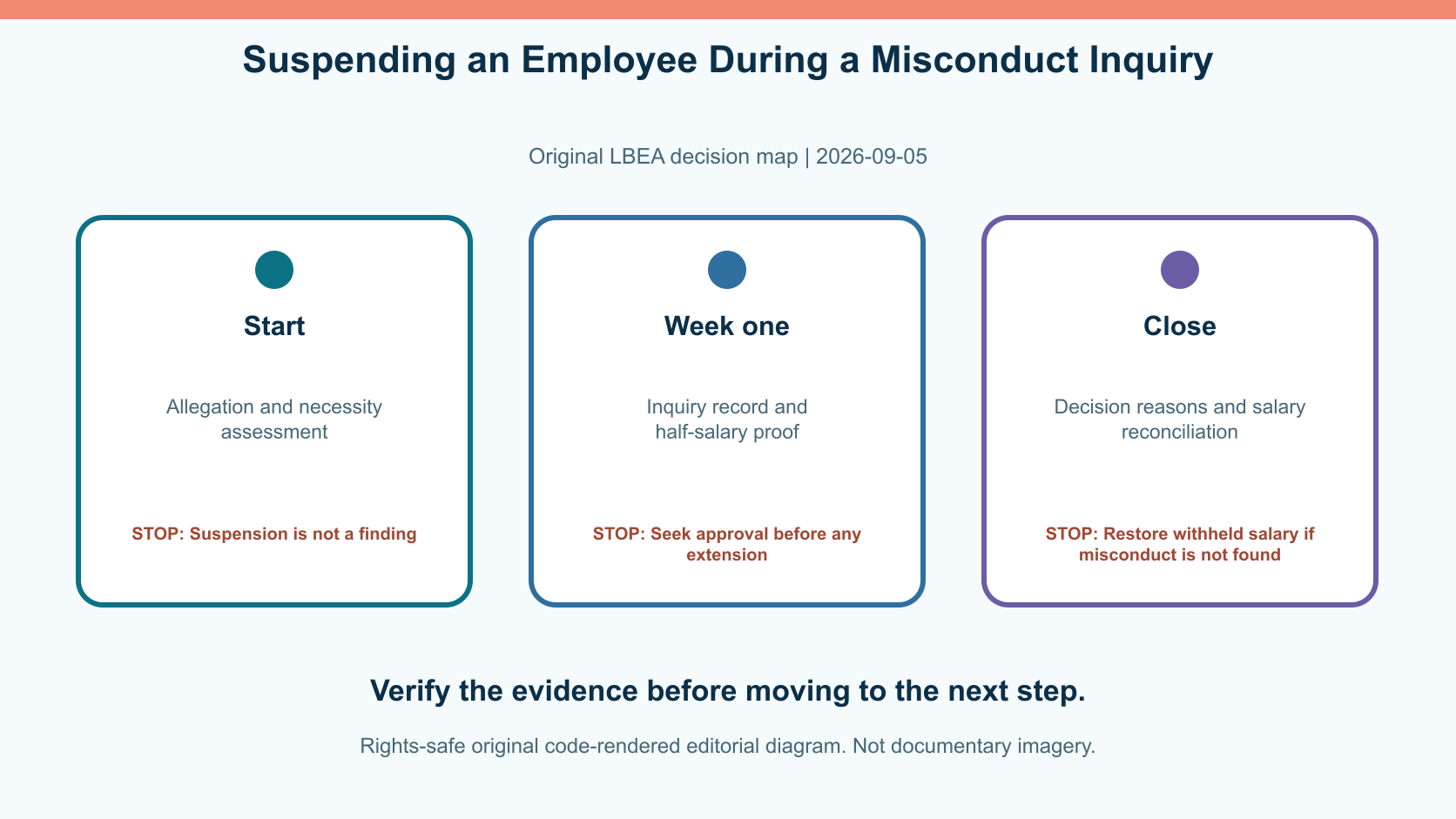
Answer first. An employer may suspend an employee during a misconduct inquiry, but the default inquiry suspension is no more than one week and at least half salary must be paid. Longer suspension needs advance approval from the Commissioner for Labour.
Related reading: misconduct inquiry playbook and disciplinary procedure contract risk.
Define the allegation
Record the alleged act, relevant policy or contractual duty, dates, people and evidence. Tell the employee enough to answer the case without contaminating witnesses or disclosing protected material unnecessarily. Suspension is not a finding. Use neutral language and prevent internal announcements from presenting suspicion as fact.
Decide whether suspension is necessary
Consider access controls, evidence preservation, safety, witness influence and alternatives such as temporary reporting changes or paid leave. Apply the contract and policy consistently. Record why the chosen restriction is proportionate. An automatic suspension for every allegation can create avoidable fairness and trust problems.
Control time and pay
MOM states that an inquiry suspension may not exceed one week without the Commissioner’s approval and the employee must receive at least half salary during suspension. Calendar the start, end and pay treatment. If more time is genuinely needed, seek approval at least three working days before the one-week period ends and provide the required explanation.
Run a fair inquiry
Give the employee the allegation and an opportunity to present the case. The decision-maker should not occupy a position suggesting bias. Preserve interview notes, documents, access logs and reasons for credibility findings. Separate investigator, complainant and final decision roles where practical, and address exculpatory evidence rather than selecting only material that supports dismissal.
Close and reconcile
If misconduct is not established, restore the full salary withheld during inquiry suspension and correct records promptly. If misconduct is established, select only an authorised and proportionate outcome after reviewing the contract, past practice and evidence. Communicate reasons and appeal or grievance routes. Obtain legal advice where dismissal or serious reputational harm is contemplated.
Turn the guidance into a dated file
For suspend employee during misconduct inquiry Singapore, assign one owner to the file and one reviewer who was not responsible for the original action. Record the official source, access date, facts, open questions and next decision. Keep originals unchanged and add corrections as new records. A clear chronology should show what was known, who decided, what authority was checked and what happened next.
Worked scenario
Suppose the first checkpoint in the matrix is incomplete but a deadline is approaching. The safer response is to preserve the current evidence, ask the relevant person for the missing record, verify the official procedure and document a temporary decision. Do not fill the gap with an assumption, a recycled template or an outcome promise. Recheck the second and third checkpoints after any correction.
Limits and escalation
This checklist explains issue spotting and process for a general reader. It cannot decide disputed facts, interpret a contract on incomplete evidence or replace Singapore legal, tax, immigration or regulatory advice. Rules and procedures can change. Reopen the cited official pages before acting, use the authority’s current channel and obtain professional advice where the consequences are material.
Final verification
Before closing the file, reread the official source, confirm the date and status of every consequential fact, and have another person check the chronology, calculations, links and proposed action. Record any unresolved point explicitly. A complete checklist is evidence of a careful process, not proof that an authority, tribunal or court will accept the conclusion.
How to use this guide
Start with the reader, decision and evidence identified above. Write the next action and owner beside every unresolved point, then set a review date. Keep authority-issued records unchanged and preserve earlier versions when a correction is made. If a fact, document or deadline does not fit the matrix, pause instead of forcing it into the nearest category. Official guidance can change, and a checklist cannot decide disputed facts or replace advice on a specific case. The strongest file shows what was known, when it was known, which source controlled the step and why the chosen action followed. Record every unresolved assumption, identify who can verify it, and never treat silence or a pending application as approval.
Decision and evidence matrix
| Checkpoint | Evidence to verify | Stop condition |
|---|---|---|
| Start | Allegation and necessity assessment | Suspension is not a finding |
| Week one | Inquiry record and half-salary proof | Seek approval before any extension |
| Close | Decision reasons and salary reconciliation | Restore withheld salary if misconduct is not found |
Primary sources checked for this guide
Source status was checked on 5 September 2026. Reopen the controlling page before acting because procedures and legal status can change.
- Ministry of Manpower: Termination due to employee misconduct, supporting Employers must conduct an inquiry; inquiry suspension is normally capped at one week with at least half salary, and withheld salary is restored if misconduct is not found.
- Singapore Statutes Online: Employment Act 1968, section 14, supporting Section 14 governs misconduct action following due inquiry and suspension during inquiry.
Real people. Right here in Singapore.