
Insights for work and life.
Employee Investigation Records: A PDPA and Due-Inquiry Checklist
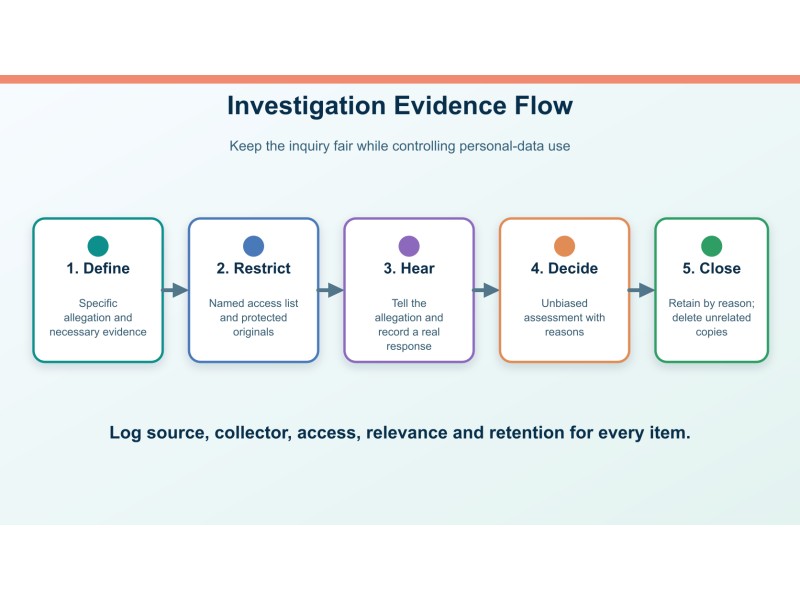
Quick answer. Workplace investigations create sensitive records. This checklist helps employers keep the evidence necessary for a fair inquiry without collecting or circulating information indiscriminately.
Related reading: misconduct due inquiry playbook and changing employment terms.
Collect for a defined allegation
Start with a written allegation and an investigation question. Do not seize every available message, device or personnel record simply because access is technically possible. Identify what fact must be established, which sources are likely to contain it and the least intrusive collection that can answer it. Record the purpose, legal or employment basis, custodian and date range. This discipline supports both a fair inquiry and the PDPA requirement that organisations act reasonably in the circumstances.
Use an evidence map
For every item, log the source, collector, collection time, original format, working copy, relevance, access list and retention decision. Distinguish direct evidence from an allegation, inference or credibility assessment. Preserve original metadata when it matters, but avoid copying irrelevant personal material into the case file. If CCTV, messaging or device logs are involved, check the organisation’s notices and policies, the stated monitoring purpose and whether the proposed use is proportionate to the allegation.
Protect the employee’s opportunity to respond
MOM describes a due inquiry as a process in which the employee is told the alleged misconduct, given a chance to present a case and heard by an unbiased person. Create an allegation pack that is specific enough to answer without disclosing unrelated confidential information. Record the questions and answers accurately. If witness confidentiality is a concern, assess how to protect the witness while still giving the respondent a meaningful description of the case. That balance may need legal advice.
Worked scenario
A manager alleges that an employee exported a customer list. IT finds a large download, but the file name also appears in the employee’s authorised monthly reporting task. The investigation file records the access log, role permissions, report instruction and interview response. It does not copy the entire mailbox. The investigator is outside the employee’s reporting line. The decision record explains why the download is or is not inconsistent with authorised work, rather than treating a technical event as automatic proof of misconduct.
Access and circulation controls
Use a named access list, not a broad HR folder. Separate the core evidence, interview notes, legal advice and decision record. Apply encryption and secure transfer where appropriate. Do not circulate allegations to managers who have no role in the inquiry. If an external investigator or service provider is engaged, define permitted use, security, return or deletion and breach notification. Record every disclosure. A later access request, grievance or court process becomes much harder when the organisation cannot explain who saw the file.
Retention after the decision
Do not set a single arbitrary deletion date for every investigation. Retain what is needed for the employment decision, any appeal, statutory claim window, litigation hold, regulator request and defensible personnel record, then review and dispose securely. Remove duplicates and unrelated data earlier where possible. If the allegation is unsubstantiated, record the outcome clearly so an incomplete accusation is not later treated as a finding. Keep audit evidence of deletion or archival controls.
Decision checklist
Before discipline, confirm that the allegation was clear, the investigator was unbiased, the employee had a real response opportunity, competing explanations were tested, the evidence chain is reliable and the proposed outcome is supported by the facts and applicable rules. Check any suspension against MOM’s current limits and pay requirements. Separate performance management from misconduct. Document reasons without exaggeration. This process does not determine the legal merits of a particular case, but it makes hidden assumptions and privacy risks visible before action is taken.
Decision and evidence matrix
| Checkpoint | Evidence to verify | Stop condition |
|---|---|---|
| Collection | Defined allegation and relevance | Avoid entire-device or mailbox sweeps |
| Access | Named investigator and need-to-know list | No broad HR-folder circulation |
| Response | Specific allegation and meaningful opportunity | Do not decide before hearing the employee |
| Retention | Appeal, claim and legal-hold rationale | Delete duplicates and unrelated material |
Primary sources checked for this guide
The legal and administrative status of each source was checked on 29 August 2026. Readers should reopen the controlling page before acting because procedures and eligibility rules can change.
- Ministry of Manpower: Termination due to misconduct, supporting A due inquiry should tell the employee the allegation, allow the employee to present a case and be conducted by an unbiased person; suspension limits and pay rules apply.
- Personal Data Protection Commission: Advisory Guidelines on the PDPA for Selected Topics, supporting Employment-related personal data may be collected, used or disclosed without consent in specified circumstances, but notification, reasonableness, protection and retention obligations remain relevant.
Real people. Right here in Singapore.