
Insights for work and life.
Misconduct Inquiries: A Singapore Employer Playbook
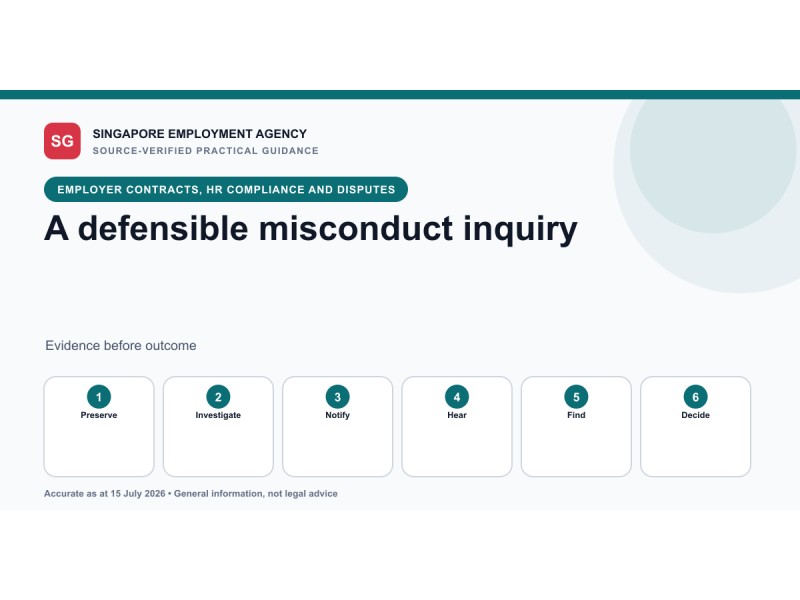
Answer first: if a Singapore employer intends to dismiss an Employment Act-covered employee without notice for misconduct, section 14 of the Act requires a due inquiry. There is no mandatory courtroom-style format, but a defensible process tells the employee the specific allegations, gives a genuine opportunity to answer them and uses a decision-maker who is not apparently biased. The employer should establish the facts before choosing dismissal, downgrading or an unpaid suspension.
A hurried meeting in which the outcome has already been decided is not much of an inquiry. Nor is an investigation file that the employee never had a chance to address. The process needs enough structure to demonstrate both what happened and why the selected sanction followed.
The legal starting point
Section 14(1) of the Employment Act 1968 permits summary dismissal for misconduct only “after due inquiry”. Instead of dismissal, it identifies immediate downgrading or suspension without salary for no more than one week as possible outcomes. MOM’s misconduct guidance says employers must conduct a formal inquiry before disciplinary action and gives three baseline protections:
- tell the employee what misconduct is alleged;
- allow the employee to present their case; and
- avoid a hearing officer whose position suggests bias.
“Misconduct” is not simply disappointing performance. MOM describes it as failure to fulfil conditions of employment, with examples such as theft, dishonesty, disorderly conduct and insubordination. Poor output, inability to meet a target and deliberate refusal to follow a lawful instruction can require different analysis. Misclassifying performance as misconduct is a common route to an avoidable dismissal dispute.
Investigation, inquiry and decision are different stages
| Stage | Purpose | Typical owner | Core record |
|---|---|---|---|
| Preservation | Secure documents, logs, devices and relevant physical evidence without deciding guilt | HR, IT, security or finance | Preservation note and access log |
| Investigation | Gather facts, identify witnesses and test alternative explanations | Investigator without a personal stake | Chronology, interview notes and evidence index |
| Allegation notice | Tell the employee the case requiring an answer | HR or inquiry secretary | Specific written allegations and supporting particulars |
| Inquiry | Receive and fairly evaluate the employee’s response | Impartial inquiry officer or panel | Response, hearing notes and follow-up evidence |
| Finding | Decide which allegations are established on the available material | Inquiry officer or panel | Reasoned finding for each allegation |
| Sanction | Select a proportionate contractual and statutory response | Authorised decision-maker | Sanction rationale and outcome letter |
One person can sometimes perform more than one role in a small business, but combining complainant, investigator, witness and final decision-maker creates an obvious fairness problem. Record why the chosen arrangement was reasonable and involve an independent manager or external investigator where the allegation concerns senior management.
A seven-step inquiry workflow
- Triage the allegation. Identify the contractual duty or policy allegedly breached, the possible harm and whether urgent preservation or safety action is needed. Do not describe conduct as “gross misconduct” before the facts are tested.
- Control the evidence. Collect relevant material lawfully and proportionately. Preserve original emails, transaction data, access records and CCTV metadata. Record who obtained each item and when. Avoid searching unrelated personal material merely because it is accessible.
- Define each allegation. State the conduct, date or period, relevant rule and essential facts. “Dishonesty” alone is too vague; “submitting invoice X on date Y while knowing service Z was not supplied” gives the employee something meaningful to answer.
- Give reasonable response time. Supply enough particulars and non-privileged supporting material for a genuine answer. Consider language needs, disability accommodation and whether the employee reasonably requires more time.
- Hear the response with an open mind. Ask clarifying questions, let the employee identify witnesses or documents and follow leads that could exonerate as well as incriminate.
- Make allegation-by-allegation findings. Separate established facts, disputed facts and matters not proved. Explain the evidential basis without overstating certainty.
- Choose and communicate the outcome. Consider seriousness, intent, harm, role, prior record, consistency with comparable cases and mitigating factors. State the result, effective date, pay consequences and any internal review route.
Suspending the employee during an inquiry
Suspension is not automatic and should not be presented as a finding of guilt. MOM says that during the inquiry an employer must:
- limit suspension to one week unless the Commissioner for Labour approves a longer period; and
- pay at least half the employee’s salary during that suspension.
If more than one week is required, the employer must apply for approval at least three working days before the one-week period ends and explain the allegation, need for more time, salary payable and estimated completion date. If misconduct is not established, any salary withheld during the inquiry suspension must be restored in full.
Do not confuse that paid inquiry suspension with the separate disciplinary outcome of an unpaid suspension of no more than one week after misconduct is established.
Outcome matrix: match the response to the finding
| Finding | Possible response | Risk-control question |
|---|---|---|
| Allegation not established | No disciplinary sanction; restore withheld inquiry-suspension salary | Has the employer corrected records and considered workplace repair? |
| Minor breach or first lapse | Counselling, training or warning where contract/policy permits | Is this consistent with comparable cases? |
| Established misconduct, continued employment viable | Warning, downgrading or up to one week’s unpaid suspension, depending on the lawful basis and facts | Is the consequence proportionate and clearly documented? |
| Established serious misconduct destroying trust or safety | Summary dismissal may be considered | Can the employer prove both the misconduct and the due inquiry? |
| Performance problem rather than misconduct | Performance management or termination with contractual notice, as appropriate | Has HR avoided relabelling poor performance to escape notice obligations? |
What recent Singapore decisions add
Decision-status caution: JGP v JGQ [2026] SGECT 1 is an Employment Claims Tribunals decision, not an appellate judgment. At [8], its grounds record that the respondent had filed applications seeking leave to appeal in all six related cases. Under section 23 of the Employment Claims Act 2016, an appeal is limited to a question of law or jurisdiction and requires District Court permission. At [10], the tribunal expressly described its general exposition of dismissal law as “largely obiter”, although aspects bore on five questions engaged by the cases. No published District Court permission order or General Division appeal disposition was located in Singapore Courts/eLitigation judgments searched through 15 July 2026; that does not establish that no unreported order has been made. Verify the current case file before relying on the decision.
In its case-specific application at [82]–[90], the tribunal described due inquiry as a modest, fact-sensitive standard of basic procedural fairness: adequate and reasonably clear notice of the allegations, a real opportunity to answer, and open-minded consideration before the employer fixes on misconduct. Its wider propositions about how procedure relates to a statutory just-cause claim should be read with the ECT-level and largely-obiter caveats above, not presented as settled appellate law.
Long Kim Wing v LTX-Credence Singapore Pte Ltd [2017] SGHC 151 shows why vague conversations are risky. The High Court found inadequate evidence that the employee had been told the allegations and allowed to answer them. The relevant contract itself required due inquiry, and the court awarded a limited period of salary reflecting the time a proper process would have taken.
At the same time, Kanan Packrisamy v Herbal Pharm Pte Ltd and others [2026] SGHC 2 cautions against lifting one proposition out of context. In that civil contractual claim, the High Court held on the pleadings and contracts before it that MOM guidance did not automatically become an implied contractual inquiry term. The court nevertheless dealt with serious established misappropriation and other contractual issues. The lesson for employers is not to skip inquiries, but to map the employee’s statutory coverage, contract, policies and proposed dismissal route before acting.
Wrongful-dismissal exposure
MOM’s wrongful-dismissal page states that for a dismissal without notice, the employer must prove that it was not wrongful. A claim normally must be filed at TADM within one month from the last day of employment. If mediation does not resolve it, the claim may proceed to the ECT, which can order reinstatement with lost income or compensation.
That one-month deadline does not make every procedural flaw outcome-determinative, but it means the employer may need to defend its decision quickly. A clean contemporaneous file is far more credible than a chronology reconstructed after the claim arrives.
Pre-decision audit checklist
- Employee’s statutory coverage and relevant contract clauses confirmed.
- Misconduct distinguished from poor performance, redundancy and capability.
- Evidence preserved with an access or custody record.
- Each allegation states conduct, timing, rule and supporting particulars.
- Employee received a genuine chance to respond and identify contrary evidence.
- Inquiry officer is independent of the complaint, or any unavoidable overlap is managed.
- Inquiry suspension pay and timing comply with MOM requirements.
- Findings and sanction are separately reasoned.
- Comparable cases and mitigating circumstances checked.
- Outcome letter, final salary and work-pass steps reviewed before delivery.
For related context, see our overview of employment-contract clauses and our guide to the Employment Claims Tribunals.
Bottom line
A due inquiry is not a ritual meeting. It is a documented decision process: specific notice, real response, impartial assessment and a proportionate outcome. Employers facing fraud, harassment, safety or senior-executive allegations should have the proposed process and dismissal route reviewed before the decision becomes irreversible.
Real people. Right here in Singapore.