
Insights for work and life.
MOM’s New Heat-Stress Duties: Employer Checklist for 1 December 2026
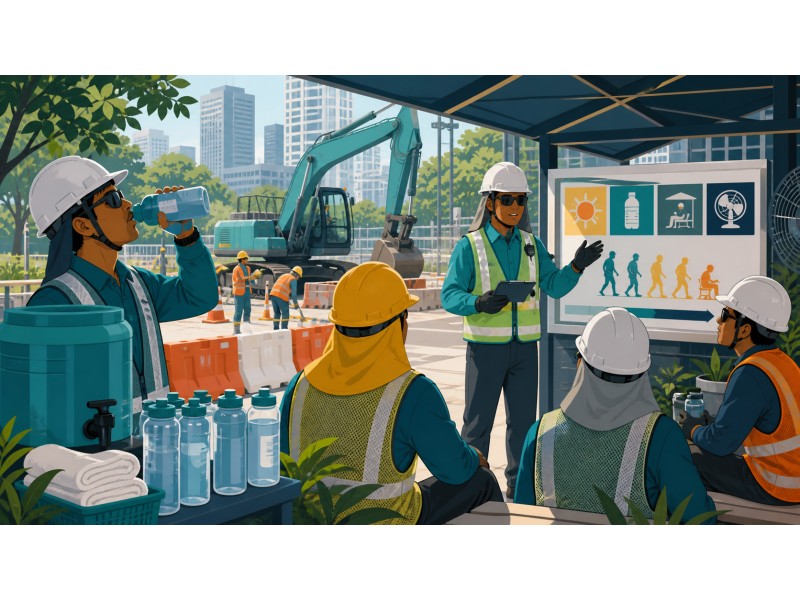
Quick answer. Four recommended heat-stress practices become mandatory on 1 December 2026. Employers have three months to close training, water, emergency-cooling and clothing gaps.
Related reading: MOM compliance calendar and workplace investigation checklist.
What changed on 28 August
MOM announced that four existing recommended practices under the outdoor-work Heat Stress Management Framework will become mandatory on 1 December 2026. Employers must establish heat-stress training for workers exposed to heat, provide cool drinking water near work areas, keep cold water, ice packs or water spray ready for emergency response, and provide suitable clothing that mitigates or protects against excessive heat stress. This is an announced future effective date, not a rule that was already in force on 29 August.
What did not disappear
The four additions sit beside existing framework requirements and controls, including Wet Bulb Globe Temperature monitoring, regular hydration, adequate shaded rest breaks, heat acclimatisation and emergency response planning. Employers should not treat the December change as a four-item shopping list. The practical question is whether the complete heat-risk system works at each outdoor site, shift and subcontracting interface. MOM also newly recommends shaded rest areas that are well ventilated and insulated or cooled.
A 90-day implementation plan
In the first 30 days, identify heat-exposed tasks, sites, worker groups, contractors and existing controls. Assign an accountable leader and compare current practice with MOM’s announcement and technical guidance. In days 31 to 60, update training, procurement, clothing assessment, water placement and emergency procedures. In days 61 to 90, run drills, observe actual shifts, correct access problems and keep dated evidence. Complete the change before 1 December rather than scheduling the first training on the effective date.
Training evidence that proves readiness
A slide deck alone is not a training programme. Record who is exposed, language and literacy needs, symptoms, hydration and rest instructions, supervisor escalation, buddy checks, first response and site-specific controls. Verify understanding through demonstrations or short checks. Train new and acclimatising workers before exposure and refresh workers when tasks or conditions change. Keep attendance and materials, but also observe whether supervisors follow the programme during real hot periods.
Water, emergency cooling and clothing
Map cool drinking-water points against the actual work area, access route and refill responsibility. Test availability at the hottest part of the shift, not only at morning inspection. Keep cold water, ice packs or water spray ready for emergency response and ensure workers know where they are. Assess clothing together with task hazards and required personal protective equipment. A lighter garment is not suitable if it creates another serious risk, while heavy protection may require stronger work-rest controls.
Worked site audit
A contractor has a water cooler at the site office, but workers are stationed several levels away and cannot leave the task freely. Ice packs are stored in a locked first-aid room, and the supervisor has not been trained on heat illness. The audit does not mark water and emergency cooling as present. It measures access time, assigns key control, moves supplies closer, trains the team and tests a response drill. Evidence focuses on usable protection, not procurement invoices.
Contractor and procurement controls
Main contractors should translate the framework into site rules that cover subcontractors, labour suppliers and temporary teams, while each employer remains responsible for its own duties. Tender and mobilisation documents should identify who provides water, shade, cooling equipment, training and supervision. Procurement should specify functional requirements and replenishment, not only item quantities. Site managers should record exceptions, such as remote work fronts or protective clothing that increases heat load, and agree controls before workers are deployed.
Management questions before sign-off
Can every exposed worker reach cool water near the work area? Can a supervisor recognise symptoms and start the emergency plan immediately? Are cooling supplies available, unlocked and replenished? Has clothing been assessed for both heat and task hazards? Do WBGT readings, acclimatisation and rest arrangements drive actual work decisions? Are contractors covered by the same site controls? Record exceptions and owners. The announcement gives preparation time, but employers should address current heat risks now rather than wait for the effective date.
Decision and evidence matrix
| Checkpoint | Evidence to verify | Stop condition |
|---|---|---|
| Training | Site-specific programme and understanding check | A slide deck alone is insufficient |
| Water | Cool supply near the actual work area | Test access at the hottest shift |
| Emergency cooling | Unlocked cold water, ice packs or spray | Assign replenishment and response owner |
| Clothing | Heat mitigation plus task-hazard review | Do not create another PPE risk |
Primary sources checked for this guide
The legal and administrative status of each source was checked on 29 August 2026. Readers should reopen the controlling page before acting because procedures and eligibility rules can change.
- Ministry of Manpower: MOM enhances heat stress protection for workers amid rising heat risks, supporting From 1 December 2026, four previously recommended heat-stress practices become mandatory; employers have three months to prepare.
- Ministry of Manpower: Guidelines for Wet Bulb Globe Temperature monitoring, supporting WBGT monitoring supports heat-risk assessment for outdoor work and sits alongside hydration, rest, acclimatisation and emergency planning controls.
Real people. Right here in Singapore.