
Insights for work and life.
When an HR Disciplinary Procedure Becomes a Contract Risk
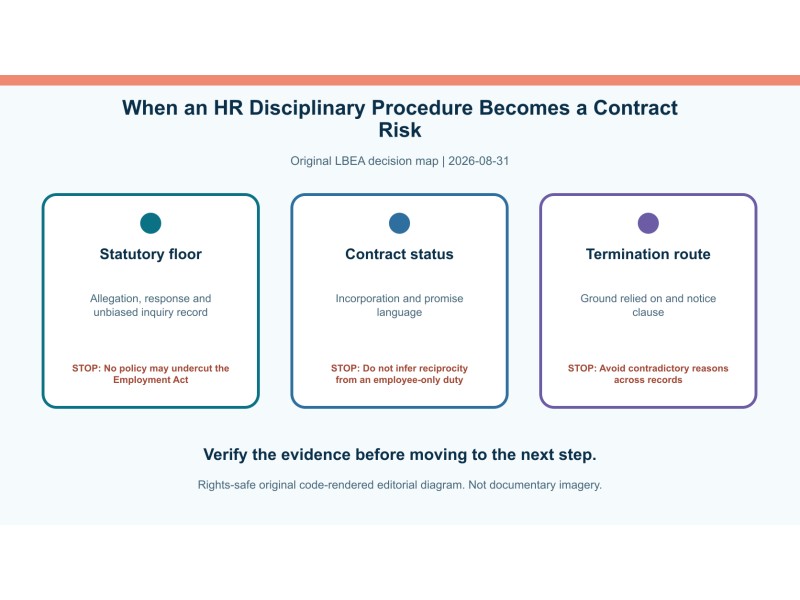
Quick answer. An employer must separate the Employment Act due-inquiry requirement from any additional disciplinary procedure that may have become contractually binding.
Related reading: employment contract clauses and contract handbook conflict matrix.
Separate three questions
An HR team considering discipline should ask three separate questions. First, does the alleged conduct engage the Employment Act due-inquiry requirement? Second, did the employer promise a particular disciplinary sequence in a contract, incorporated handbook or policy? Third, is termination with notice available on the facts and wording? A sound process does not collapse these questions into a generic belief that the company may dismiss whenever it has paid notice.
The statutory inquiry floor
MOM’s current guidance says the employee should be told the alleged misconduct, have an opportunity to present the case and be heard by someone whose position does not suggest bias. There is no single fixed inquiry format. The file should still identify the allegation, evidence, response, contested facts and reasoned finding. If suspension is used during inquiry, verify the Employment Act limits and pay requirements before acting. A policy cannot reduce a statutory safeguard.
Test whether the procedure was promised
Review the offer, contract, KETs, handbook acknowledgement, policy wording and variation clauses. SGECT 9 explains that contractual force depends on construction. Promissory language and incorporation support an obligation; guidance language, a unilateral-change reservation and an express non-contractual statement point the other way. An employee’s promise to follow policies does not automatically mean every policy reciprocally binds the employer. Record both sides of the construction issue and obtain legal advice where outcome-sensitive.
Map the procedure against the notice clause
A misconduct procedure may coexist with a separate right to terminate on notice, or it may be a condition that precedes termination of a particular kind. Read the agreement as a whole. Identify whether the employer is relying on misconduct, capability, redundancy, ordinary notice or another ground. Do not describe a termination as neutral notice while internal records say it was punishment for misconduct. Inconsistent characterisation damages trust and may affect later evidence.
Worked scenario
A handbook says the company ‘will’ issue allegations, hold an appeal and obtain panel approval before any misconduct dismissal. The contract incorporates the handbook but also contains an unqualified notice clause. After a security incident, a manager dismisses immediately without an appeal. HR should not assume that payment in lieu cures every issue. It preserves the contract and handbook versions, identifies the ground actually relied on, completes the statutory inquiry analysis and obtains advice on the interaction between the promised procedure and notice power.
Control the evidence and decision roles
Use a case chronology, allegation schedule and evidence index. Preserve originals, access logs and interview notes. The investigator should separate facts from recommendations; the decision-maker should record why each allegation is or is not established and why the sanction is proportionate. If a key witness is unavailable or digital evidence is incomplete, record the limitation. Do not copy an employee’s entire device when targeted material will answer the question.
Drafting and remediation
Future handbooks should say clearly which provisions are contractual, which are guidance and how changes are made. That drafting choice cannot retroactively resolve an existing dispute. For a live case, do not rewrite or reissue the policy mid-inquiry. Preserve the version that applied, follow any process that is safely achievable and obtain advice before departing from a stated promise. This article supports issue spotting and process design, not a conclusion on a particular dismissal.
How to use this guide
Start with the reader, decision and evidence identified above. Write the next action and owner beside every unresolved point, then set a review date. Keep authority-issued records unchanged and preserve earlier versions when a correction is made. If a fact, document or deadline does not fit the matrix, pause instead of forcing it into the nearest category. Official guidance can change, and a checklist cannot decide disputed facts or replace advice on a specific case. The strongest file shows what was known, when it was known, which source controlled the step and why the chosen action followed.
Decision and evidence matrix
| Checkpoint | Evidence to verify | Stop condition |
|---|---|---|
| Statutory floor | Allegation, response and unbiased inquiry record | No policy may undercut the Employment Act |
| Contract status | Incorporation and promise language | Do not infer reciprocity from an employee-only duty |
| Termination route | Ground relied on and notice clause | Avoid contradictory reasons across records |
Primary sources checked for this guide
Source status was checked on 31 August 2026. Reopen the controlling page before acting because procedures and legal status can change.
- Ministry of Manpower: Termination due to employee misconduct, supporting Before disciplinary action for misconduct, the employee should know the allegation, have an opportunity to respond and be heard by a person not apparently biased.
- Singapore Courts through eLitigation: [2026] SGECT 9, supporting Whether a handbook procedure has contractual force is a construction question; language of promise and incorporation points toward obligation, while guidance and non-contractual wording point away.
Real people. Right here in Singapore.