
Insights for work and life.
SGECT 10: Medical Return Requests and Constructive Dismissal Risk
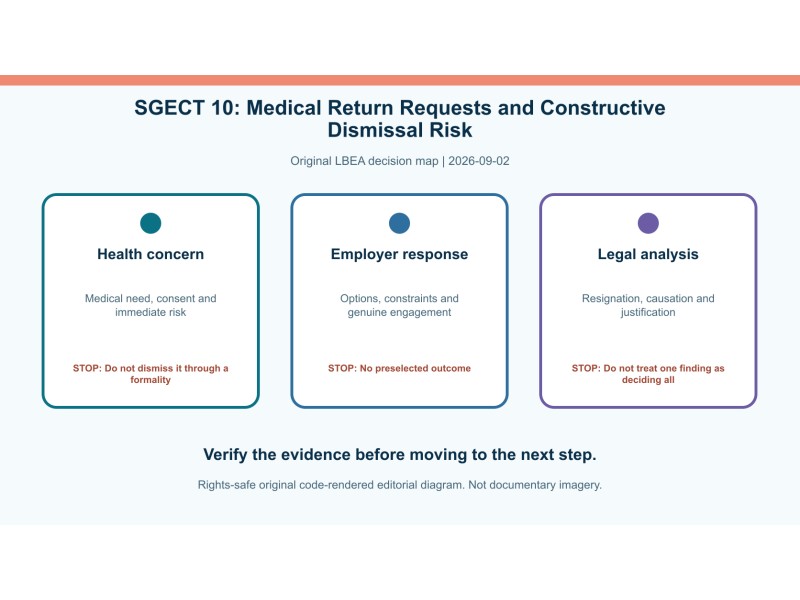
Answer first. SGECT 10 shows that an employer must genuinely investigate and respond to a medically vulnerable employee’s return-to-work needs; persistent failure can support a statutory constructive-dismissal finding on the facts.
Related reading: disciplinary procedure contract risk and contract and handbook conflict matrix.
What the Tribunal decided
In [2026] SGECT 10, the Employment Claims Tribunals considered a long-serving employee who returned after serious illness and raised medical needs affecting her work. The judgment found that the employer’s course of conduct fundamentally breached its duty to take reasonable care of her health and safety and breached mutual trust and confidence. It also found that her resignation was not voluntary but forced by the employer’s conduct within the Employment Act definition of dismissal.
Engagement was the starting point
The Tribunal said that when an employer is told of medical needs and vulnerabilities, it should reasonably investigate, consider and respond with care and sensitivity. It did not say that engagement had to produce the employee’s preferred outcome. A range of reasonable outcomes might have emerged. The problem was the lack of sensible inquiry and meaningful exploration, including around medical recommendations and redeployment. Employers should preserve the dialogue, evidence considered, operational constraints and reasons.
Policies did not end the inquiry
The respondent relied on internal requirements and operational priorities, but the judgment stressed that these may have to yield where reasonable care for health and safety demands it. This does not mean every policy must be waived or every medical request accepted. It means the employer should understand the actual risk, clarify ambiguous medical material, consider feasible adjustments and explain any limits. A standard form should not replace a fact-specific assessment.
The statutory test was carefully separated
The judgment distinguished common-law constructive dismissal from the Employment Act definition. Under the statutory language, the question is whether the employee resigned voluntarily or was forced by employer conduct, assessed objectively in the employee’s circumstances. The Tribunal described a practical-alternative inquiry and a causation requirement. It also stated that a dismissal finding does not automatically establish that dismissal lacked just cause or excuse; that is a separate question.
Worked employer response
An employee returning after cancer treatment supplies medical recommendations limiting exposure and requiring rehabilitation appointments. HR meets the employee, seeks focused clarification with consent, obtains a task-risk map from the manager, assesses temporary adjustments and redeployment, and records why each option is feasible or not. It sets a review date and avoids pressuring the employee to choose between health and immediate resignation. The file shows genuine engagement rather than a preselected outcome.
A practical response matrix
First, acknowledge the health concern and identify immediate safety needs. Second, obtain only relevant medical clarification with consent and privacy controls. Third, map essential duties and actual operational constraints. Fourth, consider adjustments, leave, redeployment or other options without promising a result. Fifth, explain the decision and review date. Sixth, route any grievance to a person not committed to the earlier position. Legal advice is prudent before conduct that may force a resignation.
What the case does not decide
SGECT 10 is fact-specific and subject to final editorial corrections. It does not make every rejected adjustment request wrongful, guarantee redeployment or supply a universal damages formula. The current Tripartite Guidelines support fair and respectful employment practices, while the Workplace Fairness Act has a separate future implementation timetable and should not be described as governing the case facts. Employers and employees should obtain advice on their own evidence, legal status and deadlines.
Evidence for both sides
The employer should retain medical material received, consent, meeting notes, task and risk analysis, options considered, communications, grievance records and decision reasons. The employee should preserve requests, medical recommendations, responses, attendance impacts and the resignation chronology. Neither side should edit records after the event or infer motives not shown by evidence. A reliable chronology is essential because voluntariness, practical alternatives, causation and justification are distinct questions.
How to use this guide
Start with the reader, decision and evidence identified above. Write the next action and owner beside every unresolved point, then set a review date. Keep authority-issued records unchanged and preserve earlier versions when a correction is made. If a fact, document or deadline does not fit the matrix, pause instead of forcing it into the nearest category. Official guidance can change, and a checklist cannot decide disputed facts or replace advice on a specific case. The strongest file shows what was known, when it was known, which source controlled the step and why the chosen action followed. Record every unresolved assumption, identify who can verify it, and never treat silence or a pending application as approval.
Decision and evidence matrix
| Checkpoint | Evidence to verify | Stop condition |
|---|---|---|
| Health concern | Medical need, consent and immediate risk | Do not dismiss it through a formality |
| Employer response | Options, constraints and genuine engagement | No preselected outcome |
| Legal analysis | Resignation, causation and justification | Do not treat one finding as deciding all |
Primary sources checked for this guide
Source status was checked on 2 September 2026. Reopen the controlling page before acting because procedures and legal status can change.
- Singapore Courts through eLitigation: [2026] SGECT 10, supporting The Tribunal found a fundamental breach of duty of care and held that the claimant was forced to resign under the Employment Act’s statutory dismissal definition.
- Tripartite Alliance for Fair and Progressive Employment Practices: Tripartite Guidelines on Fair Employment Practices, supporting Employers are expected to implement fair, respectful and progressive employment practices and comply with labour laws.
Real people. Right here in Singapore.