
Insights for work and life.
Withdrawing Salary-Deduction Consent: An Employee Checklist
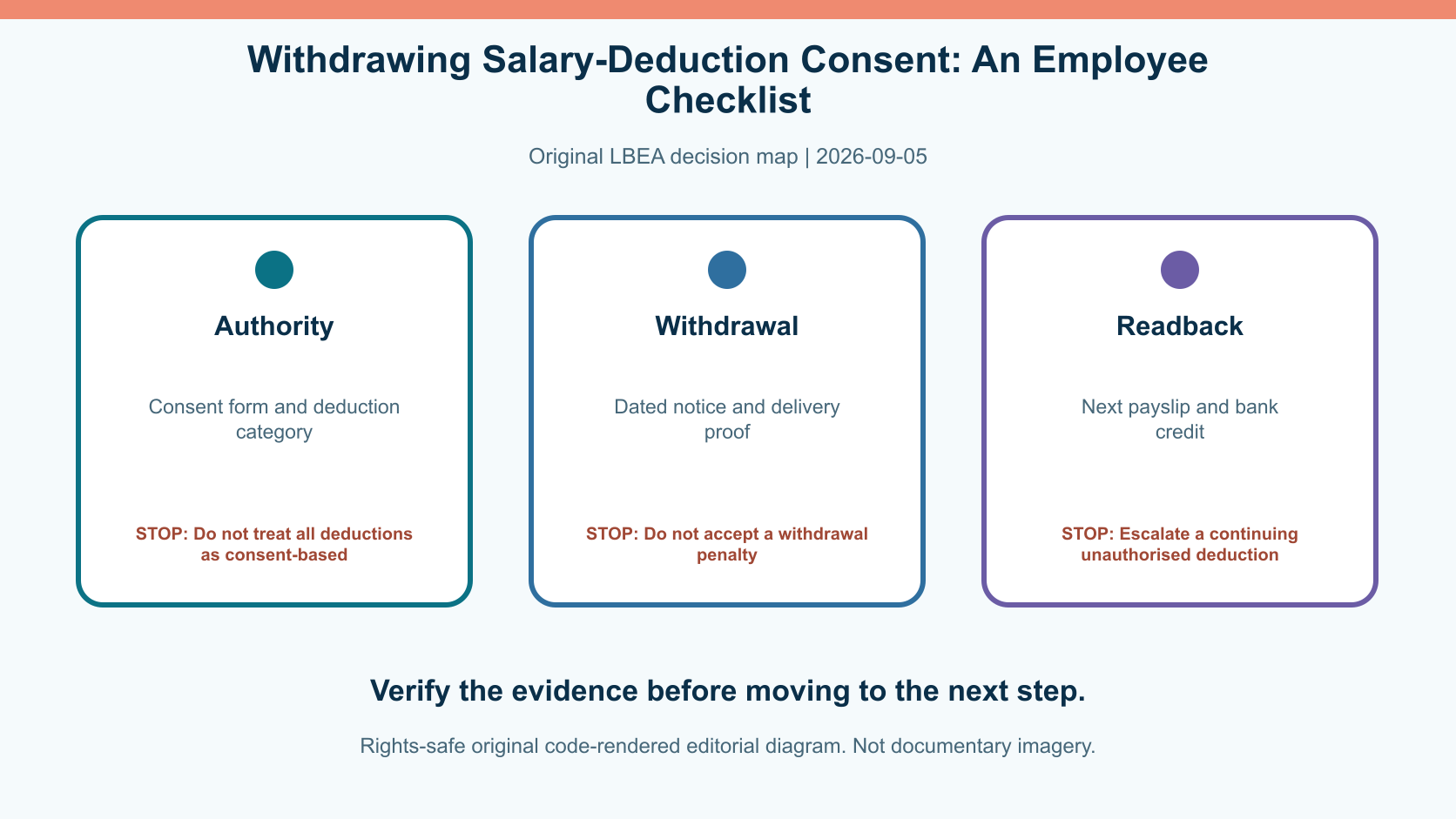
Answer first. For a benefit-related deduction based on written consent, MOM says the employer must allow that consent to be withdrawn at any time. The withdrawal should be dated, specific and checked against the next salary record.
Related reading: salary overpayment reconciliation and missing or wrong payslip.
Identify the legal basis
List every deduction shown on the payslip and ask which category supports it. Court orders, CPF, absence, loans, overpayments, accommodation and voluntary benefit arrangements do not share one rule. A consent withdrawal affects the deduction that depends on that consent. It does not cancel a valid court order or erase a genuine debt.
Send a precise withdrawal
State the benefit or service, the amount or payroll code, the date consent ends and the salary period from which the employee expects the deduction to stop. Send it through a traceable channel and keep delivery evidence. Do not sign a blank cancellation form or agree that withdrawal waives unrelated salary rights.
Check the benefit consequence
A voluntary service may end when payment ends. Ask when access, insurance, transport, accommodation or another benefit will cease and whether separate notice applies. The employer should not impose a penalty merely for withdrawing consent where the deduction rule requires withdrawal to be allowed. Distinguish the benefit contract from payroll authority.
Audit the next payslip
Compare gross salary, each deduction, net salary and bank credit. If the deduction continues, ask whether payroll processed the withdrawal too late for the cycle and when it will be refunded. Keep the original consent, withdrawal message, payslips, policy and responses. A running reconciliation is more useful than an unexplained total.
Use the right dispute path
Raise a written payroll correction first. If an unauthorised deduction remains, employees can seek official information and may approach TADM for salary-claim assistance. Time limits and facts matter. Do not assume every disputed deduction is criminal, and do not offset other amounts without advice.
Turn the guidance into a dated file
For withdraw salary deduction consent Singapore, assign one owner to the file and one reviewer who was not responsible for the original action. Record the official source, access date, facts, open questions and next decision. Keep originals unchanged and add corrections as new records. A clear chronology should show what was known, who decided, what authority was checked and what happened next.
Worked scenario
Suppose the first checkpoint in the matrix is incomplete but a deadline is approaching. The safer response is to preserve the current evidence, ask the relevant person for the missing record, verify the official procedure and document a temporary decision. Do not fill the gap with an assumption, a recycled template or an outcome promise. Recheck the second and third checkpoints after any correction.
Limits and escalation
This checklist explains issue spotting and process for a general reader. It cannot decide disputed facts, interpret a contract on incomplete evidence or replace Singapore legal, tax, immigration or regulatory advice. Rules and procedures can change. Reopen the cited official pages before acting, use the authority’s current channel and obtain professional advice where the consequences are material.
Final verification
Before closing the file, reread the official source, confirm the date and status of every consequential fact, and have another person check the chronology, calculations, links and proposed action. Record any unresolved point explicitly. A complete checklist is evidence of a careful process, not proof that an authority, tribunal or court will accept the conclusion.
How to use this guide
Start with the reader, decision and evidence identified above. Write the next action and owner beside every unresolved point, then set a review date. Keep authority-issued records unchanged and preserve earlier versions when a correction is made. If a fact, document or deadline does not fit the matrix, pause instead of forcing it into the nearest category. Official guidance can change, and a checklist cannot decide disputed facts or replace advice on a specific case. The strongest file shows what was known, when it was known, which source controlled the step and why the chosen action followed. Record every unresolved assumption, identify who can verify it, and never treat silence or a pending application as approval.
Decision and evidence matrix
| Checkpoint | Evidence to verify | Stop condition |
|---|---|---|
| Authority | Consent form and deduction category | Do not treat all deductions as consent-based |
| Withdrawal | Dated notice and delivery proof | Do not accept a withdrawal penalty |
| Readback | Next payslip and bank credit | Escalate a continuing unauthorised deduction |
Primary sources checked for this guide
Source status was checked on 5 September 2026. Reopen the controlling page before acting because procedures and legal status can change.
- Ministry of Manpower: Allowable salary deductions, supporting Only specified deductions are allowed; benefit-related written consent must be withdrawable, and general deduction limits apply.
- Ministry of Manpower: Salary deduction acknowledgement form, supporting Participation is voluntary and employees must be allowed to withdraw consent.
Real people. Right here in Singapore.