
Insights for work and life.
SGECT 12: A Training Bond Does Not Suspend Earned Salary
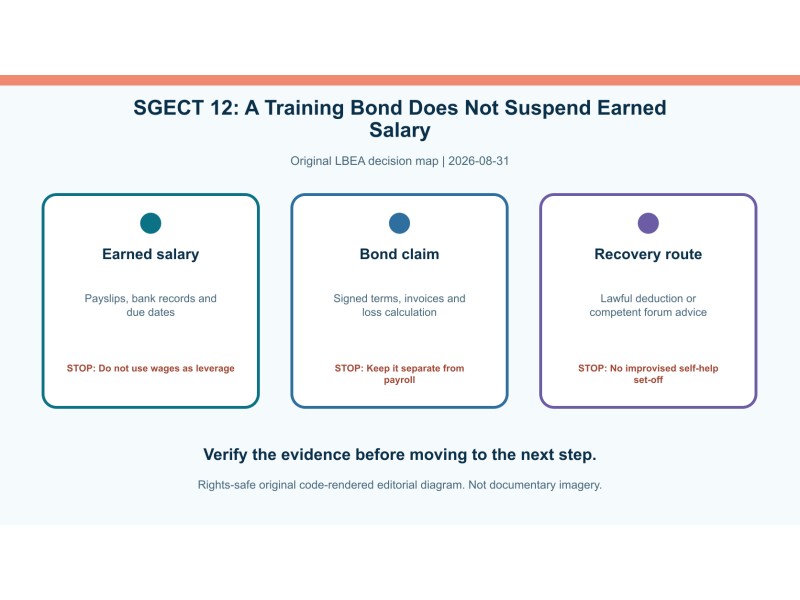
Quick answer. In SGECT 12, the Employment Claims Tribunals ordered earned salary to be paid because a disputed training-bond claim did not create a lawful salary deduction or self-help set-off.
Related reading: salary deduction guide and late final salary timeline.
What the case decided
On 25 August 2026, the Employment Claims Tribunals published grounds in JKD v JKE, [2026] SGECT 12. The employer did not dispute that S$5,877.91 in salary had been earned. It argued that it could withhold or set off that salary against compensation said to be due under a training bond. The Tribunal allowed the salary claim in full. The decision is a focused warning against using earned wages as leverage while a separate contractual claim remains disputed.
Agreement to pay is not consent to deduct
The Tribunal distinguished an agreement to compensate the employer for breach of a bond from specific consent to deduct that sum from salary. Even if consent had been inferred, the judgment noted the employee’s written withdrawal before deduction. HR teams should therefore separate three documents: the training sponsorship terms, any compensation calculation, and any lawful salary-deduction authority. One does not automatically perform the work of another.
Why the training benefit was not unearned
The employer also relied on the Employment Act category concerning an unearned employment benefit. The Tribunal reasoned that the employee had become legally entitled to the sponsored training by accepting the bilateral arrangement and its obligations. Leaving before the bond ended could create a separate compensation claim, but did not retroactively make the original benefit unearned. The exact conclusion depends on the case facts and wording; it is not a universal ruling that every training bond is invalid.
Set-off did not create a self-help route
The judgment explained that equitable set-off could not be used to circumvent the Employment Act’s salary-deduction scheme. Legal set-off is procedural and did not suspend the substantive obligation to pay salary on time. The Tribunal also found that the employer’s training-bond cross-claim fell outside the ECT’s limited jurisdiction. An employer that believes money is owed may need to pay earned salary first and pursue a properly evidenced claim in the competent forum.
The evidence failure mattered
The employee repeatedly asked for invoices and receipts supporting the amount claimed. The employer initially demanded far more than the course fees it later proved it had paid. The Tribunal did not decide the correct bond compensation, but its discussion shows why contemporaneous evidence matters. A bond file should identify the actual employer cost, subsidies, formula, service period, credit for service completed, approval and recovery route. A headline course price is not a substitute for proof of loss or contractual entitlement.
Employer action matrix
First, pay undisputed earned salary according to the statutory and contractual timetable. Second, freeze self-help deductions unless the exact Employment Act ground and safeguards are verified. Third, calculate the bond claim separately with invoices and the signed clause. Fourth, give the employee the basis and documents. Fifth, obtain advice on enforceability, mitigation, jurisdiction and recovery. Do not threaten to hold salary until the employee accepts a disputed number.
Employee evidence checklist
An employee facing withholding should preserve the bond, resignation, course records, salary records, requests for invoices, employer calculations and any statement about set-off. Identify the unpaid salary period separately from the bond dispute. Use TADM’s current process and time limits for salary claims, and obtain advice about the separate contract issue. The case does not erase a genuine bond obligation or predict another tribunal’s outcome.
Legal status and limits
SGECT 12 is a reported Employment Claims Tribunals decision and remains subject to final editorial corrections. Its reasoning is persuasive for the issue it decided, but every contract, deduction and forum question depends on facts and law. The controlling Employment Act and MOM guidance should be reopened before action. This analysis is current as at 31 August 2026 and does not provide personalised legal advice.
How to use this guide
Start with the reader, decision and evidence identified above. Write the next action and owner beside every unresolved point, then set a review date. Keep authority-issued records unchanged and preserve earlier versions when a correction is made. If a fact, document or deadline does not fit the matrix, pause instead of forcing it into the nearest category. Official guidance can change, and a checklist cannot decide disputed facts or replace advice on a specific case. The strongest file shows what was known, when it was known, which source controlled the step and why the chosen action followed.
Decision and evidence matrix
| Checkpoint | Evidence to verify | Stop condition |
|---|---|---|
| Earned salary | Payslips, bank records and due dates | Do not use wages as leverage |
| Bond claim | Signed terms, invoices and loss calculation | Keep it separate from payroll |
| Recovery route | Lawful deduction or competent forum advice | No improvised self-help set-off |
Primary sources checked for this guide
Source status was checked on 31 August 2026. Reopen the controlling page before acting because procedures and legal status can change.
- Singapore Courts through eLitigation: [2026] SGECT 12, supporting The Tribunal allowed a claim for S$5,877.91 in earned salary and held that the asserted training-bond compensation did not justify withholding or self-help set-off.
- Ministry of Manpower: Salary deductions, supporting Salary deductions must fall within authorised grounds and applicable safeguards.
- Tripartite Alliance for Dispute Management: For employees: file a claim for mediation, supporting TADM publishes the salary-claim route, filing windows and required supporting documents.
Real people. Right here in Singapore.