
Insights for work and life.
Final Salary Is Late: A Singapore Employee Action Timeline
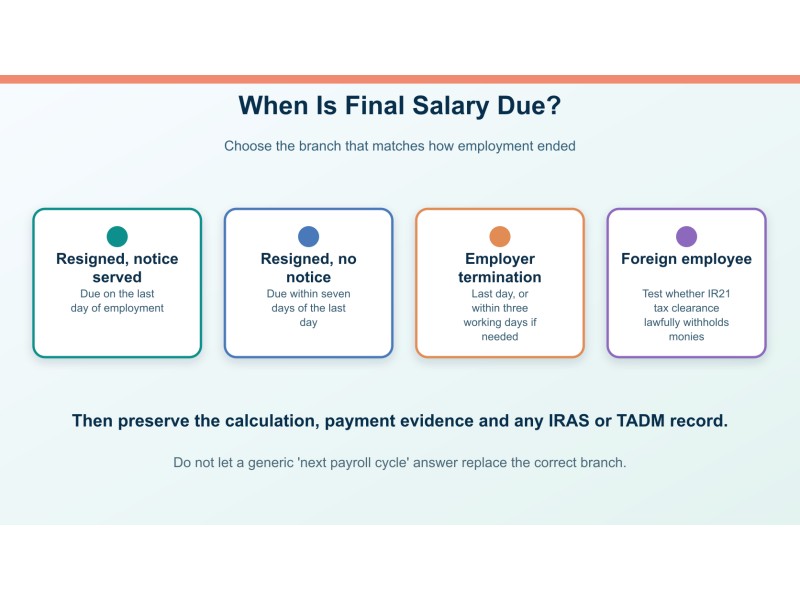
Quick answer. Final salary deadlines depend on how employment ended and whether tax clearance applies. This timeline helps employees identify the correct due date and next action.
Related reading: work-pass cancellation guide and IR21 tax clearance guide.
Identify the legal due date first
A final salary is not automatically due seven days after every last working day. MOM’s table distinguishes the way employment ended. If an employee resigns and serves the required notice, final salary is due on the last day. If the employee resigns without serving notice, it is due within seven days of the last day. For dismissal on misconduct grounds or termination by the employer, payment is due on the last day, or within three working days if same-day payment is not possible. Record the applicable row before alleging delay.
Day zero: close the calculation
On the last working day, save the termination or resignation record, notice calculation, final attendance, leave balance, commission terms, expense claims and recent payslips. List the components expected in final pay and mark which are fixed, variable, disputed or not yet due under the contract. Do not assume every bonus or commission becomes payable on cessation. The contract or established policy may set a later entitlement or calculation date. Separate those issues from ordinary salary up to the final day.
Day one to three: ask for a dated breakdown
Where payment is already due or approaching the relevant three-working-day boundary, ask payroll to confirm the gross calculation, deductions, payment method and release date. If the company relies on a deduction, request the contractual or statutory basis. If it relies on a handover dispute, note that a general handover complaint does not automatically rewrite MOM’s final-pay timetable. Preserve the response. If money has been transferred, verify when it actually cleared rather than relying only on a payment screenshot.
Foreign employees: test the tax-clearance explanation
A departing foreign employee may face a lawful tax-clearance hold. MOM says employers may be required to withhold monies for up to 30 days after notifying IRAS. Ask whether Form IR21 was required, when it was filed, which payments are being withheld and whether IRAS has issued a direction. This is different from an employer saying only that finance is processing the departure. Do not treat the existence of a work pass, by itself, as proof that every final payment may be held.
Worked scenario
An employee resigns, serves the full contractual notice and finishes on Friday. Payroll says the final salary will arrive in the next regular cycle two weeks later. The employee identifies MOM’s row for resignation with notice, attaches the resignation acceptance and final-day record, and requests payment plus an itemised final payslip. Payroll then says IR21 applies. The employee asks for the filing date and clarifies whether all monies or only a disputed component are held. Each step converts a moving explanation into a dated evidence trail.
When to approach TADM
If payment remains outstanding after the correct due date and a documented internal query, consider TADM promptly. Prepare the contract, termination correspondence, payslips, bank records, leave or commission calculations and the employer’s responses. State the amount by component and month. TADM’s current materials explain the filing process, evidence and fees. Do not wait for several unpaid periods to accumulate, especially after leaving, because statutory filing windows can expire even while informal discussions continue.
A practical decision tree
Ask four questions in order. Has the correct MOM deadline passed? Is the unpaid item salary, a contractual variable payment, reimbursement or another benefit? Is there a documented IRAS tax-clearance hold? Has payroll provided a reproducible calculation and payment date? If the first answer is no, diary the date. If the item is genuinely disputed, gather the governing term. If tax clearance applies, track the IRAS process. If salary is overdue without a supported explanation, prepare the TADM evidence file rather than continuing open-ended verbal follow-up.
Decision and evidence matrix
| Checkpoint | Evidence to verify | Stop condition |
|---|---|---|
| Resigned with notice | Last day of employment | Check IR21 if applicable |
| Resigned without notice | Within seven days of last day | Separate notice-pay dispute |
| Employer termination | Last day or within three working days | Ask for dated calculation |
| Tax clearance | IR21 filing and withholding record | Do not accept a generic finance delay |
Primary sources checked for this guide
The legal and administrative status of each source was checked on 29 August 2026. Readers should reopen the controlling page before acting because procedures and eligibility rules can change.
- Ministry of Manpower: Paying salary, supporting The final salary due date differs for resignation with notice, resignation without notice, misconduct dismissal and employer termination; foreign-employee tax clearance can require temporary withholding.
- Tripartite Alliance for Dispute Management: Employees file an employment claim, supporting Employees should assemble written evidence, pay the applicable filing fee and observe the current claim procedure and deadlines.
- Inland Revenue Authority of Singapore: Tax clearance for foreign employees, supporting An employer may need to file Form IR21 and withhold monies for tax clearance when a non-citizen employee ceases Singapore employment or leaves Singapore.
Real people. Right here in Singapore.