
Insights for work and life.
Missing or Wrong Payslip? Build a Salary Evidence File
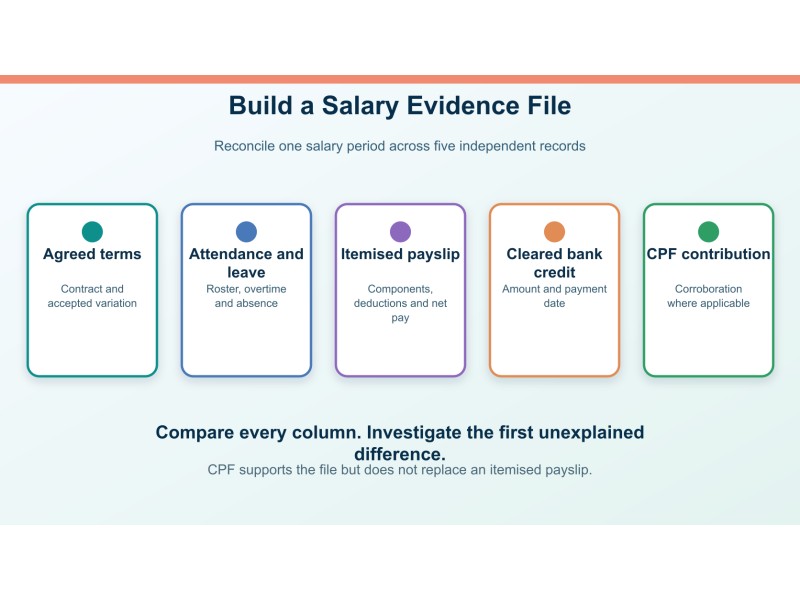
Quick answer. A missing or inaccurate payslip should trigger a structured evidence exercise, not guesswork. This guide shows employees how to rebuild the salary record and raise a precise query.
Related reading: salary deduction guide and changing employment terms.
Start with the answer
If a payslip is missing or appears wrong, preserve the records you already control, compare each pay component against the employment terms and actual work, then ask payroll for a corrected itemised payslip in writing. Do not begin by estimating a single net figure. Build a month-specific evidence file that separates basic salary, allowances, overtime, deductions, CPF and the bank transfer. That turns a vague complaint into a checkable reconciliation and reduces the chance that two different issues, such as a payslip omission and a genuine underpayment, are confused.
The four-column reconstruction
Create four columns for each disputed salary period: what the contract or latest agreed variation says, what the attendance and leave records show, what the payslip states, and what reached the bank. Add a fifth column for CPF if contributions apply. A difference between columns does not prove the cause, but it identifies the exact question payroll must answer. For example, a bank credit lower than the payslip may be a separate transfer error, while a payslip that omits an allowance may reflect a payroll coding or entitlement dispute.
Evidence checklist
Keep the contract and signed variations, the disputed and neighbouring payslips, bank statements showing only relevant transactions, CPF contribution history, rosters or timesheets, approved leave, expense records, commission statements and payroll correspondence. Preserve original files and their dates. Redact unrelated banking transactions only on a copy. If messages were exchanged through a company account that may soon close, export the relevant thread lawfully without taking confidential business information. Record who supplied each document and when.
Worked scenario
An employee expects basic salary, a fixed shift allowance and approved overtime. The payslip lists the basic salary and overtime but not the shift allowance, while the bank credit matches that reduced total. The useful question is not simply why the salary is short. It is whether the allowance remained part of the agreed monthly terms for that roster, whether a signed variation removed it, and which payroll code produced the omission. The employee attaches the contract page, roster, prior correct payslip and bank credit, and asks for a component-by-component response.
How to write the payroll query
State the salary period, disputed component and exact documents, then request the itemised calculation and any correction date. Keep the tone factual. Ask whether the record is missing, whether the amount is disputed, or whether payment failed after payroll processing. Give a reasonable response window and keep the reply. Do not sign a backdated variation merely to make the records match. If the employer proposes a correction, check both the cash payment and the replacement payslip, plus any CPF adjustment that should follow.
When escalation becomes necessary
If internal payroll review does not resolve a salary shortfall, check TADM’s current filing route and time limits promptly. Former employees generally have a shorter filing window, so delay can matter. A claim requires evidence, not only a reconstructed spreadsheet. Keep the original source documents behind every figure. For a union member, the union may also assist. Where the issue concerns tax clearance for a departing foreign employee, distinguish a lawful temporary withholding process from an unexplained non-payment and ask for the IRAS-related record.
Two mistakes to avoid
First, do not treat CPF history as a complete payslip substitute. CPF can corroborate wages and contributions, but it does not necessarily show every allowance, deduction or overtime item. Second, do not combine many months into one unexplained total. Reconcile month by month and identify the first divergence. That makes corrections easier, preserves limitation evidence and helps everyone see whether the problem is recurring or isolated. The file should allow a neutral reader to reproduce the calculation without relying on memory.
Decision and evidence matrix
| Checkpoint | Evidence to verify | Stop condition |
|---|---|---|
| Contract or variation | Agreed pay component and effective date | No signed or otherwise evidenced term |
| Attendance or leave | Hours, roster, overtime and absence | Record does not match the salary period |
| Payslip and bank | Itemised calculation and cleared payment | Totals differ without explanation |
| CPF record | Contribution corroboration where applicable | Use as support, not a payslip substitute |
Primary sources checked for this guide
The legal and administrative status of each source was checked on 29 August 2026. Readers should reopen the controlling page before acting because procedures and eligibility rules can change.
- Ministry of Manpower: Itemised payslips, supporting Employers must issue itemised payslips to Employment Act-covered employees, normally with payment or within three working days, and retain specified records.
- Tripartite Alliance for Dispute Management: Know your options, supporting Salary claim preparation can use contracts, salary and attendance records, CPF records and correspondence; filing time limits apply.
- Ministry of Manpower: Paying salary, supporting Salary must generally be paid at least monthly and within seven days after the salary period; late or unpaid salary can be taken to TADM.
Real people. Right here in Singapore.