
Insights for work and life.
Charged Before Placement? Check the Employment Agency Fee Rules
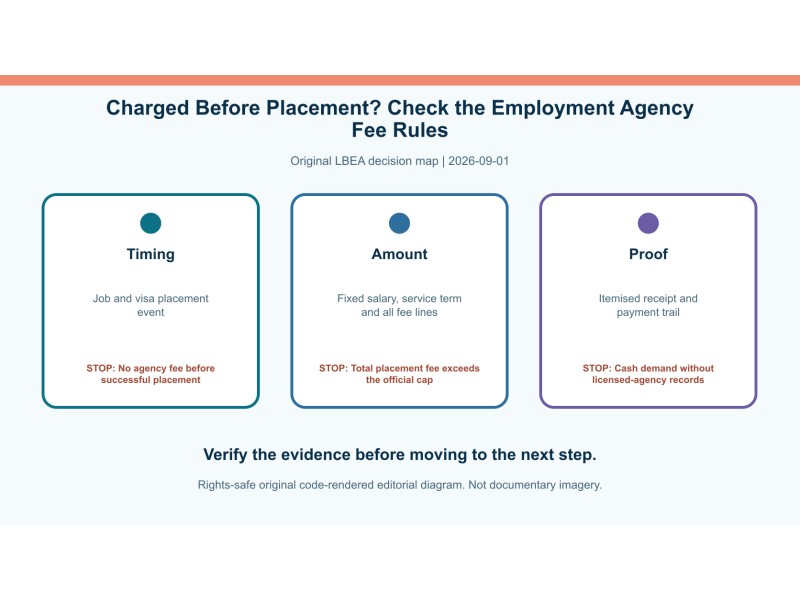
Answer first. A licensed employment agency should not collect an agency fee before successful placement, and the worker should check the statutory cap, receipt and refund rules before paying.
Related reading: salary deductions guide and employment claims guide.
Identify what the payment is for
Ask the agency to name each charge before money changes hands. Separate the agency fee for job placement from passport, medical, training, travel or government charges. A label such as processing fee does not decide the legal character of a payment. Keep the advertisement, chat, invoice and bank details. If the payment is demanded before a job is secured, pause and ask the agency to identify the successful-placement event it relies on. Do not hand cash to an individual without an itemised receipt from the licensed agency.
Apply the timing rule
MOM’s alert says an employment agency may collect its fee only after successful placement. For an overseas placement, the work visa is the relevant trigger described in the alert. A promise that a fee is refundable later does not cure premature collection. Ask whether the employer, job, salary and pass route are confirmed and whether the official In-Principle Approval or equivalent document matches what was promised. Never pay merely to reserve an interview slot or move your name to the front of a queue.
Calculate the cap from fixed monthly salary
The official FAQ states a cap of one month of fixed monthly salary for each year of service, subject to an overall ceiling of two months. Use the salary and service period actually stated in the placement documents. Do not calculate the cap from overtime, uncertain incentives or a higher salary mentioned only in marketing. If the agency shows several fees, total the amounts that are really placement fees rather than assuming each line has a separate cap.
Check the receipt and refund path
Require an itemised receipt showing the agency, payer, date, amount and purpose. MOM’s November 2024 reply also describes a refund protection when employment ends within six months: at least half the agency fee is refundable, subject to the official exceptions. Record the last workday, reason the employment ended and the date the refund was requested. Do not promise yourself a refund until the agency and official rule have been checked against the actual facts.
Worked example
A worker is offered an eighteen-month job at a fixed monthly salary of S$1,800. Before the pass is approved, an intermediary asks for S$4,000 cash and calls it documentation. The worker should not treat the label as decisive. She asks for the licensed agency name, itemised invoice, successful-placement basis and calculation. The stated service period points to a fee-cap calculation below the two-month ceiling, but the premature demand is already a stop signal. She preserves the messages and verifies the agency through MOM before paying.
Renewal and employer costs are different
Work-pass application and renewal fees and the foreign worker levy are employer responsibilities under MOM’s rules. An employment agency should not shift those employer costs to the worker by renaming them an agency fee. A genuine later job placement is different from a renewal of the same worker’s existing pass. Ask for the precise transaction and official charge. If salary has already been deducted, preserve the payslip and bank statement and check the separate salary-deduction rules.
Escalate with an evidence pack
First ask the licensed agency for a written explanation and correction. If the concern remains, use MOM’s employment-agency reporting route and provide the agency name, personnel details, advertisements, messages, receipts and payment evidence. A report should state what happened without exaggerating motive. Workers facing threats, passport retention or immediate housing and work-pass risks should seek prompt official help. This checklist spots issues; it does not decide criminal liability or guarantee recovery.
How to use this guide
Start with the reader, decision and evidence identified above. Write the next action and owner beside every unresolved point, then set a review date. Keep authority-issued records unchanged and preserve earlier versions when a correction is made. If a fact, document or deadline does not fit the matrix, pause instead of forcing it into the nearest category. Official guidance can change, and a checklist cannot decide disputed facts or replace advice on a specific case. The strongest file shows what was known, when it was known, which source controlled the step and why the chosen action followed. Record every unresolved assumption, identify who can verify it, and never treat silence or a pending application as approval.
Decision and evidence matrix
| Checkpoint | Evidence to verify | Stop condition |
|---|---|---|
| Timing | Job and visa placement event | No agency fee before successful placement |
| Amount | Fixed salary, service term and all fee lines | Total placement fee exceeds the official cap |
| Proof | Itemised receipt and payment trail | Cash demand without licensed-agency records |
Primary sources checked for this guide
Source status was checked on 1 September 2026. Reopen the controlling page before acting because procedures and legal status can change.
- Ministry of Manpower: Ongoing efforts to educate vulnerable workers and protect their interests, supporting The fee cap is one month of fixed monthly salary for each year of service, capped at two months.
- Ministry of Manpower: Alert on collecting agency fees upfront, supporting An employment agency may collect agency fees only after successful placement, with the overseas-placement trigger tied to the work visa.
- Ministry of Manpower: MOM suspends licences of employment agencies involved in overseas job placements, supporting Agency fees must not be collected before successful placement and the two-month cap also applies to overseas placement.
Real people. Right here in Singapore.