
Insights for work and life.
13O and 13U Annual Declarations: A Family-Office Evidence Calendar
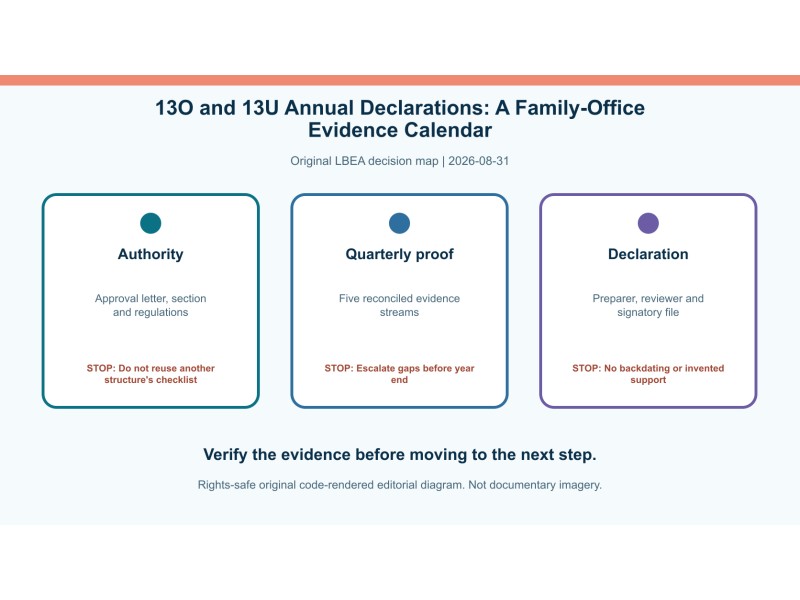
Quick answer. A family office should treat the 13O or 13U annual declaration as the output of a year-round evidence system, not a form assembled from unreconciled records at year end.
Related reading: family-office payroll reconciliation and 13O and 13U comparison.
Build the calendar from the approval file
Start with the exact approval letter, applicable section and current IRAS and MAS submission guidance. Do not use a generic family-office checklist as the authority. Record the fund vehicle, fund manager, basis period, declaration addressee, signatory, conditions and any bespoke approval terms. IRAS identifies the MAS approval letter and annual declarations submitted since approval as supporting documents for the relevant GST remission process. A 13O file and a 13U file are not interchangeable.
Create five evidence streams
Maintain separate ledgers for fund identity and ownership, investment activity, local business spending, investment-professional or other staffing conditions, and tax or regulatory filings. Each entry should identify source document, entity, period, currency, approver and exception. The annual declaration is prepared from reconciled ledgers. It should not become the first time the team asks whether an invoice belongs to the fund, manager, family office or another group company.
Quarterly control points
At each quarter end, compare assets and investments against the applicable condition set, reconcile Singapore spending to invoices and bank entries, and compare payroll headcount with contracts, duties, work-pass records and CPF where relevant. Review related-party allocations and foreign-currency conversions with tax advisers. Record conditions that are not yet met, any grace period and the person responsible. Do not wait until the declaration date to discover that evidence has been booked in the wrong entity.
Worked scenario
A single family office pays research software, two employee salaries and shared premises from the management company. The fund pays custody and transaction costs. A group service company pays one travel invoice and recharges it months later. The quarterly reconciliation links each expense to contract, invoice, payment and allocation basis. The tax adviser decides whether it counts for a particular condition. The annual declaration file records that advice rather than assuming every Singapore payment is qualifying local spending.
Keep immigration separate
An investment-professional headcount statement and a work-pass record may refer to the same person, but they answer different legal questions. A tax-incentive condition does not authorise the individual to work. A work pass does not prove that duties or spending meet a tax-incentive condition. Reconcile employer, role, salary, work location and actual duties across both files, then obtain specialist advice on each regime.
Sign-off and exception management
Use preparer, reviewer and authorised-signatory steps. The reviewer should sample supporting documents and investigate differences across the general ledger, bank, payroll and corporate records. Exceptions should state amount or condition, cause, legal status, corrective action and whether authority guidance or approval is needed. Never backdate a board paper or create a document merely to fill an evidence gap. A late honest escalation is safer than a false clean file.
Scope boundaries
Corporate setup, fund-tax incentive, fund-management licensing or exemption analysis, investor immigration and work permission are distinct workstreams. A VCC or company incorporation does not itself secure tax treatment, a licence exemption, a work pass, permanent residence or citizenship. Reopen the controlling material and approval letter before filing. This technical checklist supports evidence governance and does not replace legal, tax or regulatory advice.
How to use this guide
Start with the reader, decision and evidence identified above. Write the next action and owner beside every unresolved point, then set a review date. Keep authority-issued records unchanged and preserve earlier versions when a correction is made. If a fact, document or deadline does not fit the matrix, pause instead of forcing it into the nearest category. Official guidance can change, and a checklist cannot decide disputed facts or replace advice on a specific case. The strongest file shows what was known, when it was known, which source controlled the step and why the chosen action followed.
Decision and evidence matrix
| Checkpoint | Evidence to verify | Stop condition |
|---|---|---|
| Authority | Approval letter, section and regulations | Do not reuse another structure’s checklist |
| Quarterly proof | Five reconciled evidence streams | Escalate gaps before year end |
| Declaration | Preparer, reviewer and signatory file | No backdating or invented support |
Primary sources checked for this guide
Source status was checked on 31 August 2026. Reopen the controlling page before acting because procedures and legal status can change.
- Inland Revenue Authority of Singapore: Finance sector GST guidance, supporting For funds under sections 13O and 13U, IRAS identifies the MAS approval letter and annual declarations submitted since approval as supporting documents for the relevant GST remission process.
- Monetary Authority of Singapore: MASNET tax incentives information, supporting MAS directs sections 13O, 13OA and 13U funds-tax-incentive applications to the Tax Schemes Portal.
- Ministry of Manpower: Work passes, supporting Work permission is a separate regime: foreigners who intend to work in Singapore must have a valid pass before starting work.
Authority and relationship disclosure. Little Big Employment Agency Pte. Ltd. is not affiliated with or endorsed by MOM, ICA, ACRA, MAS or IRAS. Contacting LBEA does not create a solicitor-client relationship.
Real people. Right here in Singapore.