
Insights for work and life.
Can Your Employer Deduct Salary in Singapore?
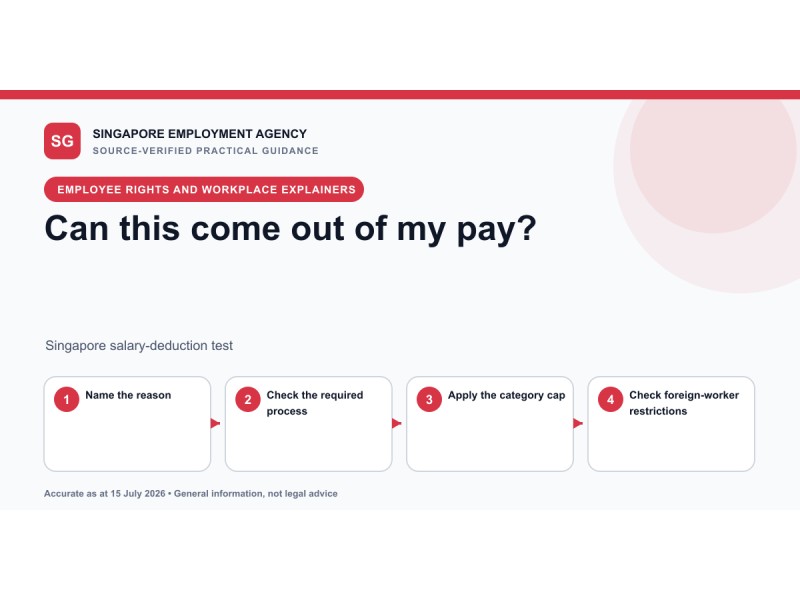
Short answer: an employer cannot take money from an employee’s salary simply because the company believes it is owed. For an employee covered by Singapore’s Employment Act, a deduction must fit an authorised category and follow the safeguards for that category. A general “we may deduct anything you owe us” clause does not turn an otherwise unauthorised deduction into a lawful one.
This matters when payroll deducts money for lateness, damaged equipment, a cash shortage, a training bond, an accidental overpayment or a work-pass cost. The label on the payslip is not decisive; the reason, process and amount must comply with the law. The controlling provisions are sections 26 to 32 of the Employment Act 1968, supplemented by the Ministry of Manpower’s current salary-deduction guidance.
A quick four-question test
- What is the precise reason? Ask payroll to identify the authorised category, not merely a contract clause or company policy.
- Was the required process followed? Damage or loss, for example, requires an inquiry and an opportunity for the employee to explain.
- Is the calculation within the applicable cap? Different categories have different limits; the familiar 50% overall cap has exclusions.
- Does a stricter foreign-manpower rule apply? Work Permit, S Pass and Employment Pass salary reductions or deductions carry additional MOM requirements.
If any answer is unclear, request the calculation and legal basis in writing before assuming the deduction is correct.
Salary-deduction decision matrix
| Reason given by employer | When it may be allowed | Important safeguard |
|---|---|---|
| Absence or lateness | For the period the employee was absent | The amount must be proportionate. MOM’s example says 30 minutes late permits, at most, a 30-minute salary deduction, not a half-day penalty. |
| Damage or loss | Where entrusted money or goods were lost or damaged through the employee’s neglect or default | Hold an inquiry, let the employee explain, limit the deduction to the loss and generally no more than 25% of one month’s salary as a one-time deduction. |
| Accommodation | Where the employee accepted the accommodation in writing | The deduction must not exceed the value supplied; accommodation and authorised amenities/services are also subject to a 25% salary-period limit. |
| Amenities or services | Where accepted in writing and authorised by the Commissioner for Labour | The employer needs the required approval; an ordinary workplace cost cannot simply be renamed an “amenity”. |
| Advance or loan | To recover an actual advance or loan | Each instalment is generally capped at 25% of salary for that salary period; advance recovery is spread over no more than 12 months. |
| Overpaid salary or unearned benefit | To adjust a genuine overpayment or recover an unearned employment benefit | MOM says the full amount may be recovered. The employee should still ask for the affected pay periods and arithmetic. |
| Employee’s CPF share | In accordance with the CPF Act | Check the payslip and CPF contribution record; this category does not authorise an unrelated recovery. |
| Another employee-benefiting purpose | With written consent that the employee may withdraw at any time | The arrangement must benefit the employee and cannot contravene another law. Written consent does not validate liquidated damages or an employer’s own business cost. |
| Court order or valid authority | Where the employer is legally required to deduct | Ask for enough information to identify the order or authority and verify the amount. |
The 50% cap is real, but it is not the whole rule
Total authorised deductions ordinarily cannot exceed 50% of salary payable in one salary period. MOM identifies exclusions from that overall calculation for absence, recovery of advances or loans, adjustment of overpaid salary or unearned benefits, and consented payments to registered co-operative societies. On termination, total authorised deductions may exceed 50% of the final salary payment.
That does not mean an employer may deduct 50% for any reason. The deduction must first be authorised. A category-specific cap may then be lower. For example, a deduction for damage or loss cannot be converted into an automatic 50% penalty.
Three worked scenarios
1. “You were 20 minutes late, so we deducted half a day”
The company may address repeated lateness through a properly communicated attendance and disciplinary process. But a salary deduction for absence should reflect the actual period of absence. MOM’s lateness guidance expressly says the deduction cannot exceed that period. A punitive half-day deduction for 20 minutes is therefore a warning sign.
2. “The laptop was damaged, so the whole repair bill is coming from your pay”
The employer should first establish that the laptop was entrusted to the employee and that the damage was directly attributable to neglect or default. The employee must have an opportunity to explain, perhaps the device failed through ordinary wear, a manufacturing defect or someone else’s act. Only after the inquiry should liability and the permitted amount be decided. A blanket equipment policy is not a substitute for this fact-finding step.
3. “Payroll accidentally paid an extra S$1,200”
A genuine salary overpayment is an authorised recovery category, and MOM says the full amount can be recovered. The sensible response is not to ignore the error, but to request a written reconciliation showing the dates, gross components, CPF impact and proposed correction. Where immediate recovery creates hardship, the parties can discuss a repayment schedule even if the legislation permits full adjustment.
Deductions that should trigger extra caution
- Liquidated damages or a flat “penalty”: MOM states that the written-consent category is intended for purposes benefiting the employee, not items such as liquidated damages.
- Customer complaints, stock variances or team losses: responsibility cannot safely be assumed from job title alone. The direct-fault and inquiry requirements matter.
- Training or recruitment costs: a contractual repayment dispute is not automatically an authorised payroll deduction. The wording, purpose and applicable statutory rules need separate review.
- Parking or regulatory fines: an employer should not treat every fine associated with work as payroll-deductible without identifying a lawful basis.
- Work-pass expenses: foreign-worker levy, security bond, medical insurance, repatriation, compulsory training, work-pass renewal and specified medical costs cannot be shifted to a migrant worker through salary deductions.
Special rules for Work Permit, S Pass and Employment Pass holders
Foreign-manpower rules sit on top of the Employment Act analysis. MOM says an employer reducing a migrant worker’s salary, or increasing or introducing deductions, needs written consent. For a Work Permit holder, the change must be reported through WP Online. For an Employment Pass or S Pass holder, the employer must submit the salary-reduction request through EP eService one month before the reduction. A Work Permit salary cannot be changed before the permit is issued.
Some employment costs are prohibited deductions regardless of consent. These include the levy, security bond, medical insurance, repatriation, compulsory training and work-pass renewal costs listed by MOM. Employees should preserve their in-principle approval, work-pass salary record, payslips and bank statements where the paid salary differs from what was declared.
What an employee can do
- Save the employment contract, key employment terms, payslip, bank statement, attendance records and messages about the deduction.
- Ask payroll in writing for the reason, affected salary period, formula, statutory category and any consent or inquiry record relied upon.
- Compare the answer with MOM’s official deduction list and the Employment Act.
- Raise a concise grievance internally. State the amount disputed and the correction requested; avoid making allegations that go beyond the evidence.
- If unresolved, consider a salary-related claim at the Tripartite Alliance for Dispute Management. TADM’s current filing page says an employee still employed must file within one year after the dispute arose. A former employee must file within six months after the last day of employment, and the recoverable period cannot go back more than one year from filing.
TADM currently states a claim limit of S$20,000, or S$30,000 where a union files on the employee’s behalf. Documents matter: the contract or KETs, payslips, CPF records, attendance evidence, bank credits and written exchanges help turn a complaint into a provable calculation. For a broader overview, read our guide to the Employment Act and our explanation of the Employment Claims Tribunals.
Bottom line
Start with authorisation, then process, then amount. Consent is not a universal cure, and the 50% overall cap is not a licence to impose a penalty. Employers should document the category and calculation before payroll closes; employees should challenge a questionable deduction promptly and with records.
Real people. Right here in Singapore.