
Insights for work and life.
After-Hours Messages: What MOM’s 2026 Answer Means for HR
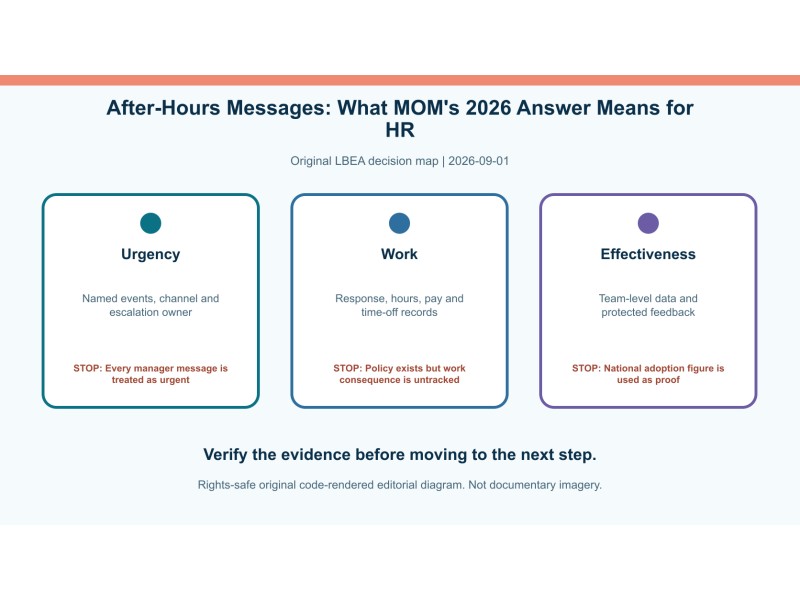
Answer first. MOM reported that 55% of full-time resident employees had employer policies on after-hours communication in 2025, but it did not separately assess the effectiveness of individual policies.
Related reading: flexible work request checklist and salary and hours evidence.
What changed on 5 August
In an oral parliamentary answer, MOM said that 55 percent of full-time resident employees reported employer policies governing after-hours communication in 2025, compared with 48 percent in 2022. MOM gave examples such as not expecting replies to non-urgent messages until the next working day and providing time off in lieu for after-hours work. The answer is an official policy statement and data point, not a new statutory right to disconnect.
What MOM did not claim
MOM expressly said it had not conducted a separate assessment of the effectiveness of individual policies. Employers should therefore avoid turning the 55 percent figure into proof that their own policy works. Adoption and effectiveness are different. A policy can exist on paper while workload, manager behaviour, customer coverage or reward systems still create an expectation of immediate response.
Define urgency operationally
A useful policy identifies which incidents are urgent, who may contact whom, the preferred channel, response target and escalation path. Examples may include safety incidents, critical system outages or time-sensitive customer harm. Routine updates, approvals and planning should normally wait. Avoid a definition that makes every manager request urgent. Test the rule against different functions, shifts, time zones and seniority levels.
Record the work consequence
After-hours communication can raise separate questions about actual working time, overtime eligibility, rest, time off, workload and health. The parliamentary answer mentions time off in lieu as one policy example, but it does not say that this resolves every pay or hours obligation. HR should map the affected employee’s contract and statutory coverage and keep reliable records where working-time rules apply.
Worked policy test
A regional sales team receives evening client messages. The policy labels only live customer outages and transactions closing before the next workday as urgent. One on-call manager triages the channel, while non-urgent messages carry a next-day response expectation. Monthly data tracks after-hours contacts, actual responses, time off and repeat sources. Employees can report boundary pressure without first accusing a manager of misconduct.
Measure effectiveness locally
Use staff feedback, after-hours message volume, response patterns, time-off use, overtime records, leave, error and turnover signals. Protect privacy and do not read personal devices without a lawful and proportionate basis. Segment results by team and schedule because a company average can hide one high-pressure unit. Review whether managers who respect the policy are disadvantaged in performance systems.
A ninety-day HR action plan
In the first month, define urgency and audit current message patterns. In the second, train managers, publish escalation routes and align time-recording or on-call arrangements. In the third, review data and employee feedback and correct exceptions. Keep the policy connected to the Tripartite Advisory on mental well-being and work-life harmony. State clearly that the 2026 answer reports adoption data and continuing encouragement, not a guaranteed outcome or new standalone cause of action.
How to use this guide
Start with the reader, decision and evidence identified above. Write the next action and owner beside every unresolved point, then set a review date. Keep authority-issued records unchanged and preserve earlier versions when a correction is made. If a fact, document or deadline does not fit the matrix, pause instead of forcing it into the nearest category. Official guidance can change, and a checklist cannot decide disputed facts or replace advice on a specific case. The strongest file shows what was known, when it was known, which source controlled the step and why the chosen action followed. Record every unresolved assumption, identify who can verify it, and never treat silence or a pending application as approval.
Decision and evidence matrix
| Checkpoint | Evidence to verify | Stop condition |
|---|---|---|
| Urgency | Named events, channel and escalation owner | Every manager message is treated as urgent |
| Work | Response, hours, pay and time-off records | Policy exists but work consequence is untracked |
| Effectiveness | Team-level data and protected feedback | National adoption figure is used as proof |
Primary sources checked for this guide
Source status was checked on 1 September 2026. Reopen the controlling page before acting because procedures and legal status can change.
- Ministry of Manpower: Oral Answer to PQ on After-hours work communications, supporting MOM reported 55 percent policy adoption among full-time resident employees in 2025, up from 48 percent in 2022, and said it had not separately assessed individual-policy effectiveness.
- Ministry of Manpower: Tripartite Advisory on Mental Health and Well-being at Workplaces, supporting The tripartite materials encourage work-life harmony and clear expectations for after-hours work communication.
Real people. Right here in Singapore.