
Insights for work and life.
Moving an Employee to Part-Time: An HR Contract Checklist
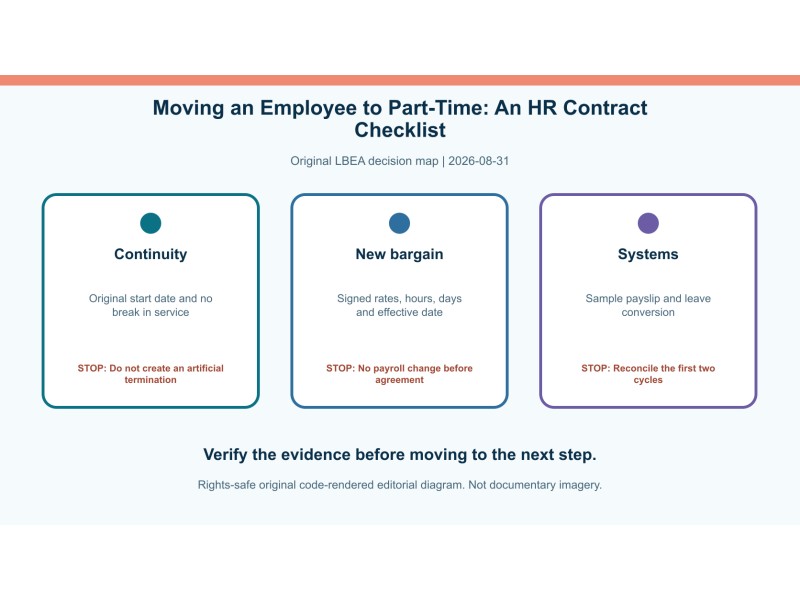
Quick answer. A full-time to part-time conversion can preserve continuous service, but the employer should agree and sign the new hours, rates, days, leave treatment and effective date before the change.
Related reading: changing employment terms and contract KET handbook matrix.
Treat conversion as a terms project
Moving an employee from full-time to part-time is more than changing a payroll flag. The employer and employee should agree the new bargain, document it and map every downstream system before the effective date. MOM says service remains continuous where there is no break. The file should therefore avoid an artificial termination and rehire unless that is the genuine agreed arrangement. Preserve the original start date and service-linked history.
Define the new hours and rates
A part-time employee works less than 35 hours a week. The contract should state hourly basic pay, hourly gross pay, hours per day or week, and working days per week or month. Also record meal breaks, roster change rules, overtime treatment and how additional hours are authorised. A monthly salary converted to an hourly rate should be reproducible. Do not use a rough percentage if allowances or benefits are treated differently.
Build the entitlement conversion table
List annual leave, sick leave, public holidays, rest days, medical benefits, bonuses, allowances, expenses and insurance. For each item, state the existing entitlement, lawful part-time treatment, agreed enhanced benefit, system field and owner. Preserve accrued leave and continuity unless a lawful and agreed rule says otherwise. Avoid telling the employee that every benefit simply falls in proportion to hours; different entitlements have different rules and some employer benefits may exceed statutory minimums.
Worked scenario
A full-time administrator working 44 hours asks to work 24 hours over three days. HR agrees a start date, hourly rates, Monday-Wednesday roster and a process for extra Thursday work. The conversion table shows how accrued annual leave will be carried, how future leave is calculated, which fixed transport allowance ends and which medical benefit stays unchanged. Payroll tests a sample month before signing. The employee keeps the original start date and receives a signed part-time contract.
Check every downstream record separately
Use the signed part-time contract as the approved source for payroll, timekeeping, leave, rostering and benefits. List every system field that changes and every field that stays the same. Treat a system limitation as an implementation problem, not permission to change the agreed terms. Where another regulatory question arises, pause and reopen the current controlling source rather than extending this employment-contract checklist by assumption.
System implementation
Update payroll, timekeeping, leave, rostering, benefits, CPF treatment where applicable and manager instructions from one approved source. Run a sample payslip showing ordinary hours, additional hours and allowances. Keep a change ticket with the signed contract and effective date. Reconcile the first two payroll cycles. If the HR system cannot express the agreed roster, do not rely on a manager’s side spreadsheet as the permanent authority.
Closing checklist
Before the first part-time day, confirm consent, signed terms, no break in service, rates, schedule, entitlement table, downstream record checks, payroll test and employee contact point. After the first month, compare roster, attendance, payslip and leave balance. Correct mismatches with a dated explanation. This process reduces misunderstandings while preserving the distinction between statutory minimums, contractual terms and voluntary benefits.
How to use this guide
Start with the reader, decision and evidence identified above. Write the next action and owner beside every unresolved point, then set a review date. Keep authority-issued records unchanged and preserve earlier versions when a correction is made. If a fact, document or deadline does not fit the matrix, pause instead of forcing it into the nearest category. Official guidance can change, and a checklist cannot decide disputed facts or replace advice on a specific case. The strongest file shows what was known, when it was known, which source controlled the step and why the chosen action followed.
Decision and evidence matrix
| Checkpoint | Evidence to verify | Stop condition |
|---|---|---|
| Continuity | Original start date and no break in service | Do not create an artificial termination |
| New bargain | Signed rates, hours, days and effective date | No payroll change before agreement |
| Systems | Sample payslip and leave conversion | Reconcile the first two cycles |
Primary sources checked for this guide
Source status was checked on 31 August 2026. Reopen the controlling page before acting because procedures and legal status can change.
- Ministry of Manpower: Full-time to part-time conversion FAQ, supporting Without a break in service, employment remains continuous; changes should be in writing and a signed part-time contract should be issued.
- Ministry of Manpower: Who is a part-time employee, supporting A part-time employee works less than 35 hours weekly under a contract of service, which should state hourly basic and gross rates, hours and working days.
Real people. Right here in Singapore.