
Insights for work and life.
Required Training After Work: An Employee Pay Checklist
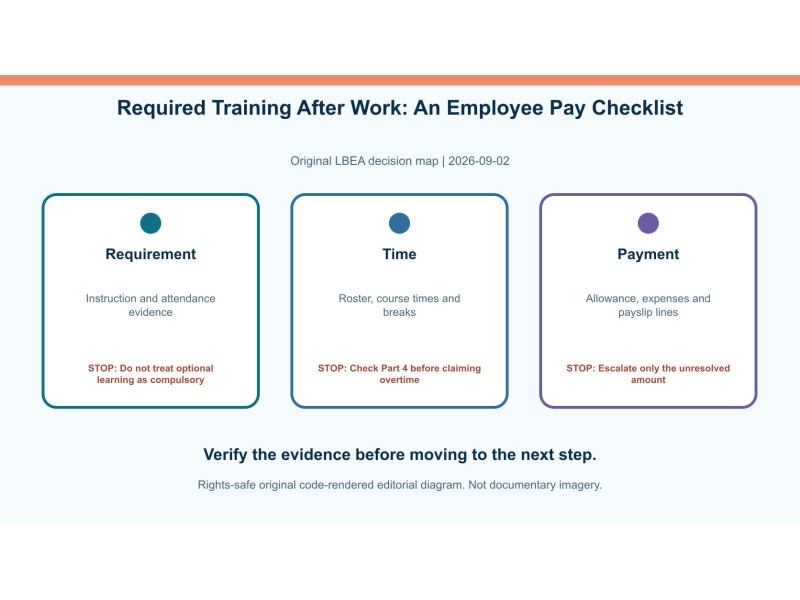
Answer first. If an employer requires training outside normal working hours, MOM says the employee should receive an allowance at the hourly rate that at least covers attendance expenses; overtime is a separate coverage and calculation question.
Related reading: overtime pay basics and salary evidence file.
Separate the training allowance from overtime
Start with two questions instead of one. MOM’s training FAQ says required training outside normal working hours should be paid through an allowance at the employee’s hourly rate, and that allowance should at least cover out-of-pocket expenses such as food or transport. Separately, determine whether the employee is covered by Part 4 of the Employment Act and whether the training time is overtime under the applicable working-hour arrangement. Do not merge the allowance, expense reimbursement and statutory overtime analysis into one unexplained payroll line.
Confirm that attendance was required
Keep the invitation, manager instruction, roster, course attendance record and any statement about consequences for non-attendance. A genuinely optional webinar is different from a course the employer directs the employee to attend. If the invitation uses soft language but the manager treats attendance as compulsory, record both. The useful evidence is what the employee was expected to do, when and for whose business purpose, not merely the label placed on the calendar event.
Map the hours
Write down the normal start and end time, meal breaks, training start and end time, travel between workplaces, and any ordinary work performed before or after the course. MOM defines hours of work as the period during which employees are expected to perform assigned duties, excluding rest and meal intervals. The map lets payroll identify the training allowance and then test any overtime calculation. It also prevents a two-hour course from being rounded into an unsupported full-day claim.
Check Part 4 coverage before calculating overtime
MOM states that Part 4 regulates hours, rest days and overtime for covered employees, but not managers and executives. Coverage and salary thresholds must be checked against the current official page and the employee’s actual role. Employees outside Part 4 still need their contract, collective agreement and policy reviewed. Do not promise a 1.5-times overtime rate merely because training happened after office hours; verify coverage and the agreed working arrangement first.
Worked scenario
A technician finishes the rostered shift at 6 pm and is directed to attend a safety course from 7 pm to 9 pm. She pays for a bus transfer and dinner. Her evidence sheet records the manager’s instruction, attendance certificate, course times, transport receipt, ordinary hours and Part 4 coverage check. Payroll identifies the training allowance described by MOM, reimbursable expenses and any overtime treatment as distinct entries. The payslip explanation matches the calculation rather than showing one unexplained lump sum.
Ask payroll a precise question
Send a short written query identifying the course, date, required attendance, actual times and expenses. Ask which line will show the training allowance, whether overtime applies, and when payment will be made. Attach receipts and the attendance record. Avoid accusing the employer of wage theft before the facts and payroll period are checked. If payroll corrects an error, retain both the original and corrected payslip so the audit trail remains intelligible.
Escalate only the unresolved issue
If payment remains missing, preserve the contract, KETs, roster, instruction, attendance, receipts, time records and payslips. State the exact amount or calculation that remains disputed. A union member may seek union support, and MOM directs salary disputes to TADM. Keep the complaint focused on verifiable hours and terms. This checklist does not decide disputed coverage, whether travel time counts as work, or the correct calculation for a particular employee.
How to use this guide
Start with the reader, decision and evidence identified above. Write the next action and owner beside every unresolved point, then set a review date. Keep authority-issued records unchanged and preserve earlier versions when a correction is made. If a fact, document or deadline does not fit the matrix, pause instead of forcing it into the nearest category. Official guidance can change, and a checklist cannot decide disputed facts or replace advice on a specific case. The strongest file shows what was known, when it was known, which source controlled the step and why the chosen action followed. Record every unresolved assumption, identify who can verify it, and never treat silence or a pending application as approval.
Decision and evidence matrix
| Checkpoint | Evidence to verify | Stop condition |
|---|---|---|
| Requirement | Instruction and attendance evidence | Do not treat optional learning as compulsory |
| Time | Roster, course times and breaks | Check Part 4 before claiming overtime |
| Payment | Allowance, expenses and payslip lines | Escalate only the unresolved amount |
Primary sources checked for this guide
Source status was checked on 2 September 2026. Reopen the controlling page before acting because procedures and legal status can change.
- Ministry of Manpower: If I have to attend training outside normal working hours, can I be paid for it?, supporting Required training outside normal working hours should attract an allowance at the hourly rate, minimally covering out-of-pocket attendance expenses.
- Ministry of Manpower: Hours of work, overtime and rest day, supporting Part 4 coverage governs statutory hours and overtime, while employees outside Part 4 look primarily to their employment terms.
Real people. Right here in Singapore.