
Insights for work and life.
Leaving a Job? Build Your Salary and Hours Evidence Pack
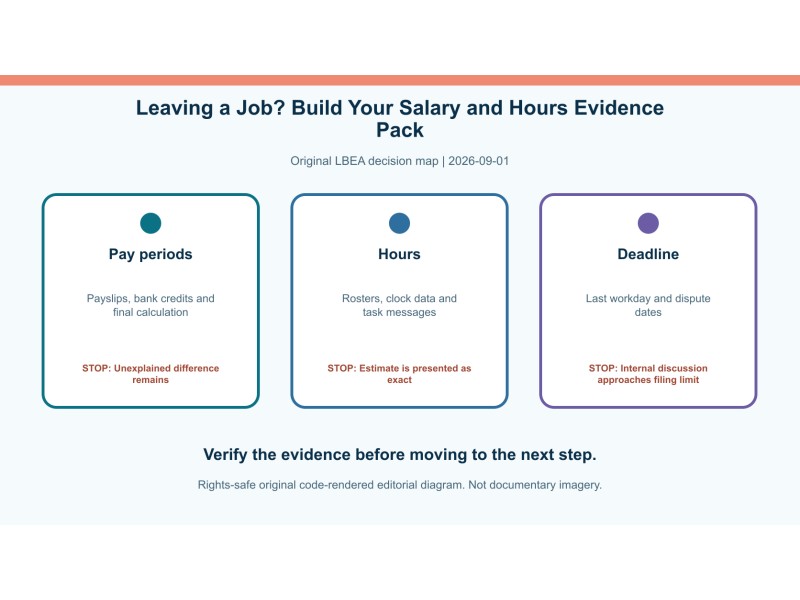
Answer first. Before workplace access ends, save your own lawful copies of payslips, rosters, leave records and salary evidence, then request missing employment records promptly.
Related reading: salary deduction guide and employment claims guide.
Save records before accounts close
Download or request each itemised payslip, signed contract, Key Employment Terms, variation, leave statement and final salary calculation. Preserve rosters, timesheets and approved overtime records that relate to your own employment. Use lawful personal copies and do not take customer data, colleagues’ records, trade secrets or confidential business material. Note when each system account will close and ask HR how former employees can obtain missing records after departure.
Build a month-by-month pay table
For each salary period, record basic salary, allowances, additional payments, deductions, overtime hours, overtime pay, payment date and net amount received. Match the table to payslips and bank entries. Mark a difference as unresolved instead of silently choosing one record. This turns a broad complaint into specific pay periods and amounts, and it helps an employer find a payroll error without reconstructing an entire employment history.
Reconstruct hours carefully
Keep contemporaneous rosters, clock records, approved overtime forms and messages assigning work. A calendar created after a dispute is weaker than records made during the work. If you must reconstruct time, identify the source for each entry and mark estimates. Do not edit screenshots or strip dates. Separate ordinary hours, overtime, rest-day work and public-holiday work because the legal and contractual treatment may differ.
Know what the employer should retain
MOM says employers must maintain detailed records for Employment Act-covered employees. For former employees, the latest two years of records are to be kept for one year after the employee leaves. The list includes start and leaving dates, daily working hours and breaks, leave and public holidays, salary components, deductions and overtime. That retention duty supports a focused request, but it does not authorise an employee to access systems without permission.
Worked example
A restaurant employee leaves on 31 August and believes twelve overtime shifts were missed. Instead of sending a single total, he creates a table with each date, roster, clock photo, supervisor message, expected hours, paid hours and payslip. Three dates are estimates and are labelled. He asks the employer for the official attendance records covering those dates. The precise request gives both sides a realistic way to compare evidence and correct genuine errors.
Use a request that can be answered
State your full name, employment dates, the records requested and the relevant pay periods. Explain the apparent difference and ask for a response by a reasonable date. Keep the tone factual. If HR says records do not exist, preserve that response. Do not threaten public accusations or assume missing data proves your full calculation. The evidential effect of unavailable records depends on the existing case, the requested material and the explanation.
Do not miss the dispute clock
TADM’s current process says a former employee generally has six months from the last day of employment to file a salary-related claim, subject to the claim also arising within the applicable one-year period. Internal discussions do not necessarily stop that clock. Check the official page for the current rule and required documents. If the issue concerns dismissal rather than salary, a different and much shorter deadline may apply.
How to use this guide
Start with the reader, decision and evidence identified above. Write the next action and owner beside every unresolved point, then set a review date. Keep authority-issued records unchanged and preserve earlier versions when a correction is made. If a fact, document or deadline does not fit the matrix, pause instead of forcing it into the nearest category. Official guidance can change, and a checklist cannot decide disputed facts or replace advice on a specific case. The strongest file shows what was known, when it was known, which source controlled the step and why the chosen action followed. Record every unresolved assumption, identify who can verify it, and never treat silence or a pending application as approval.
Decision and evidence matrix
| Checkpoint | Evidence to verify | Stop condition |
|---|---|---|
| Pay periods | Payslips, bank credits and final calculation | Unexplained difference remains |
| Hours | Rosters, clock data and task messages | Estimate is presented as exact |
| Deadline | Last workday and dispute dates | Internal discussion approaches filing limit |
Primary sources checked for this guide
Source status was checked on 1 September 2026. Reopen the controlling page before acting because procedures and legal status can change.
- Ministry of Manpower: Employment records, supporting Employers keep the latest two years of records for former employees for one year after departure, including hours, leave and salary particulars.
- Tripartite Alliance for Dispute Management: File an employment claim, supporting Former employees generally file salary-related claims within six months of the last day of employment, subject to the one-year dispute period.
Real people. Right here in Singapore.