
Insights for work and life.
Flexible Work Request Rejected? An Employee Review Checklist
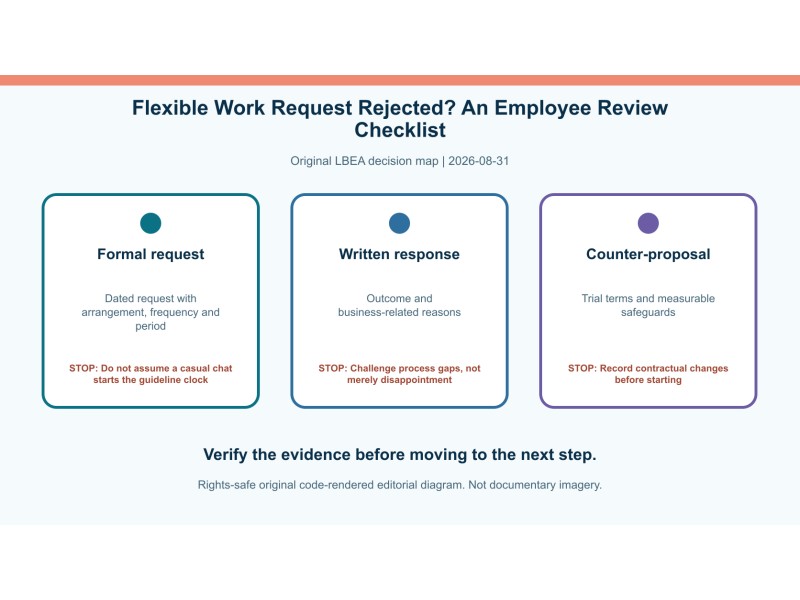
Quick answer. A rejected flexible work request is not automatically improper, but the employee can check whether the request was formal, answered within the guideline process and rejected for a business-related reason.
Related reading: changing employment terms and contract, KET and handbook matrix.
Start with the process, not the outcome
An employer keeps the prerogative to approve or reject a flexible work arrangement. The useful first question is therefore not whether the employee deserved approval, but whether a formal request was made and properly considered. Locate the submitted request, the employer’s process, the date received and the written outcome. Check that the request identified the proposed work location, hours or workload, its frequency, start and end dates, and a reason. A casual conversation can still be useful, but it may not trigger the formal process in the Tripartite Guidelines.
Build a rejection review table
Use four columns: what was requested, the business reason given, evidence relevant to that reason, and a possible adjustment. If the response says customer coverage would suffer, identify the hours and customer-facing tasks involved. If it says team collaboration would be affected, identify the meetings, handovers or shared equipment that require presence. The point is not to argue that every concern is wrong. It is to convert a general refusal into testable operational constraints and see whether a narrower arrangement could work.
Reasonable business grounds are not personal approval tests
MOM’s guidance says the employer may consider the job, business and output. The employee’s personal reason helps explain the request, but the employer should not treat disagreement with that reason as the business analysis. A response such as ‘we do not think caregiving is necessary’ misses the operational question. A response explaining why a particular duty must be covered onsite addresses it more directly. Preserve the exact words used and avoid adding a motive that the employer did not state.
Try a bounded counter-proposal
Where the stated constraint is genuine, offer a trial with measurable safeguards. A three-month flexi-time trial might preserve core service hours, specify response times, keep named onsite days and include a review date. A flexi-load proposal should state the reduced workload, hours and corresponding pay discussion. Do not begin an arrangement that changes contractual hours or pay until those terms are agreed and recorded. A trial is useful only if the employee and manager know what evidence will decide whether it continues.
Worked example
A payroll officer asks to work from home three days each week. The employer rejects the request because original documents arrive on Mondays and Thursdays and the team needs two people onsite for control. The employee does not repeat the same request. She proposes remote work on Tuesday, a later start on Friday, onsite coverage for document days and a six-week trial measured by processing errors and turnaround time. The revised proposal responds to the stated constraint while preserving the employee’s underlying need for flexibility.
Escalate a process gap carefully
If the employer gave no written response, missed the two-month guideline period or relied only on a non-business reason, first use the organisation’s grievance route. A union member can seek union help. If the process issue remains unresolved, the official materials say an employee may seek TAFEP assistance. Keep the escalation focused on process and evidence. Do not describe the guideline as a guarantee of remote work, or assume that a rejection by itself proves discrimination or wrongful conduct.
Evidence checklist
Keep the formal request, proof of receipt, policy, response, meeting notes and every revised proposal. Record the current duties and any objective performance data relevant to the arrangement. Separate confidential customer or company information from personal notes. If health or family documents are genuinely needed, share only what is necessary through the employer’s approved channel. The final file should allow a neutral reviewer to understand the request, the stated business problem and the alternatives considered.
How to use this guide
Start with the reader, decision and evidence identified above. Write the next action and owner beside every unresolved point, then set a review date. Keep authority-issued records unchanged and preserve earlier versions when a correction is made. If a fact, document or deadline does not fit the matrix, pause instead of forcing it into the nearest category. Official guidance can change, and a checklist cannot decide disputed facts or replace advice on a specific case. The strongest file shows what was known, when it was known, which source controlled the step and why the chosen action followed.
Decision and evidence matrix
| Checkpoint | Evidence to verify | Stop condition |
|---|---|---|
| Formal request | Dated request with arrangement, frequency and period | Do not assume a casual chat starts the guideline clock |
| Written response | Outcome and business-related reasons | Challenge process gaps, not merely disappointment |
| Counter-proposal | Trial terms and measurable safeguards | Record contractual changes before starting |
Primary sources checked for this guide
Source status was checked on 31 August 2026. Reopen the controlling page before acting because procedures and legal status can change.
- Ministry of Manpower: Tripartite Guidelines on Flexible Work Arrangement Requests, supporting A formal request should contain the arrangement, frequency, duration and reason, and employers should respond in writing within two months using business-related grounds.
- Ministry of Manpower: Can employers reject an FWA request based on disagreement with the employee’s reason?, supporting Employers may reject an FWA request for business-related reasons, including job requirements and effects on business or output.
Real people. Right here in Singapore.