
Insights for work and life.
Changing a Commission Scheme: An Employer Evidence Checklist
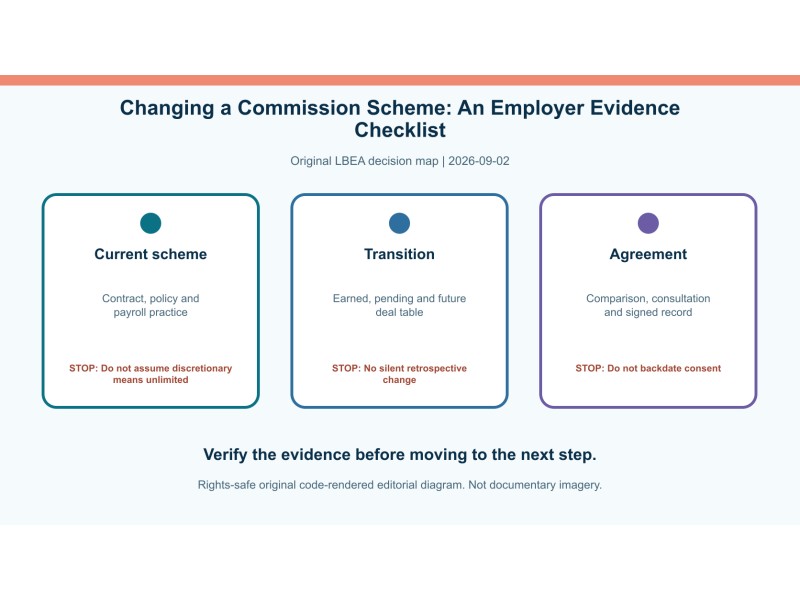
Answer first. Before changing a commission scheme, identify which terms are contractual, preserve already earned amounts, obtain agreement where terms change, and align the written scheme with payroll evidence.
Related reading: employment contract clauses and contract and handbook conflict matrix.
Map the current promise
Collect the signed contract, KETs, commission plan, employee handbook, offer materials, prior circulars and actual payroll practice. Mark the sales event that earns commission, the payment trigger, clawback conditions, treatment after resignation, dispute process and any variation clause. A scheme described as discretionary may still contain specific promises or be shaped by consistent practice. Do not announce a new percentage until the existing source of entitlement and accrued pipeline are understood.
Separate earned, pending and future sales
Create three buckets. Earned commission has satisfied the current trigger. Pending commission relates to work performed but awaits a defined event, such as customer payment. Future commission concerns work not yet performed. A change date may affect these buckets differently. Record each deal, employee contribution, contractual trigger and status. Do not use the new plan retrospectively simply because the payment date falls after launch.
Treat consent as a process
MOM’s FAQ states that an employer cannot change employment terms without employee consent and should negotiate an acceptable agreement. Give the employee the proposed plan, comparison, reason, effective date and worked examples. Allow meaningful review and questions. Record agreement clearly rather than relying on silence, continued work for a few days or an unread intranet notice. Obtain advice where a variation clause or collective agreement may affect the process.
Use worked calculations
Show at least three representative deals under the old and proposed schemes: a deal signed before the change but paid after, a renewal spanning the change, and a deal cancelled or refunded. State the revenue base, rate, accelerator, split, currency, payment trigger and clawback. These examples reveal hidden ambiguities before payroll runs. Make clear whether examples are binding terms or illustrations, and ensure the operative wording controls consistently.
Worked scenario
A company plans to replace a five percent commission on signed contracts with three percent on collected revenue from 1 October. Its pipeline table shows two September contracts not yet invoiced. HR does not apply the new rule automatically. It identifies when commission is earned under the existing plan, seeks agreement for future work, states how the September pipeline will be treated and tests the October payslip. The signed variation and calculation sheet carry the same effective date.
Align systems and managers
Update payroll codes, CRM fields, manager guidance, approval thresholds and payslip descriptions only after the legal and employee process is settled. Freeze manual overrides during the transition and require a reviewer for the first two cycles. Managers should not promise side arrangements in chat. If an exception is approved, record its authority, duration and affected deals. Reconcile the commission register to the payslip and general ledger before release.
If agreement is not reached
Do not falsify consent or backdate a variation. Continue the existing terms while advice is obtained, or consider the lawful contractual options. MOM notes that if no agreement is reached, either party may end employment by serving written notice under the contract. That is not a shortcut around consultation, accrued rights or wrongful-dismissal risk. This checklist provides an evidence structure and not a conclusion on enforceability in an individual case.
How to use this guide
Start with the reader, decision and evidence identified above. Write the next action and owner beside every unresolved point, then set a review date. Keep authority-issued records unchanged and preserve earlier versions when a correction is made. If a fact, document or deadline does not fit the matrix, pause instead of forcing it into the nearest category. Official guidance can change, and a checklist cannot decide disputed facts or replace advice on a specific case. The strongest file shows what was known, when it was known, which source controlled the step and why the chosen action followed. Record every unresolved assumption, identify who can verify it, and never treat silence or a pending application as approval.
Decision and evidence matrix
| Checkpoint | Evidence to verify | Stop condition |
|---|---|---|
| Current scheme | Contract, policy and payroll practice | Do not assume discretionary means unlimited |
| Transition | Earned, pending and future deal table | No silent retrospective change |
| Agreement | Comparison, consultation and signed record | Do not backdate consent |
Primary sources checked for this guide
Source status was checked on 2 September 2026. Reopen the controlling page before acting because procedures and legal status can change.
- Ministry of Manpower: My employer wants to change my job duties. Can I resign without serving notice?, supporting An employer cannot change employment terms without consent; the parties should negotiate, and unresolved disagreement may lead to termination with notice.
- Ministry of Manpower: Paying salary, supporting The timing and method for commission payments depend on the employment contract or existing policies and practices.
- Ministry of Manpower: Key employment terms, supporting Written KETs include salary period, basic salary, fixed components and other salary-related components such as bonuses and incentives.
Real people. Right here in Singapore.