
Insights for work and life.
Changing Employment Terms: The Consent Rule
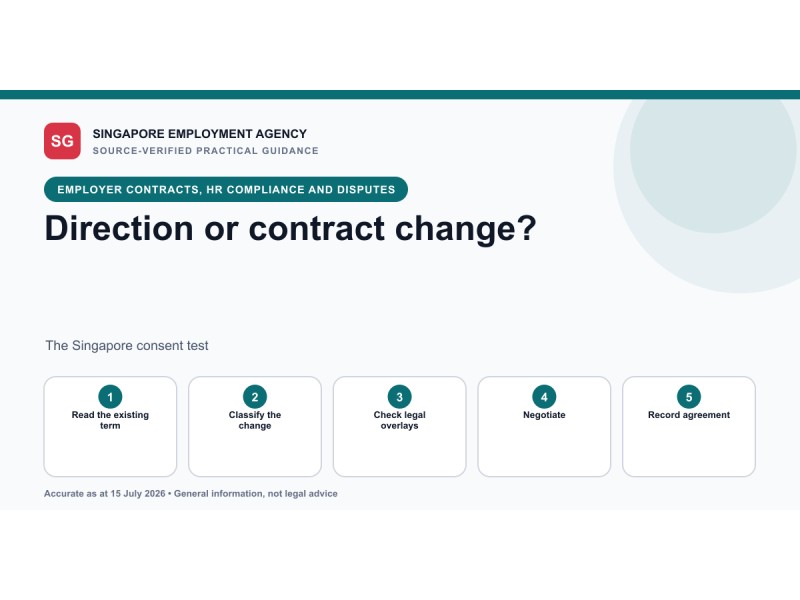
Answer first: a Singapore employer generally cannot change fundamental employment terms, such as salary, role or contractual working arrangements, without the employee’s consent. The safe route is to negotiate the change, record clear acceptance and issue a signed variation or replacement contract. A broad clause allowing the company to update “policies and procedures” may not authorise a pay cut or demotion.
The distinction matters because businesses do need to reorganise. Some day-to-day directions fall within management authority; others rewrite the bargain. A badly drafted flexibility clause does not make that boundary disappear, and an employee’s signature acknowledging receipt is not necessarily agreement.
The current MOM position
MOM’s contract-of-service guidance is direct: employers cannot change contractual terms without employee consent. The parties should negotiate an acceptable arrangement, consider both business needs and employee concerns, and sign a new contract stating the revised terms. If agreement cannot be reached, either party may serve the required notice and end employment.
That summary is a sound operational rule, but individual cases remain contractual and fact-sensitive. The first task is to identify whether the proposed change is a contractual term, a genuinely discretionary benefit, a non-contractual policy or a reasonable instruction within an existing term. Section 8 of the Employment Act 1968 also makes a contractual term less favourable to an employee than an applicable condition prescribed by the Act illegal and void to that extent.
Change-risk matrix
| Proposed change | Typical risk level | What HR should check |
|---|---|---|
| Reduction in basic or fixed salary | Very high | Express consent, statutory minimums, salary-deduction rules, CPF/payroll treatment and work-pass declarations. |
| Demotion or material loss of responsibilities | High | Contractual job scope, status, reporting line, pay impact, disciplinary basis and whether acceptance is explicit. |
| Change in contractual hours, days or permanent work location | High | Exact wording, scale of disruption, mobility/flexibility clause, caregiving or disability concerns and Part IV requirements where applicable. |
| Adjustment to a formula-based commission or bonus | High | Whether entitlement has accrued, whether the formula is contractual, effective date and any express prospective variation power. |
| Change to a benefit described as discretionary | Medium | Whether conduct, communications or a fixed formula has made the benefit contractual despite its label. |
| Routine workflow, reporting format or security procedure | Usually lower | Whether it is a reasonable operational direction consistent with the job and existing contract. |
| Handbook or policy update | Variable | Whether the handbook is incorporated into the contract and whether the change concerns administration or a fundamental economic term. |
| Salary reduction for a Work Permit, S Pass or EP holder | Very high | Written consent plus the applicable MOM reporting or pre-approval process; continuing pass eligibility. |
This is a triage tool, not a conclusion. For example, relocating a desk within the same office is different from moving a role permanently across the island; changing an internal approval form is different from removing a guaranteed allowance.
The 2026 High Court warning on broad variation clauses
Kanan Packrisamy v Herbal Pharm Pte Ltd and others [2026] SGHC 2 is a useful modern illustration. The employer relied on wording that reserved a right to modify terms and conditions. The clause appeared under “Policies & Procedures” and followed a statement requiring compliance with company policies. The High Court held that this context was not clear enough to authorise unilateral variation of every employment term, particularly a fundamental and detrimental change to salary.
The employee had signed the demotion letter, but the court accepted that the signature was only an acknowledgement that he had read it. His prompt written objection and the employer’s own description of the signature as an acknowledgement supported that conclusion. The court awarded salary due on the original rates up to termination.
The holding should be reported precisely. The employee did not win the separate wrongful-termination claim: the court found serious misconduct and held that immediate termination was lawful on the facts. Substantial counterclaims were also allowed against him. The salary-variation point was narrower, the purported demotion and pay reduction did not take effect merely because of that broad clause and acknowledgement.
Why “we reserve the right to change anything” is weak drafting
A unilateral variation power is unusual. The High Court referred to the need for clear language where a party claims such a power, and emphasised even greater clarity for a detrimental change to a fundamental term such as salary. Four drafting problems commonly arise:
- Wrong location. A sentence buried in an IT or policy section may be read as limited to those subjects.
- No subject boundary. “Terms may change” does not identify whether the power covers workflow, benefits, duties, location or remuneration.
- No process. The clause says nothing about notice, consultation, effective date or how acceptance is recorded.
- Conflict with specific promises. A general flexibility sentence may not displace a detailed salary, bonus or job-title provision.
Even precise drafting is not a blank cheque. Section 8’s statutory floor cannot be contracted away, and the way a discretion is exercised can raise separate contractual, wrongful-dismissal or work-pass issues. Employers should draft for legitimate operational flexibility, not assume that maximum breadth equals maximum enforceability.
Acceptance evidence: what does it really prove?
| Record | Indicative evidential value | Common weakness |
|---|---|---|
| Signed variation stating “I agree” and identifying each change | Strongest starting point | Pressure, misrepresentation, unclear effective date or unlawful terms can still create issues. |
| Email expressly accepting attached revised terms | Potentially strong | Attachment version or authority may be unclear. |
| Signature beside “received” or “acknowledged” | Usually proves receipt, not necessarily consent | The wording does not say the employee agrees. |
| Silence after an announcement | Weak and fact-sensitive | Silence may reflect uncertainty or objection, not acceptance. |
| Continued work after a unilateral change | Ambiguous; obtain express written acceptance | Do not use continued performance as a substitute for a signed variation. Record any objection and the surrounding communications, and obtain advice before inferring agreement. |
| Manager’s oral assurance | Risky for both sides | Scope, wording and authority are hard to prove. |
The practical drafting point is simple: separate acknowledgement from acceptance. If HR needs consent, say so expressly and give the employee the final, dated document before signature.
An eight-step variation process
- Map the existing bargain. Review the signed contract, offer letter, incorporated policies, collective agreement, past variations and actual payroll practice.
- Classify every change. Mark it contractual, discretionary, policy-based or operational. Do not bundle a pay cut with routine housekeeping amendments.
- Check legal overlays. Review Employment Act minimums, CPF, protected leave, discrimination/retaliation risks, union obligations and foreign-manpower requirements.
- Document the business reason. State why the change is proposed, alternatives considered and whether it is temporary or permanent. This improves negotiation and later consistency.
- Consult before deciding. Explain the effect on pay, duties, location, hours, benefits and reporting lines. Invite questions and alternatives.
- Give meaningful review time. Avoid presenting a fundamental reduction for immediate signature in a surprise meeting. Encourage independent advice where the impact is substantial.
- Record clear agreement. Use a variation letter or replacement contract that identifies the original term, new term, effective date, duration and terms that remain unchanged.
- Implement consistently. Update payroll, KETs, HR systems, manager instructions, CPF treatment and work-pass records. Store the accepted final version, not only a draft.
If the employee says no
Do not treat refusal as automatic misconduct. Continue negotiation and consider alternatives such as a temporary arrangement, narrower change, redeployment or voluntary separation. If there is no agreement, MOM says either party can terminate in accordance with the notice requirements. That route still needs care: contractual notice and final pay must be correct. MOM’s current wrongful-dismissal guidance identifies discriminatory dismissal, dismissal to deprive an employee of benefits, and dismissal to punish the exercise of an employment right as wrongful.
Where the proposed change follows alleged misconduct, keep the processes separate. A disciplinary demotion under section 14 of the Employment Act, a consensual role redesign and an organisational redundancy are not interchangeable labels.
Foreign employees: consent is only the first gate
MOM’s salary guidance says an employer reducing the salary of a migrant worker needs written consent. For Work Permit holders, the change is reported through WP Online. For Employment Pass and S Pass holders, the salary-reduction request must be submitted through EP eService one month before the reduction. The revised salary must also be tested separately against the current Employment Pass or S Pass eligibility rules and the facts represented to MOM.
A company should therefore never implement the payroll change first and ask immigration to catch up later. Incorporation, directorship or an internal title change does not independently authorise foreign work or preserve a pass.
Contract review checklist
- Does the contract distinguish contractual terms from non-contractual policies?
- Are salary, bonus, commission, allowance and benefits described accurately?
- Does any flexibility clause identify its subject and limits?
- Are mobility, duties and reporting-line provisions proportionate to the role?
- Does the variation procedure require consultation, written notice and a clear effective date?
- Do signature blocks distinguish receipt from agreement?
- Are statutory, union and work-pass checks built into HR approval?
For more context, see our overview of common employment-contract clauses and our broader Employment Act guide.
Bottom line
Begin with classification, not announcement. Identify the existing term, decide whether the business is directing work or changing the contract, negotiate material changes and record unmistakable consent. The cost of doing this carefully is small compared with disputed back pay, a failed restructuring or litigation over what a signature meant.
Real people. Right here in Singapore.