
Insights for work and life.
Section 18A Business Transfer: An Employer Due-Diligence Matrix
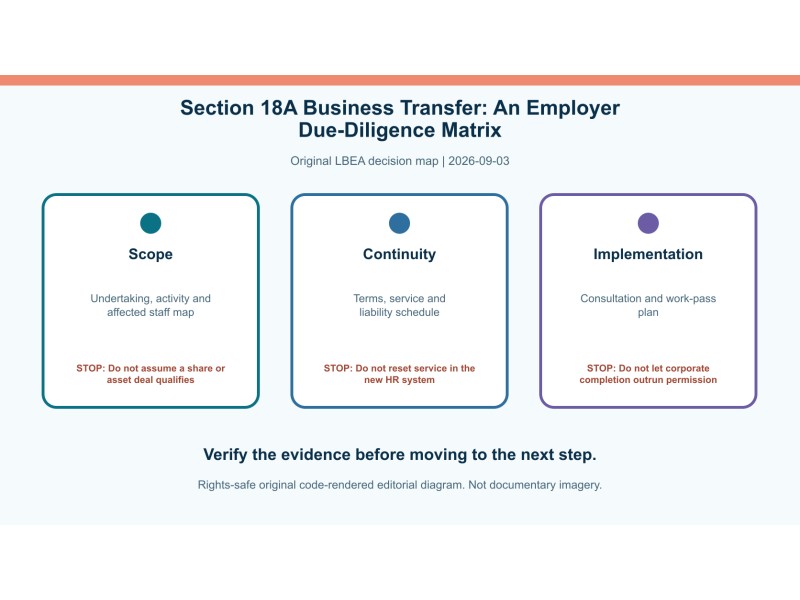
Answer first. A qualifying transfer of an undertaking moves affected employment contracts, continuity, rights and liabilities to the transferee by law. Employers must first prove that section 18A applies.
Related reading: related-company work pass movement and contract and handbook conflict matrix.
Classify the transaction before messaging staff
Section 18A applies to a transfer of an undertaking or part of one, not every corporate transaction. MOM lists mergers, takeovers, sales of parts and subsidiary restructurings as examples, while excluding a share transfer, an asset-only transfer, an overseas operations transfer, outsourcing of support functions and replacement of a service provider after tender. Build a legal classification memo using the actual business, people, assets, customers and operating continuity. The transaction label alone is insufficient.
Define the affected population
Map which business unit is transferred and which employees are assigned to it immediately before completion. Review duties, reporting lines, cost centres, work location and time allocation. Include employees on leave and those in notice periods for legal review. Do not select people merely to remove liabilities or assume every group employee follows the asset. Record edge cases and obtain advice before issuing definitive letters.
Preserve continuity and terms
The statute says a qualifying transfer does not terminate the contract, and prior service counts with the transferee. Rights, powers, duties and liabilities connected with the contract transfer as well. MOM says terms remain unchanged unless the employee agrees to a change. Carry forward service dates, leave balances, salary, benefits, notice, disciplinary history and claims. A new HR-system identifier must not reset substantive continuity.
Consult with real information
MOM directs the old and new employers to notify affected employees and unions and to consult as soon as reasonably practicable. Prepare a pack covering the reason, legal effect, effective date, identity of the new employer, continuity, terms, benefits, payroll, data transfer and points of contact. Consultation is not satisfied by a completion-day broadcast that withholds the information needed to ask meaningful questions.
Build a liabilities schedule
List accrued salary, bonus and commission, leave, expense claims, loans, disciplinary matters, grievances, injuries, confidentiality obligations and existing proceedings. Allocate commercial responsibility in the transaction documents, while recognising that private allocation does not necessarily alter employee rights under section 18A. Reconcile HR, payroll, finance and legal schedules. Preserve evidence of pre-transfer acts because the statute addresses how they are treated after completion.
Worked example
A retailer sells one operating division, including its stores, stock, systems and customer activity, to a buyer. The parties identify staff dedicated to those stores, preserve original service dates and terms, consult before completion and transfer payroll balances. A separate employee serving several divisions is flagged for individual analysis rather than automatically included. The purchase agreement allocates historical liabilities, but the employee communication does not suggest that allocation removes statutory rights.
Keep work passes as a separate track
A section 18A employment analysis does not itself transfer immigration permission. For foreign employees, use MOM’s business-restructuring or fresh-application route and obtain any required written consent. Do not schedule a person to work for the new entity until the pass position is cleared. Align the corporate completion date, employment transfer and work-pass effective date, and document any lawful interim arrangement. This article spots issues and is not transaction-specific legal advice.
How to use this guide
Start with the reader, decision and evidence identified above. Write the next action and owner beside every unresolved point, then set a review date. Keep authority-issued records unchanged and preserve earlier versions when a correction is made. If a fact, document or deadline does not fit the matrix, pause instead of forcing it into the nearest category. Official guidance can change, and a checklist cannot decide disputed facts or replace advice on a specific case. The strongest file shows what was known, when it was known, which source controlled the step and why the chosen action followed. Record every unresolved assumption, identify who can verify it, and never treat silence or a pending application as approval.
Decision and evidence matrix
| Checkpoint | Evidence to verify | Stop condition |
|---|---|---|
| Scope | Undertaking, activity and affected staff map | Do not assume a share or asset deal qualifies |
| Continuity | Terms, service and liability schedule | Do not reset service in the new HR system |
| Implementation | Consultation and work-pass plan | Do not let corporate completion outrun permission |
Primary sources checked for this guide
Source status was checked on 3 September 2026. Reopen the controlling page before acting because procedures and legal status can change.
- Singapore Statutes Online: Employment Act 1968, section 18A, supporting A qualifying transfer preserves the contract and continuity and transfers contract-related rights, duties and liabilities.
- Ministry of Manpower: Transfer of employment, supporting MOM distinguishes qualifying restructurings from share sales, asset-only sales, overseas transfers, outsourcing and competitive-tender service-provider changes.
Real people. Right here in Singapore.