
Insights for work and life.
Missing Time Records: What SGECT 2 Means for Employers
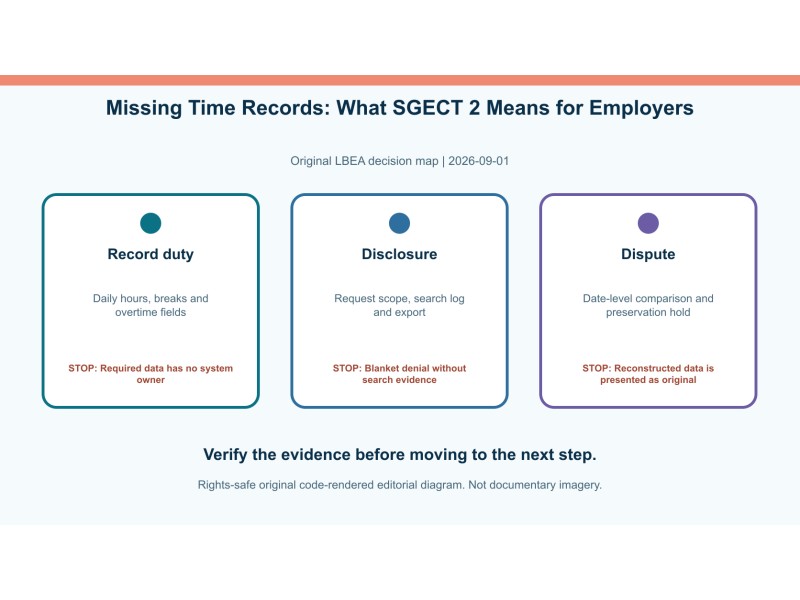
Answer first. [2026] SGECT 2 shows why an employer should preserve, produce and explain attendance records instead of relying on a blanket denial of overtime.
Related reading: salary evidence guide and employment claims guide.
Read the case at the correct level
JHU v JHV is an Employment Claims Tribunals decision, not an appellate judgment. It concerned a specific overtime claim and a respondent whose account the tribunal found unconvincing. The decision is useful because it explains how record duties and missing evidence operated on those facts. It should not be reduced to a slogan that every missing timesheet automatically proves every employee calculation.
The statutory record issue
At paragraph 37, the tribunal referred to the employer’s duty under section 95 of the Employment Act to make and keep records, including daily working hours and breaks. MOM’s current employment-records page lists those items and overtime particulars. Map each required field to the actual payroll, roster and timekeeping system. A policy saying managers approve overtime does not replace the underlying record.
Accessibility matters as well as retention
The respondent maintained that the records did not exist, while the tribunal found that attendance systems were in use and records had been withheld. The decision treated the failure to make records readily accessible to the former employee as engaging the Employment Claims Act adverse-inference provision. An employer should therefore document how a focused records request is searched, preserved, exported and answered, including any genuine technical limitation.
Do not answer a detailed claim with a blanket denial
The tribunal noted that the employer did not identify a single day or objective record contradicting the claimant’s attendance table. Audit by date. Compare roster, clock data, access logs, approved overtime, messages and payslips. Mark differences and explain the source hierarchy. A precise partial concession is often more credible than asserting that no overtime was ever worked when the operational record points elsewhere.
Worked scenario
A former kitchen employee claims overtime for 180 shifts. HR finds that the restaurant changed time systems midway through employment. It preserves both exports, documents the migration gap, requests the employee’s schedule, and builds a date-by-date comparison. For missing weeks, it searches rosters and supervisor messages and explains the limitation. The employer does not invent reconstructed clock data or destroy the remaining source after making a spreadsheet.
Create a dispute hold
Once a claim or credible dispute is known, suspend routine deletion for relevant rosters, time systems, messages, payroll and access records. Identify custodians and related companies whose systems may hold data. Record exports with dates and hashes where appropriate. Do not collect unrelated employee data or alter live systems. Coordinate privacy, employment and litigation considerations rather than treating preservation as unlimited copying.
Board and HR audit questions
Ask who owns daily-hours data, how breaks are recorded, whether overtime approvals reconcile to actual work, how former employees request access, and what happens when a vendor contract ends. Test one employee journey from roster through clock, payroll and payslip. Record remediation outside the live dispute file. Employers facing a substantial claim should obtain advice on evidence, statutory duties and response strategy before making admissions.
How to use this guide
Start with the reader, decision and evidence identified above. Write the next action and owner beside every unresolved point, then set a review date. Keep authority-issued records unchanged and preserve earlier versions when a correction is made. If a fact, document or deadline does not fit the matrix, pause instead of forcing it into the nearest category. Official guidance can change, and a checklist cannot decide disputed facts or replace advice on a specific case. The strongest file shows what was known, when it was known, which source controlled the step and why the chosen action followed. Record every unresolved assumption, identify who can verify it, and never treat silence or a pending application as approval.
Decision and evidence matrix
| Checkpoint | Evidence to verify | Stop condition |
|---|---|---|
| Record duty | Daily hours, breaks and overtime fields | Required data has no system owner |
| Disclosure | Request scope, search log and export | Blanket denial without search evidence |
| Dispute | Date-level comparison and preservation hold | Reconstructed data is presented as original |
Primary sources checked for this guide
Source status was checked on 1 September 2026. Reopen the controlling page before acting because procedures and legal status can change.
- Singapore Courts through eLitigation: JHU v JHV [2026] SGECT 2, supporting The tribunal drew an adverse inference after the employer refused to disclose attendance records and allowed the capped claim on the evidence.
- Ministry of Manpower: Employment records, supporting Employment records include daily hours and breaks, overtime hours and overtime pay, with stated retention periods.
Real people. Right here in Singapore.