
Insights for work and life.
Changing an Employee’s Work Location: A Contract and KET Checklist
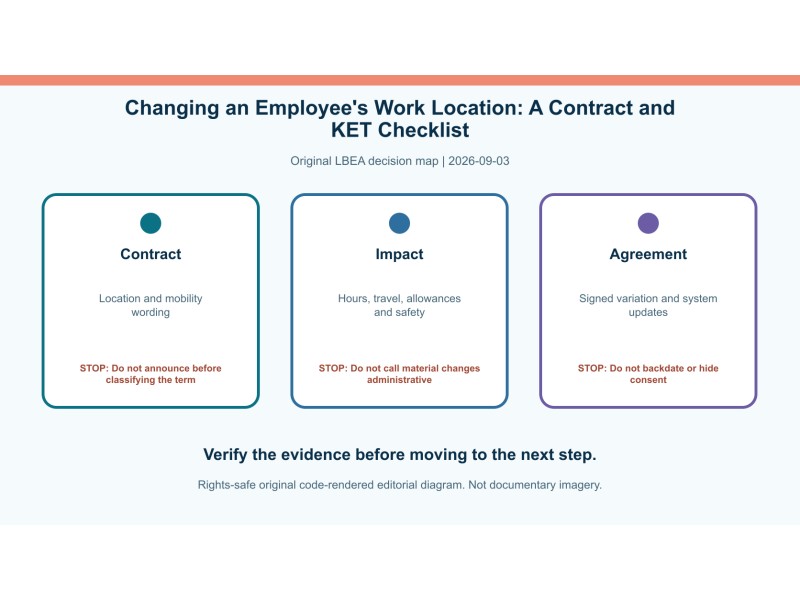
Answer first. A material work-location change should be checked against the contract and agreed terms. If consent is required, record the new location and related arrangements before the move.
Related reading: changing employment terms and moving an employee to part-time.
Read the location wording
Collect the signed contract, KETs, mobility clause, remote-work agreement, handbook and any accepted variation. Identify whether the location is fixed, multi-site, client-based, hybrid or stated broadly within Singapore. A mobility clause is not a substitute for considering its actual wording and use. Record the present place, proposed place, effective date, duration and business reason. Do not announce a permanent relocation before completing the contractual analysis.
Separate location from working arrangements
A site move can affect hours, rest days, travel time, transport, allowances, safety controls, reporting lines and access to equipment. MOM lists working arrangements as written KETs and identifies place of work when different from the employer’s address. Build a change table for each connected term. Avoid describing the move as administrative if it materially changes the employee’s bargain or daily burden.
Consult before seeking agreement
Explain why the move is proposed, alternatives considered, distance, start date, expected attendance and support. Invite concrete concerns such as disability access, caregiving, shift transport or client confidentiality. Consultation does not guarantee the employee’s preferred outcome, but it improves the information behind the decision. Keep legitimate business requirements separate from assumptions about attitude or loyalty. Consider a trial where the facts are uncertain.
Document consent and the final package
MOM says contractual changes require consent and recommends a new contract with clear terms. Use a signed variation when only selected terms change, or a replacement agreement when appropriate. State the location, mobility scope, hybrid pattern, hours, allowances, travel treatment, review date and what remains unchanged. Do not use a receipt acknowledgement as hidden consent or backdate the document to the announcement date.
Worked example
An employer moves an operations team from Tanjong Pagar to Changi and relies on a clause naming several Singapore sites. HR still maps the additional commute, earlier shift and late-night transport. It consults staff, provides a shuttle for the closing shift and signs variations covering the new site and hours. One employee proposes a different shift because of caregiving. HR evaluates the operational evidence rather than treating the question as refusal to relocate.
If agreement is not reached
MOM states that if the parties cannot agree, either may end the relationship by serving contractual notice. That is not permission to manufacture misconduct or force a resignation. Consider whether the proposal can be adjusted and whether redundancy or another lawful process is genuinely engaged. Record the decision and obtain advice before acting where protected characteristics, medical needs, union issues or constructive-dismissal allegations may arise.
Implementation checklist
Update the contract or variation, KET record, payroll location, emergency contacts, insurance, workplace safety assessment, data access, roster, transport and manager instructions. Confirm the employee’s first reporting date and who resolves problems. Review the arrangement after the stated period. A technically correct letter can still fail if systems show conflicting locations or the employee arrives without access, supervision or safe transport.
How to use this guide
Start with the reader, decision and evidence identified above. Write the next action and owner beside every unresolved point, then set a review date. Keep authority-issued records unchanged and preserve earlier versions when a correction is made. If a fact, document or deadline does not fit the matrix, pause instead of forcing it into the nearest category. Official guidance can change, and a checklist cannot decide disputed facts or replace advice on a specific case. The strongest file shows what was known, when it was known, which source controlled the step and why the chosen action followed. Record every unresolved assumption, identify who can verify it, and never treat silence or a pending application as approval.
Decision and evidence matrix
| Checkpoint | Evidence to verify | Stop condition |
|---|---|---|
| Contract | Location and mobility wording | Do not announce before classifying the term |
| Impact | Hours, travel, allowances and safety | Do not call material changes administrative |
| Agreement | Signed variation and system updates | Do not backdate or hide consent |
Primary sources checked for this guide
Source status was checked on 3 September 2026. Reopen the controlling page before acting because procedures and legal status can change.
- Ministry of Manpower: Can an employer change an employee’s terms and conditions of work?, supporting Employers cannot change contractual terms without consent; agreed new terms should be stated clearly in a signed contract.
- Ministry of Manpower: Key employment terms, supporting Place of work should be stated where it differs from the employer’s address, and working arrangements are required KET items where applicable.
Real people. Right here in Singapore.