
Insights for work and life.
Salary Sent to the Wrong Account: An Employee Recovery Checklist
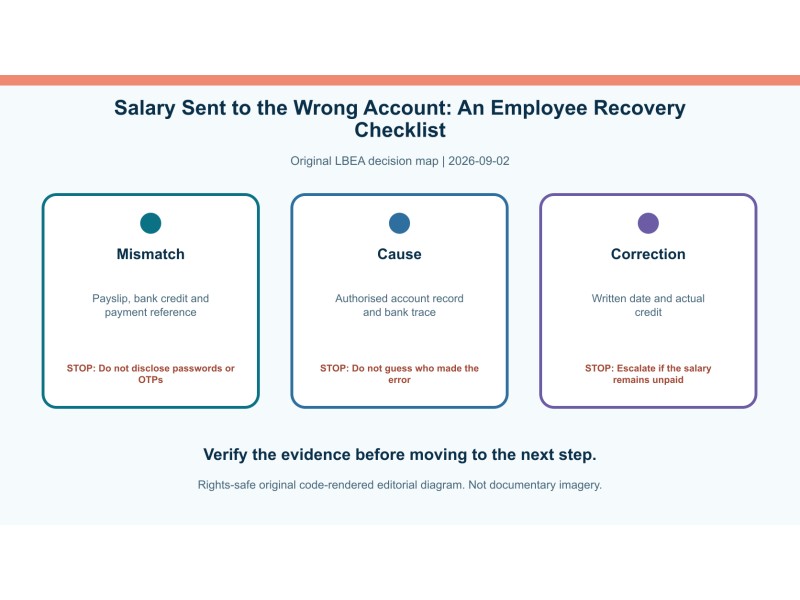
Answer first. Report a suspected misdirected salary transfer immediately, preserve the payslip and bank evidence, and ask payroll to confirm the correction path and payment date without exposing banking credentials.
Related reading: missing or wrong payslip and late salary action timeline.
Report the mismatch immediately
Tell payroll or HR in writing as soon as the expected salary does not appear. State the salary period, expected payment date, amount shown on the payslip, last four digits of the correct account and whether the employee recently submitted an account change. Do not email a full bank password, one-time password or card security code. A genuine payroll investigation can proceed from the authorised account record, payment reference and bank trace without the employee revealing login credentials.
Distinguish three possible errors
The problem may be a delayed transfer, a transfer to an old but still employee-owned account, or a transfer to an unrelated account because payroll data was wrong. It may also be a payslip error with no payment instruction. Ask payroll for the value date, beneficiary name or masked account, bank reference and transaction status. Do not assume the receiving account owner can simply be contacted by the employee; banks and the employer should manage recovery through lawful channels.
Keep the salary obligation visible
MOM says salary for employees covered by the Employment Act must generally be paid at least monthly and within seven days after the end of the salary period. The fact that payroll initiated a transfer does not by itself answer whether the employee received salary as required when the beneficiary details were wrong. The legal effect may depend on who supplied or approved the incorrect details. Ask the employer to state its position and correction date, and obtain advice if responsibility is disputed.
Build a neutral evidence pack
Keep the employment terms, authorised bank-change form, payroll acknowledgement, payslip, bank statement covering the expected date, and every correction message. Redact unrelated transactions when sharing a statement. MOM’s payslip guidance requires the payment date, salary period, components, deductions and total net salary. Compare those fields with the actual credit. Preserve original PDFs and email headers rather than editing screenshots into a single image that loses dates and provenance.
Worked scenario
An employee changes banks in August and receives HR confirmation. September’s payslip shows the new account ending 2481, but the credit is absent. Payroll discovers that its payment file retained the prior account ending 9044, which had already been closed. The employer opens a bank trace, gives the employee a written correction date and makes the corrected payment. The employee keeps the rejected-transfer confirmation and both payroll records, without sending online banking credentials to anyone.
Watch for payroll-themed scams
A wrong-account incident creates urgency that scammers exploit. Verify requests through the employer’s known HR channel and the bank’s official contact route. Never move money to a so-called safe account or approve an authentication prompt merely because a caller knows the salary amount. If an unknown account received the money, do not threaten or identify its owner. Let the bank and employer handle tracing, recall and any report to the authorities.
Escalation record
If salary remains unpaid after the employer’s promised correction or the statutory timetable may be breached, send a dated summary with the salary period, amount, evidence and requested resolution. MOM directs salary disputes to TADM, and a union member may seek union help. The employee should not inflate the amount with guessed bank loss or compensation. Separate the unpaid salary issue from any consequential-loss question requiring advice.
How to use this guide
Start with the reader, decision and evidence identified above. Write the next action and owner beside every unresolved point, then set a review date. Keep authority-issued records unchanged and preserve earlier versions when a correction is made. If a fact, document or deadline does not fit the matrix, pause instead of forcing it into the nearest category. Official guidance can change, and a checklist cannot decide disputed facts or replace advice on a specific case. The strongest file shows what was known, when it was known, which source controlled the step and why the chosen action followed. Record every unresolved assumption, identify who can verify it, and never treat silence or a pending application as approval.
Decision and evidence matrix
| Checkpoint | Evidence to verify | Stop condition |
|---|---|---|
| Mismatch | Payslip, bank credit and payment reference | Do not disclose passwords or OTPs |
| Cause | Authorised account record and bank trace | Do not guess who made the error |
| Correction | Written date and actual credit | Escalate if the salary remains unpaid |
Primary sources checked for this guide
Source status was checked on 2 September 2026. Reopen the controlling page before acting because procedures and legal status can change.
- Ministry of Manpower: Paying salary, supporting Salary must generally be paid at least monthly and within seven days after the salary period, and may be transferred directly to the employee’s bank account.
- Ministry of Manpower: Itemised pay slips, supporting Covered employees must receive itemised payslips showing payment date, salary period, components, deductions and net salary.
Real people. Right here in Singapore.