
Insights for work and life.
Employer Says You Were Overpaid? Build a Repayment Reconciliation
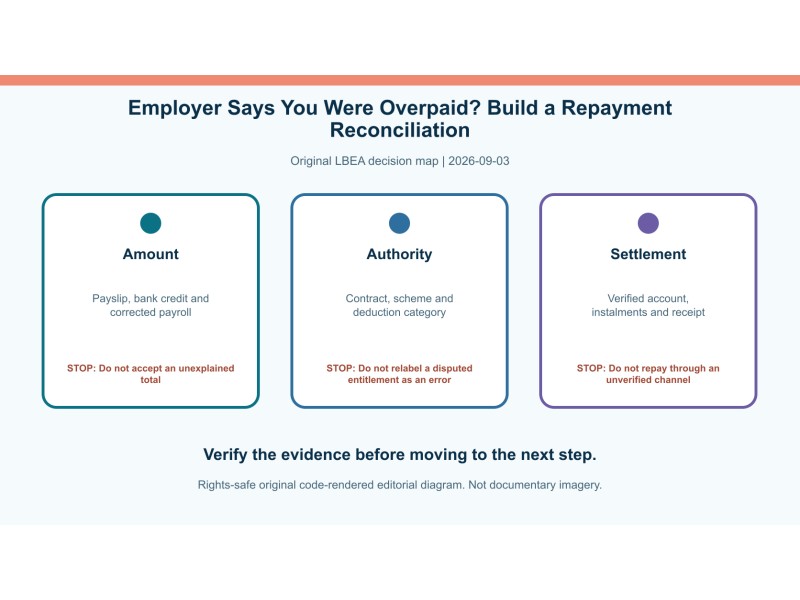
Answer first. An employer may recover overpaid salary, but the employee should first reconcile the exact pay period, components, gross and net amounts, statutory adjustments and repayment method.
Related reading: salary evidence file and salary sent to a wrong account.
Ask for a calculation, not a conclusion
Request the affected salary period, original payroll inputs, amount actually transferred, contractual entitlement and corrected calculation. An email saying ‘you owe S$2,000’ is not a reconciliation. Separate basic pay, allowances, overtime, commission, leave adjustment, bonus, CPF and tax. Ask whether the figure is gross or net and how statutory records will be corrected. Do not transfer money to a new bank account supplied only through an unexpected message.
Match three records
Compare the employment terms, payslip and bank credit for each affected month. Then add attendance, leave, overtime and commission records relevant to the calculation. A payslip can be wrong even when the bank credit is right, and a duplicated bank transfer can occur while the payslip appears once. Preserve originals and make a separate working table. Do not edit a payslip image or overwrite the employer’s first explanation.
Use the correct deduction category
MOM lists recovery of overpaid salary and unearned employment benefits as authorised reasons. This does not mean every disputed incentive automatically becomes an overpayment. Ask what event made the payment unearned and which contract or scheme term applies. A discretionary bonus dispute, commission reversal, mistaken salary rate and duplicate transfer raise different evidence. If the employer relies on a new interpretation rather than a processing error, obtain advice.
Understand the percentage cap carefully
MOM states that total deductions generally cannot exceed 50 percent of salary in one period, but the listed exclusions include recovery of advances, loans, overpaid salary and unearned employment benefits. Do not promise that the 50 percent limit protects an employee from a full overpayment recovery. A practical instalment plan may still be agreed. Record the amount, dates and treatment of payroll, CPF and tax corrections.
Worked example
Payroll pays a monthly employee twice after a bank-file retry. The employee receives two identical net credits, while one payslip is issued. HR supplies the payment references and corrected ledger, confirms the duplicate amount and explains the CPF record is unaffected. The parties agree a traceable repayment to the employer’s verified corporate account. Both retain the reconciliation and receipt. This is different from a disputed bonus clawback based on ambiguous scheme wording.
Watch for net-versus-gross errors
If the original payment included employee CPF, employer CPF or tax withholding, the amount the employee received may differ from the payroll cost. Ask payroll to state which entries it will reverse and what will appear on the next payslip. Do not repay a gross figure merely because it is larger, and do not assume the bank credit is the complete answer. For cross-year or tax-clearance cases, professional advice may be needed.
Close the file cleanly
After repayment or deduction, obtain a corrected payslip or written payroll statement showing the remaining balance. Keep the employer’s demand, your questions, calculation, agreement and proof of payment. If the amount or entitlement remains disputed, use the grievance route and consider TADM or legal advice as appropriate. The decision is not whether to ignore the demand, but whether the claim is evidenced, correctly classified and accurately calculated.
How to use this guide
Start with the reader, decision and evidence identified above. Write the next action and owner beside every unresolved point, then set a review date. Keep authority-issued records unchanged and preserve earlier versions when a correction is made. If a fact, document or deadline does not fit the matrix, pause instead of forcing it into the nearest category. Official guidance can change, and a checklist cannot decide disputed facts or replace advice on a specific case. The strongest file shows what was known, when it was known, which source controlled the step and why the chosen action followed. Record every unresolved assumption, identify who can verify it, and never treat silence or a pending application as approval.
Decision and evidence matrix
| Checkpoint | Evidence to verify | Stop condition |
|---|---|---|
| Amount | Payslip, bank credit and corrected payroll | Do not accept an unexplained total |
| Authority | Contract, scheme and deduction category | Do not relabel a disputed entitlement as an error |
| Settlement | Verified account, instalments and receipt | Do not repay through an unverified channel |
Primary sources checked for this guide
Source status was checked on 3 September 2026. Reopen the controlling page before acting because procedures and legal status can change.
- Ministry of Manpower: Allowable salary deductions, supporting Overpaid salary and unearned employment benefits may be recovered, and the general 50 percent cap excludes those categories.
- Ministry of Manpower: Itemised pay slips, supporting Itemised payslips provide the salary period, payment date, components, deductions and net salary needed to reconcile an alleged overpayment.
Real people. Right here in Singapore.