
Insights for work and life.
Foreign Founder Visiting Singapore: Meetings or Work?
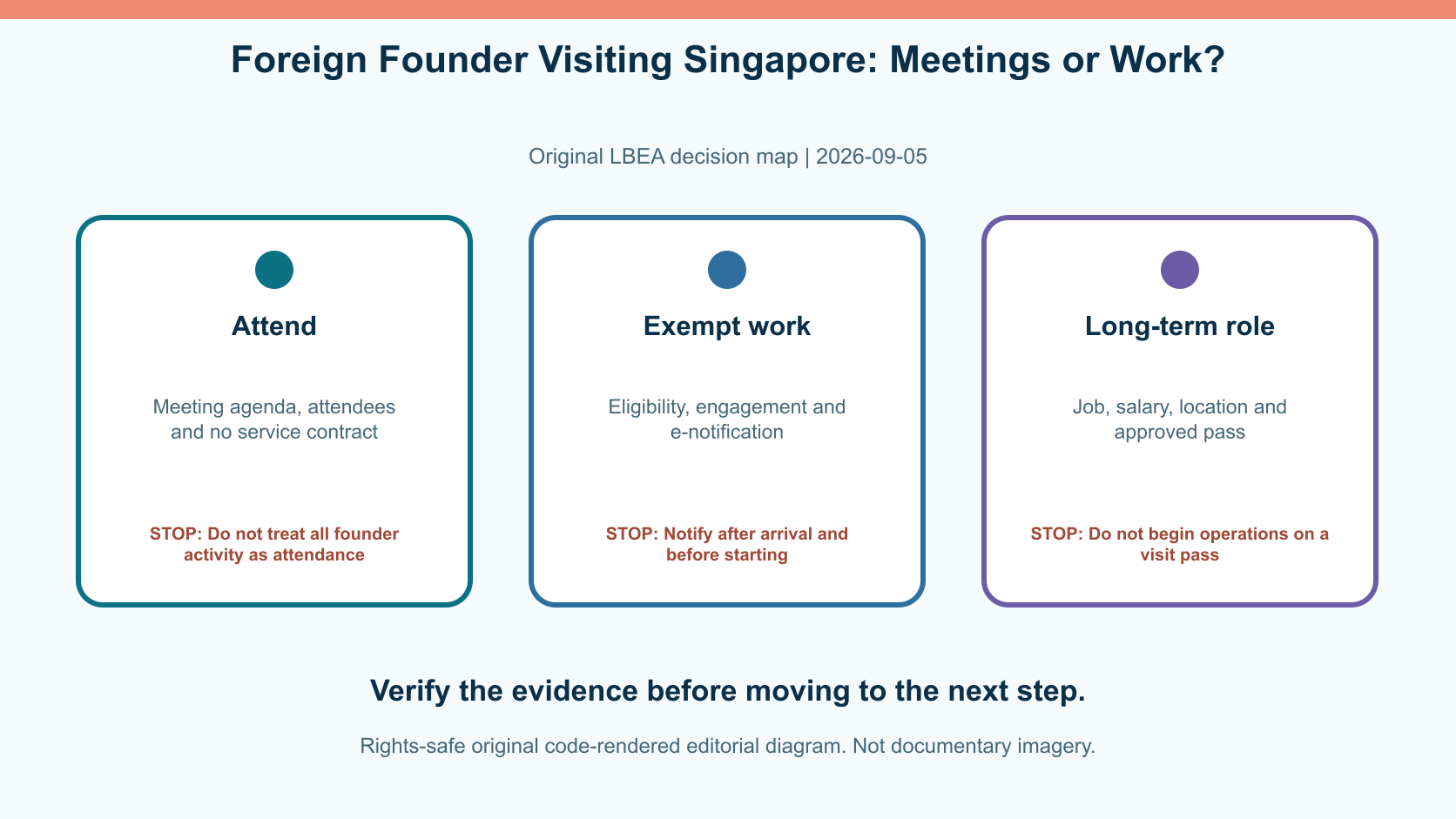
Answer first. A foreign founder may attend company or business-partner meetings on a valid Short-Term Visit Pass without notifying MOM if no Singapore service contract is involved. Operational work or another activity needs separate analysis and may require notification or a work pass.
Related reading: overseas founder boundaries and resident director sequence.
Classify each calendar item
List board meetings, investor discussions, customer sales, delivery work, staff supervision, training, speaking, installation and other activities separately. MOM’s no-notification examples cover attendance at company meetings, retreats and business-partner meetings where there is no Singapore contract of service or contract for service. A trip label such as founder visit does not classify every activity.
Check entry and engagement facts
Confirm the Short-Term Visit Pass, who engaged the founder, when the engagement arose, the service recipient, place, duration and payment. Some listed Work Pass Exempt Activities require the person to have been engaged before entry. Entry permission, company incorporation, share ownership and director appointment do not grant general work authority.
Notify when the exemption requires it
For a qualifying notified activity, submit the e-notification only after arrival and before starting, then retain the acknowledgement. The notification covers only the stated activity and period. It does not extend lawful stay, remove professional licensing rules or authorise unrelated operational work. Monitor the annual day limit across all visits.
Draw a stop line for operations
Routine management, customer delivery, local employment, ongoing sales execution and other work outside the listed exemptions may require an appropriate work pass. If the itinerary moves beyond permitted meeting attendance, pause and obtain advice before acting. Do not backfill an e-notification after work begins or describe an operational role as a meeting.
Keep governance separate
A director still owes company-law duties and needs proper records, information and independent judgment. Immigration permission answers a different question. Record minutes accurately without using them as a device to conceal work. Before relocation, align company role, salary, place of work, pass application and start date. Incorporation never guarantees a pass, PR or citizenship.
Turn the guidance into a dated file
For foreign founder Singapore meetings work pass exempt activity, assign one owner to the file and one reviewer who was not responsible for the original action. Record the official source, access date, facts, open questions and next decision. Keep originals unchanged and add corrections as new records. A clear chronology should show what was known, who decided, what authority was checked and what happened next.
Worked scenario
Suppose the first checkpoint in the matrix is incomplete but a deadline is approaching. The safer response is to preserve the current evidence, ask the relevant person for the missing record, verify the official procedure and document a temporary decision. Do not fill the gap with an assumption, a recycled template or an outcome promise. Recheck the second and third checkpoints after any correction.
Limits and escalation
This checklist explains issue spotting and process for a general reader. It cannot decide disputed facts, interpret a contract on incomplete evidence or replace Singapore legal, tax, immigration or regulatory advice. Rules and procedures can change. Reopen the cited official pages before acting, use the authority’s current channel and obtain professional advice where the consequences are material.
Final verification
Before closing the file, reread the official source, confirm the date and status of every consequential fact, and have another person check the chronology, calculations, links and proposed action. Record any unresolved point explicitly. A complete checklist is evidence of a careful process, not proof that an authority, tribunal or court will accept the conclusion.
How to use this guide
Start with the reader, decision and evidence identified above. Write the next action and owner beside every unresolved point, then set a review date. Keep authority-issued records unchanged and preserve earlier versions when a correction is made. If a fact, document or deadline does not fit the matrix, pause instead of forcing it into the nearest category. Official guidance can change, and a checklist cannot decide disputed facts or replace advice on a specific case. The strongest file shows what was known, when it was known, which source controlled the step and why the chosen action followed. Record every unresolved assumption, identify who can verify it, and never treat silence or a pending application as approval.
Decision and evidence matrix
| Checkpoint | Evidence to verify | Stop condition |
|---|---|---|
| Attend | Meeting agenda, attendees and no service contract | Do not treat all founder activity as attendance |
| Exempt work | Eligibility, engagement and e-notification | Notify after arrival and before starting |
| Long-term role | Job, salary, location and approved pass | Do not begin operations on a visit pass |
Primary sources checked for this guide
Source status was checked on 5 September 2026. Reopen the controlling page before acting because procedures and legal status can change.
- Ministry of Manpower: Eligible activities for a work pass exemption, supporting Company meetings and business-partner meetings do not require notification when they do not involve a Singapore contract of service or contract for service; listed exempt work has separate conditions and a 90-day annual ceiling.
- Ministry of Manpower: Notify MOM for Work Pass Exempt Activities, supporting A person performing a notified exempt activity must notify after arrival and before starting the activity.
- Accounting and Corporate Regulatory Authority: Company directors’ duties, supporting Director appointment carries company-law duties independent of immigration permission.
Authority and relationship disclosure. Little Big Employment Agency Pte. Ltd. is not affiliated with or endorsed by MOM, ICA, ACRA, MAS or IRAS. Contacting LBEA does not create a solicitor-client relationship.
Real people. Right here in Singapore.