
Insights for work and life.
13O and 13U Local Business Spending: Build the Evidence File
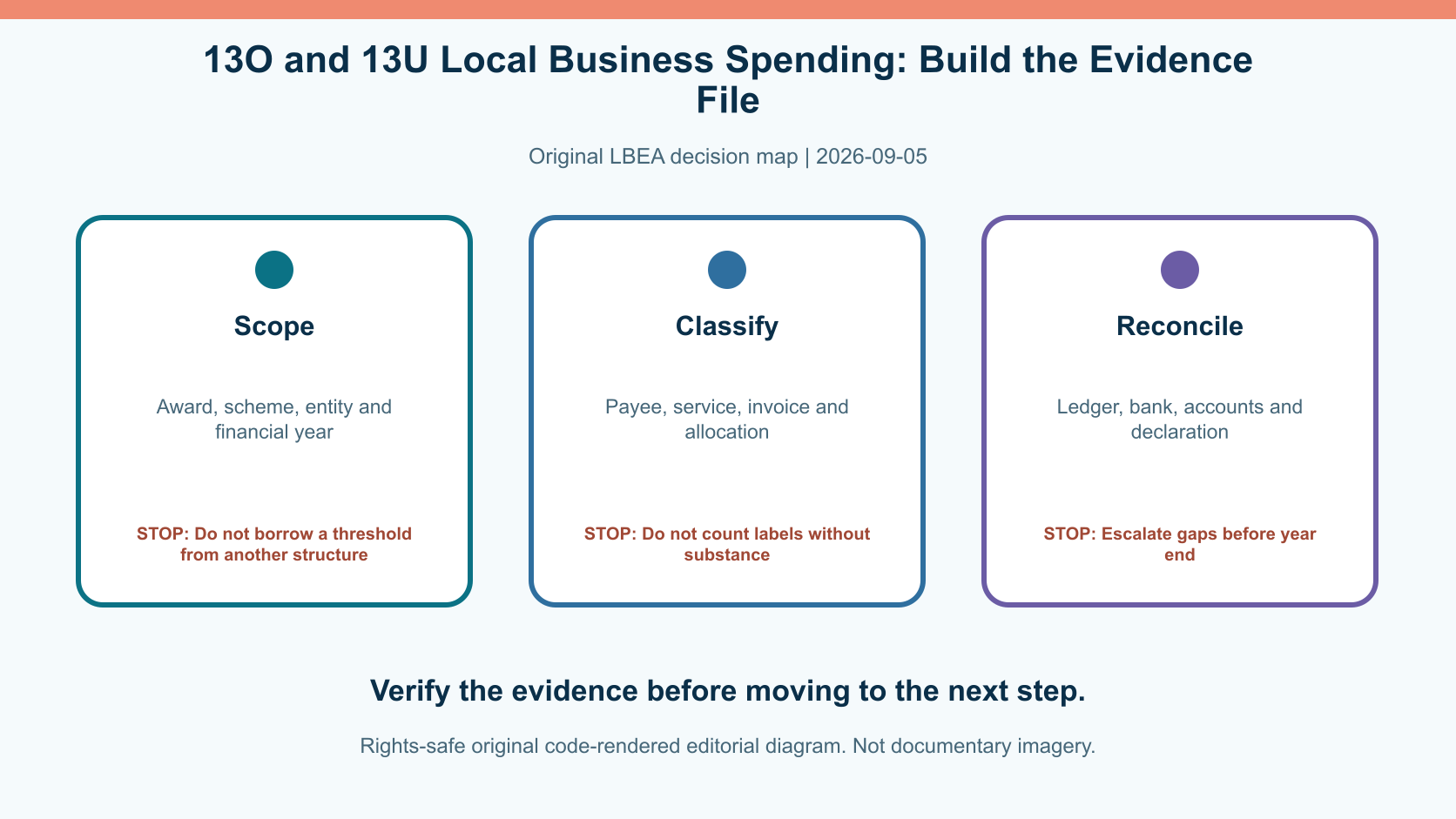
Answer first. Local business spending is a recurring 13O or 13U condition, not a year-end estimate. The family office should identify the exact award terms, classify Singapore spending consistently and reconcile invoices, payees, accounts and annual declarations.
Related reading: annual declaration calendar and investment professional evidence.
Pin the governing instrument
Collect the MAS award letter, application date, structure chart, financial year, fund and manager details, and any later variation. Do not lift one threshold from a prospectus, old article or a different sub-fund. Conditions can differ by scheme, application cohort, assets and transition period. Record the exact paragraph the advisers say controls.
Define the spending population
Build a ledger of Singapore payees, service descriptions, invoice dates, payment dates, tax treatment, related-party status and accounting codes. Decide consistently which entity incurred each cost. A Singapore address on an invoice does not by itself prove the expense belongs to the qualifying fund or period. Exclude capital, pass-through or unrelated items unless the controlling treatment supports inclusion.
Test substance, not labels
Review management fees, salaries, professional fees, custody, administration, technology, rent and other categories against the award and current guidance. Keep contracts and work product for material services. Related-party charges need commercial support and allocation logic. Do not relabel overseas spending as local or duplicate one invoice across funds, sub-funds or incentive conditions.
Reconcile quarterly
Tie the spending ledger to the general ledger, bank payments, invoices, vendor master and fund accounts each quarter. Flag reversals, accruals, prepayments, foreign currency and intercompany allocations. Forecast conservatively, but do not book artificial expenditure merely to reach a threshold. Escalate uncertainty early enough to obtain tax and regulatory advice.
Close the annual file
Prepare a signed reconciliation showing included and excluded items, scheme basis, review notes and links to evidence. Align it with annual declarations and financial statements. Preserve snapshots of the controlling material used. A 13O or 13U award does not grant a fund-management licence, work pass, PR or citizenship, and incorporation alone proves none of those outcomes.
Turn the guidance into a dated file
For 13O 13U local business spending evidence Singapore, assign one owner to the file and one reviewer who was not responsible for the original action. Record the official source, access date, facts, open questions and next decision. Keep originals unchanged and add corrections as new records. A clear chronology should show what was known, who decided, what authority was checked and what happened next.
Worked scenario
Suppose the first checkpoint in the matrix is incomplete but a deadline is approaching. The safer response is to preserve the current evidence, ask the relevant person for the missing record, verify the official procedure and document a temporary decision. Do not fill the gap with an assumption, a recycled template or an outcome promise. Recheck the second and third checkpoints after any correction.
Limits and escalation
This checklist explains issue spotting and process for a general reader. It cannot decide disputed facts, interpret a contract on incomplete evidence or replace Singapore legal, tax, immigration or regulatory advice. Rules and procedures can change. Reopen the cited official pages before acting, use the authority’s current channel and obtain professional advice where the consequences are material.
Final verification
Before closing the file, reread the official source, confirm the date and status of every consequential fact, and have another person check the chronology, calculations, links and proposed action. Record any unresolved point explicitly. A complete checklist is evidence of a careful process, not proof that an authority, tribunal or court will accept the conclusion.
How to use this guide
Start with the reader, decision and evidence identified above. Write the next action and owner beside every unresolved point, then set a review date. Keep authority-issued records unchanged and preserve earlier versions when a correction is made. If a fact, document or deadline does not fit the matrix, pause instead of forcing it into the nearest category. Official guidance can change, and a checklist cannot decide disputed facts or replace advice on a specific case. The strongest file shows what was known, when it was known, which source controlled the step and why the chosen action followed. Record every unresolved assumption, identify who can verify it, and never treat silence or a pending application as approval.
Decision and evidence matrix
| Checkpoint | Evidence to verify | Stop condition |
|---|---|---|
| Scope | Award, scheme, entity and financial year | Do not borrow a threshold from another structure |
| Classify | Payee, service, invoice and allocation | Do not count labels without substance |
| Reconcile | Ledger, bank, accounts and declaration | Escalate gaps before year end |
Primary sources checked for this guide
Source status was checked on 5 September 2026. Reopen the controlling page before acting because procedures and legal status can change.
- Monetary Authority of Singapore: MAS 13O and 13U scheme conditions, supporting The schemes apply local business spending conditions tied to the relevant structure, period and assets under management.
- Inland Revenue Authority of Singapore: Corporate income tax, supporting Corporate income-tax administration and filing remain separate from MAS incentive-condition evidence.
Authority and relationship disclosure. Little Big Employment Agency Pte. Ltd. is not affiliated with or endorsed by MOM, ICA, ACRA, MAS or IRAS. Contacting LBEA does not create a solicitor-client relationship.
Real people. Right here in Singapore.