
Insights for work and life.
ACRA’s Free Director Training: What Changed on 31 August 2026
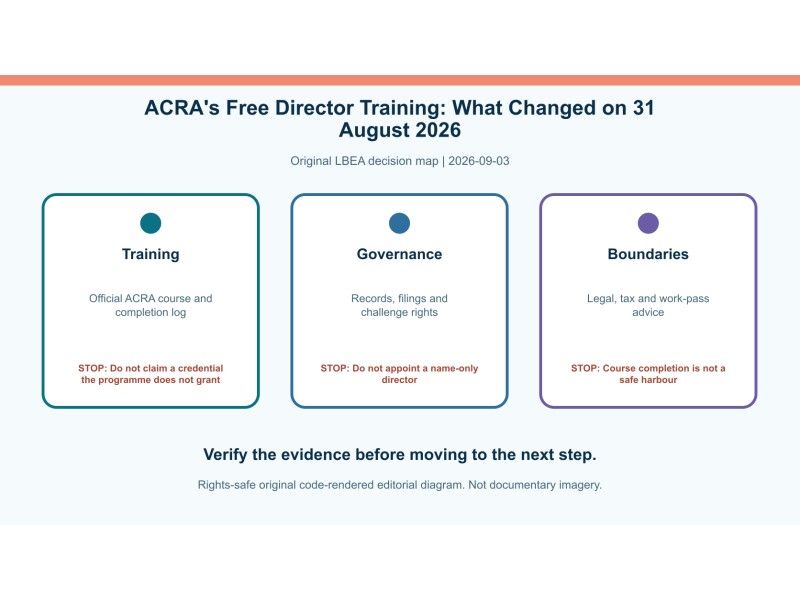
Answer first. ACRA’s updated Directors Training Programme is free, online, self-paced and about two hours. It is a useful onboarding control, but completion does not replace a director’s legal duties or company-specific advice.
Related reading: resident director responsibilities and hiring before founder work pass.
What the official page now offers
ACRA’s programme page, updated 31 August 2026, describes a free online course for aspiring, new and existing directors. It is self-paced and takes about two hours for all modules. The page says it uses games, case studies and quizzes to explain duties and responsibilities. This is an official training resource, not a new licensing requirement or a statutory safe harbour.
Who should use it
Founder-directors can use it before incorporation or appointment. New resident, executive, non-executive and nominee directors can complete it during onboarding. Existing boards can use it as a refresher and discussion prompt. Companies should record completion only with the individual’s consent and keep a simple training log. Do not advertise a director as certified, licensed or approved by ACRA unless the official programme expressly provides that status.
Turn learning into board controls
After the course, ask each director to map the company’s filing calendar, accounting-record owner, financial-statement review, registers, conflicts process and escalation route. Add company-specific risks such as payroll, work passes, safety, data protection and regulated activity. Training creates value when it changes information flow and decisions. A completion screen without access to records or authority to challenge management is weak evidence of governance.
What the course does not replace
ACRA’s duties page says all directors remain responsible for obligations under the Companies Act. The course does not appoint a director, cure disqualification, approve a nominee arrangement, validate accounts or decide a conflict. It also does not provide transaction-specific legal, tax, regulatory or immigration advice. Directors should obtain professional advice where the facts require it and keep exercising independent judgment.
Worked onboarding sequence
A foreign founder plans a Singapore company with a local resident director. Both complete the programme before the first board meeting. The company then provides the constitution, business plan, ownership record, bank controls, filing calendar and management accounts. The resident director reviews the materials and challenges unsupported assumptions. Separately, the founder maps work-pass permission before starting operational work in Singapore. Training supports, but does not replace, those steps.
Avoid the rubber-stamp trap
A nominee or non-executive label does not remove responsibility. Do not use course completion to market a person as a low-risk name-only director. A sound appointment includes due diligence, access to current records, defined information rights, conflicts disclosure, time to review decisions and the ability to refuse improper instructions. If management will not provide those conditions, the training certificate is not the solution.
Action for employers and boards
Add the programme to a risk-based director induction, set a completion date, discuss lessons at a board meeting and capture resulting actions. Review the log annually and when duties change. Keep the official page and access date in the file. As at 3 September 2026, the development is an official training-resource update, not enacted legislation or a new mandatory credential.
How to use this guide
Start with the reader, decision and evidence identified above. Write the next action and owner beside every unresolved point, then set a review date. Keep authority-issued records unchanged and preserve earlier versions when a correction is made. If a fact, document or deadline does not fit the matrix, pause instead of forcing it into the nearest category. Official guidance can change, and a checklist cannot decide disputed facts or replace advice on a specific case. The strongest file shows what was known, when it was known, which source controlled the step and why the chosen action followed. Record every unresolved assumption, identify who can verify it, and never treat silence or a pending application as approval.
Decision and evidence matrix
| Checkpoint | Evidence to verify | Stop condition |
|---|---|---|
| Training | Official ACRA course and completion log | Do not claim a credential the programme does not grant |
| Governance | Records, filings and challenge rights | Do not appoint a name-only director |
| Boundaries | Legal, tax and work-pass advice | Course completion is not a safe harbour |
Primary sources checked for this guide
Source status was checked on 3 September 2026. Reopen the controlling page before acting because procedures and legal status can change.
- Accounting and Corporate Regulatory Authority: Directors Training Programme, supporting ACRA offers a free, online, self-paced directors programme lasting about two hours for aspiring, new and existing directors.
- Accounting and Corporate Regulatory Authority: Company directors’ duties and key obligations, supporting Training does not remove statutory responsibilities for records, financial reporting, filings and company information.
Real people. Right here in Singapore.