
Insights for work and life.
When Can MOM Forfeit a Work Permit Security Bond?
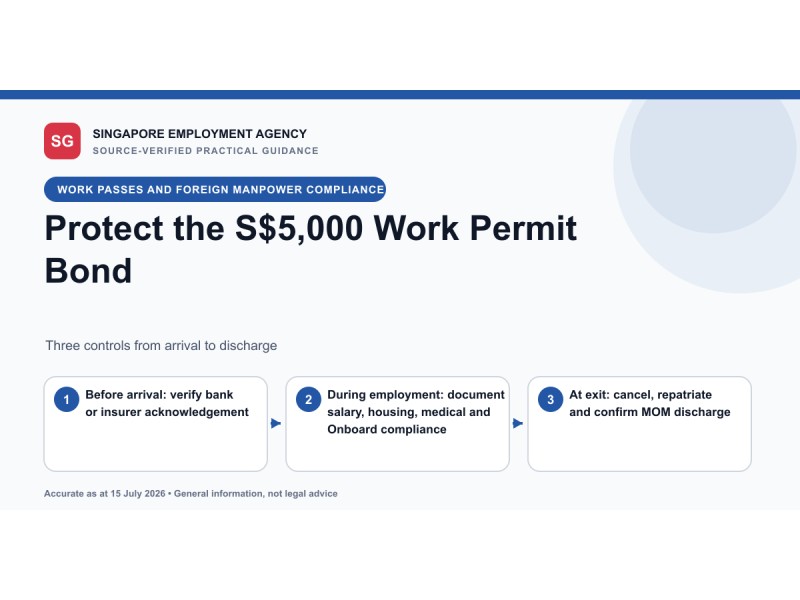
Short answer: under MOM’s company-employed migrant-worker workflow, a Singapore employer must provide a S$5,000 security bond for every non-Malaysian Work Permit holder it employs. The bond can be forfeited, wholly or partly, if the employer or worker breaches the bond or Work Permit conditions. MOM specifically identifies late salary payment, failure to repatriate a worker, a missing worker and failure to complete required CMP onboarding as forfeiture risks. The employer cannot make the worker pay for the bond.
The safest way to manage the exposure is to treat the bond as a live compliance control from before arrival until MOM confirms discharge, not as a one-off insurance purchase. This guide concerns company-employed migrant workers. Employers of migrant domestic workers should instead use MOM’s separate MDW security-bond page and rules. For the wider company-employed Work Permit framework, see our Singapore Work Permit employer guide.
What the S$5,000 bond is, and is not
MOM describes the security bond as a binding pledge to pay the Government if the employer or worker breaches applicable conditions. It is normally issued as a banker’s or insurer’s guarantee. It is not the same as the premium or fee charged by the bank or insurer, and it is not an amount that the employer may pass to the worker. Within this company-employed workflow, the requirement applies to each non-Malaysian Work Permit holder; MOM does not require the bond for a Malaysian worker.
Under regulation 13 of the Employment of Foreign Manpower (Work Passes) Regulations 2012, the Controller may direct forfeiture of all or part of the security after a failure to comply with a condition. Forfeiture does not prevent separate enforcement proceedings. In other words, S$5,000 is not necessarily the employer’s maximum regulatory or financial exposure.
Before the worker arrives: four controls
- Buy the correct guarantee. Use the bank or insurer template specified by MOM and name the Ministry of Manpower as beneficiary.
- Allow transmission time. MOM says it can take up to three working days for the institution to send the bond details.
- Match the effective date to arrival. The bond must be effective when the worker arrives. If it is not, the immigration officer will not admit the worker and the employer must send the worker home immediately.
- Verify, do not assume. Check the status in WP Online, print the acknowledgement letter and give the worker a copy.
These steps come directly from MOM’s current security bond requirements. A flight booked before the effective date is verified creates avoidable border, accommodation and repatriation costs.
Security-bond risk matrix
| Event | Why the bond is exposed | Control evidence to retain |
|---|---|---|
| Salary is paid late or not in full | MOM lists failure to pay salary on time as a forfeiture trigger. | Payroll register, bank proof, itemised payslip and resolution record for any discrepancy. |
| Worker remains after expiry, revocation or cancellation | The employer must cancel the pass, maintain lawful stay where required and send the worker home. | Cancellation record, Special Pass, itinerary, ticket with luggage allowance and departure verification. |
| Worker goes missing | MOM identifies a missing worker as a bond risk. A specific partial-forfeiture rule applies if the worker is not found. | Attendance/contact trail, police report, Work Permit cancellation and notices to MOM. |
| CMP worker misses required Onboard programme | Construction, marine shipyard and process employers must complete required onboarding at the Onboard centre. | Booking, arrival transfer plan and completion confirmation. |
| Unacceptable accommodation or unpaid upkeep/medical costs | These are express security-bond and Work Permit responsibilities. | Housing inspection records, tenancy/bed allocation, insurance, medical invoices and payment approvals. |
| Worker breaches a personal Work Permit condition | The bond may be at risk, but MOM states the employer will not be liable for a worker violation if it can prove it informed the worker and reported the breach when first aware. | Signed induction, translated condition briefing, incident chronology and prompt MOM report. |
The final row is especially important. Supervision does not mean an employer can guarantee every personal act. It does mean the employer should be able to prove that the worker received the conditions in a language and format they understood, and that the employer did not conceal a known breach. MOM’s current security bond conditions require reasonable steps, including informing the worker and reporting known non-compliance.
Worked scenario: a worker cannot be contacted
Suppose a non-Malaysian services-sector worker fails to attend work on Monday and cannot be reached. The employer should first check accommodation, emergency contacts and any known hospital or travel information. Once the employer knows the worker is missing, MOM requires two actions within one week: file a missing-person police report and cancel the Work Permit.
If the worker is not found within one month from the cancellation date, MOM states that S$2,500, half of the S$5,000 bond, will be forfeited to cover repatriation and related costs. This specific outcome is set out in MOM’s Work Permit notification guidance. It should not be generalised into a promise that every other breach attracts only half the bond.
A useful incident file should show the last confirmed sighting, attempted calls and messages, accommodation check, supervisor interviews, police-report number, cancellation date and all correspondence with MOM. A retrospective note prepared after a dispute is weaker than contemporaneous records.
Offboarding timeline that protects the bond
| When | Employer action | Reason |
|---|---|---|
| Before the last day | Give reasonable repatriation notice, settle disputes, confirm passport validity and agree the itinerary before purchasing the ticket. | The employer bears repatriation responsibilities and must settle outstanding salary. |
| Within one week after the last day of notice | Cancel the Work Permit in WP Online. | MOM’s cancellation deadline; levy runs until one day before cancellation. |
| After cancellation | Do not allow further work. If the worker remains temporarily, issue the Special Pass generated through the process and ensure departure before it expires. | A cancelled pass no longer authorises employment. |
| Departure | Keep the itinerary, boarding/departure confirmation and proof that all payments were settled. | Discharge requires cancellation, departure and compliance with the bond conditions. |
| Usually one week after departure | Check for discharge; submit an enquiry if the expected notice does not arrive. | MOM says discharge is usually about one week after departure when all conditions are met; verification can take up to two weeks where the worker had already left before cancellation. |
MOM’s cancellation instructions should be used for the live transaction. Our broader work-pass cancellation and repatriation guide explains how offboarding sits alongside payroll and tax-clearance work; always prefer the current MOM and IRAS instructions where an older article differs.
Five documents that make the control real
- a pre-arrival checklist showing bond acknowledgement before flight confirmation;
- a worker induction in a language the worker understands, with signed acknowledgement;
- a monthly salary exception report checked against actual bank payment;
- an accommodation, medical-insurance and Onboard compliance register; and
- an offboarding pack linking cancellation, final payments, lawful stay and departure evidence.
Do not alter, backdate or manufacture records after an issue arises. If MOM is considering forfeiture, preserve the actual documents, prepare a factual chronology and respond by the stated deadline. Whether a breach occurred, whether mitigation is available and whether separate enforcement exposure exists can depend on the detailed facts.
Real people. Right here in Singapore.