
Insights for work and life.
EP Sponsorship for an Overseas Company: What MOM Allows
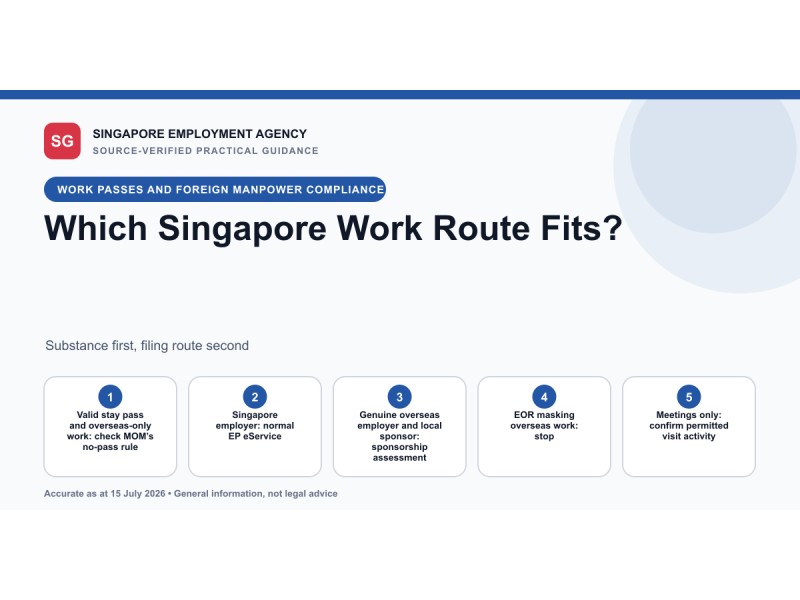
Short answer: MOM has a specific Employment Pass sponsorship process for an overseas company that does not have a Singapore-registered office. A genuine local sponsor submits the application and must explain its relationship with the overseas employer and why it needs the candidate to work in Singapore. This is not a blanket “rent a sponsor” route, and it is not permission for an Employer of Record (EOR) to obtain a pass for somebody who actually works for an unrelated overseas client.
A separate threshold applies to someone already in Singapore on a valid stay pass, for example, a Dependant’s Pass. MOM says overseas-only work or services do not need a work pass, but work or services for a Singapore-based organisation or client do. This does not make an EOR a permissible sponsor or extend the stay permission.
The first decision is therefore not “who can file the form?” It is “what Singapore activity, employer and sponsoring relationship will exist in substance?” The filing route should follow that answer. For the core salary and COMPASS framework, read our current Employment Pass guide.
Five situations that sound similar but are not
| Situation | What the official material says | Practical implication |
|---|---|---|
| Valid stay-pass holder works or provides services solely for an overseas organisation or client | MOM’s stay-pass FAQ says no work pass is needed for the overseas-only work described there. Work or services for a Singapore-based organisation or client require a work pass. | Confirm that the stay pass remains valid, map every organisation and client receiving the services, and reassess before taking on Singapore work. |
| Singapore-registered employer hires the candidate | The employer or its appointed employment agent applies through the normal EP eService. | Use the ordinary EP route and ensure the employing entity, job and reporting line are real. |
| Overseas company has no Singapore-registered office but has a genuine local sponsor | MOM provides an EP sponsorship application. The local sponsor submits it and explains the relationship and Singapore need. | Use the sponsorship form and prepare evidence of both entities and the assignment. |
| EOR seeks a pass while the individual really works for an overseas client | MOM says an EOR may not apply for work passes for foreigners based in Singapore who work for overseas companies; doing so would be an offence. | Do not use payroll paperwork to disguise the actual employer or work arrangement. |
| Visitor attends meetings or explores opportunities without working | MOM points to the Short-Term Visit Pass for permitted meetings, retreats or business-partner discussions, subject to the applicable visit conditions. | A visit permission is not authority to take up employment or perform productive work in Singapore. |
This answer concerns MOM’s work-pass requirement. It does not grant or renew the stay pass or answer tax, registration, licensing, contractual or other legal requirements.
The distinction between the sponsorship and EOR rows is the heart of the issue. MOM’s EP key facts expressly recognise a local-sponsor route for an overseas company without a Singapore-registered office. Its separate EOR clarification says an EOR cannot use its name to place an overseas company’s worker in Singapore. Both propositions can be true: a disclosed, evidenced sponsorship arrangement is not the same thing as a nominee employer that obscures who receives and directs the work.
Decision tree: sponsorship, local setup or no work pass?
- Will the person perform work while based in Singapore? If no, identify the permitted visit activity and stay within it. If yes, continue.
- Is the person lawfully in Singapore on a valid stay pass and serving only an overseas organisation or client? MOM says that overseas-only work needs no work pass. Confirm continued stay validity and other laws. Any Singapore-organisation or client work requires a work-pass assessment.
- Is there a Singapore-registered entity that will genuinely employ the person? If yes, assess the normal EP route.
- Is the overseas employer relying on a real Singapore sponsor with a defensible relationship and reason for the candidate’s presence? If yes, assess MOM’s sponsorship process. The form requires that relationship and need to be explained; the existence of a willing company alone is not enough to predict approval.
- Is the proposed “sponsor” only an EOR while the overseas client controls the role? Stop and redesign the arrangement. MOM has expressly rejected that use.
- Does the overseas business intend to conduct continuing commercial operations? Compare a representative office, subsidiary/local company, foreign-company branch or re-domiciliation. A representative office is for temporary market research and cannot earn income; it is not a substitute for a trading entity.
- Is the individual actually relocating to build their own venture? Separate company incorporation from immigration eligibility. Depending on the facts, an EP or EntrePass may be considered, but ownership of a company does not itself authorise work or guarantee a pass.
What the sponsorship application requires
MOM’s current EP application instructions give most sponsorship cases a six-week processing benchmark and state a S$105 application fee. Additional-document requests can extend that timeframe.
The local sponsor needs Corppass and the candidate’s written consent. The current EP sponsorship form asks for:
- the overseas employer’s registration details and business-registration certificate;
- the Singapore sponsor’s UEN and contact information;
- the relationship between the overseas employer and sponsor;
- why the sponsor needs the candidate to work in Singapore;
- the candidate’s passport and relevant educational evidence; and
- professional registration or support letters for specified regulated occupations.
The sponsor undertakes responsibilities for the candidate’s stay, maintenance and repatriation, and must cancel the EP within seven days after employment ends. A new local sponsor requires a new work pass.
The sponsorship route is not an eligibility waiver
As at 15 July 2026, MOM’s general EP eligibility framework has two stages: the candidate must first meet the age-adjusted qualifying salary and must then obtain at least 40 COMPASS points unless exempt. The entry salary starts at S$5,600 outside financial services and S$6,200 in financial services, rising with age. For new applications from 1 January 2027, the starting figures rise to S$6,000 and S$6,600 respectively. MOM also continues to state that employers must meet the Fair Consideration Framework advertising requirement unless an exemption applies.
Sponsorship is an application channel, not an automatic waiver. Confirm salary, COMPASS, advertising and any exemption against the actual candidate, sponsor and assignment.
Original value check: the substance-to-document test
Before deciding that the file is ready, ask whether the following five records tell the same story:
- Employment agreement: identifies the true employer, role, salary, location and reporting line.
- Inter-company or sponsorship agreement: explains why the local sponsor is involved and allocates responsibilities consistently with MOM’s form.
- Organisation chart: shows who directs and evaluates the candidate in practice.
- Singapore activity plan: explains the actual project, client, market-research or operational need, not a generic desire to live in Singapore.
- Invoices and payroll flow: do not contradict the stated employment and sponsor relationship.
A mismatch does not merely create a drafting problem. It can turn the application into a misleading account of the arrangement. The sponsorship form warns that materially false or misleading statements can lead to prosecution and adversely affect future work-pass applications.
Worked examples
Example 1: regional installation under a genuine group relationship
A European equipment manufacturer has no Singapore office. Its documented Singapore distributor needs a specialist engineer for a defined local installation and accepts the sponsor undertakings. This may justify assessing sponsorship, subject to the role, eligibility and relationship evidence.
Example 2: remote employee wants to live in Singapore
A software employee lawfully holds a valid Dependant’s Pass and serves only an overseas employer and overseas clients. MOM’s stay-pass FAQ says no work pass is needed for that overseas-only work. The employee must maintain valid stay permission and consider other laws. Singapore-client work requires a work pass.
This differs from an EOR applying for a pass while the overseas company controls the role, which MOM says is impermissible. The overseas-only branch is not an EOR exception or a way to relabel Singapore work.
Example 3: founder incorporates a dormant company
A founder registers a Singapore company but has no funded role, operating plan or genuine activity. Incorporation creates an entity; the role, salary, business substance and pass criteria still require evidence.
Choosing a Singapore presence
ACRA’s current foreign-business setup comparison distinguishes four routes: representative office, subsidiary/local company, foreign-company branch and re-domiciliation. A representative office is temporary and limited to market research; a subsidiary is a separate Singapore company; a branch remains part of the overseas parent; and re-domiciliation moves the company’s legal home. Corporate, tax, liability and work-pass consequences should be evaluated together rather than letting the immigration form choose the structure.
Associated-company disclosure: if the decision is to establish a Singapore company or branch, Raffles Corporate Services, an associated company of LBEA, provides company incorporation and corporate-administration services. Its role is separate from MOM’s decision on any work-pass application, and using an associated service does not improve or guarantee approval.
Real people. Right here in Singapore.