
Insights for work and life.
S Pass Medical Claim Above S$15,000: An Employer File
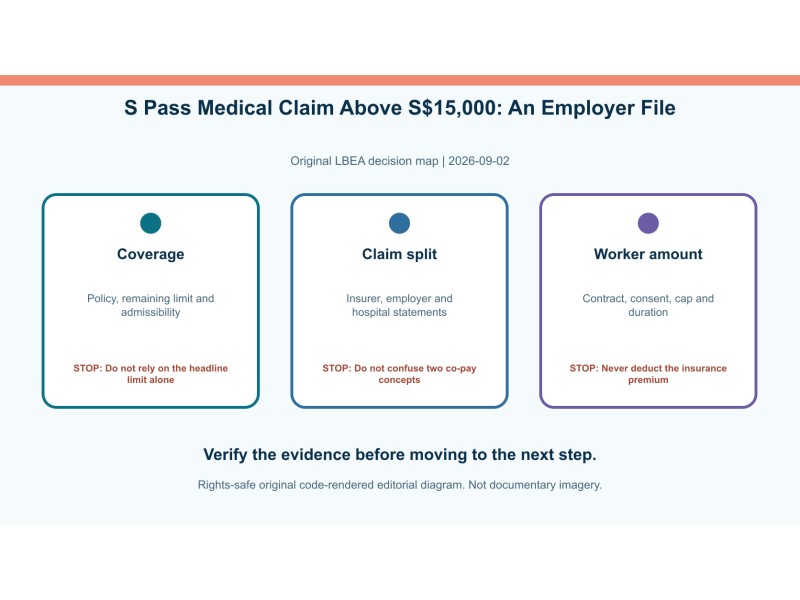
Answer first. For a large S Pass inpatient or day-surgery claim, verify the policy start date, S$60,000 annual limit, insurer-employer share above S$15,000, direct-payment process and any separately lawful worker co-pay.
Related reading: mandatory medical insurance budgeting and S Pass employer guide.
Open the policy before discussing cost
Confirm the insured worker, policy period, start or renewal date, annual limit, exclusions, sub-limits, deductible, insurer network and claim status. MOM requires at least S$60,000 annual coverage for inpatient care and day surgery, including conditions that may not be work-related. If the policy has sub-limits, each relevant sub-limit must meet the minimum annual claim limit. Do not quote the headline cover without checking whether prior claims have reduced the remaining amount.
Map the enhanced claim split
For the enhanced requirements, MOM describes the insurer paying 75 percent and employer paying 25 percent for claim amounts above S$15,000. Build a claim table showing admissible bill, exclusions, amount up to S$15,000, amount above it, insurer share, employer share and any disputed line. The table is an administrative aid, not a substitute for the policy wording or insurer’s adjudication. Reconcile it to the hospital and insurer statements.
Check the Stage 2 process
Policies, renewals or extensions starting from 1 July 2025 are subject to Stage 2 features including standardised allowable exclusions, age-differentiated premiums and direct payment by insurers to hospitals when a claim is admissible. Confirm whether the hospital has obtained the guarantee or direct-payment confirmation before asking the worker to fund a large deposit. Record any non-admissible amount and the reason separately.
Do not pass the premium to the worker
MOM says the employer must buy and maintain the insurance and cannot pass the insurance cost to the S Pass holder. Salary-deduction guidance also lists medical insurance among migrant-worker employment costs that may not be deducted. Keep premiums, employer claim share, non-insured patient costs and any lawful worker co-pay in separate ledger lines. A generic consent form does not turn the insurance premium into an employee expense.
Test any worker co-pay arrangement
MOM allows a co-pay arrangement for medical bills only if all stated conditions are satisfied: it is reasonable, no more than 10 percent of fixed monthly salary, lasts no more than six months for every two years of employment, and is expressly agreed in the contract or collective agreement with full consent. Verify each condition before payroll action. Do not confuse this worker co-pay with the insurer-employer allocation above S$15,000.
Worked scenario
An S Pass holder has an admissible S$35,000 hospital claim under a Stage 2 policy. HR obtains the insurer’s adjudication and direct-payment confirmation, then maps the first S$15,000 and the S$20,000 excess band under the policy. The employer separately reviews whether a signed worker co-pay clause meets every MOM condition. It does not deduct premiums or improvise a recovery because the hospital invoice arrived before the insurer statement.
Close the claim file
Retain the policy schedule, renewal date, hospital bill, insurer decision, direct-payment evidence, employer payment, contract clause, consent and any payroll entries. Give the worker a plain-language reconciliation without unnecessary medical details. Escalate denied or excluded items to the insurer and obtain advice before any salary deduction. This checklist does not decide policy coverage, employment-law liability, work-injury compensation or the reasonableness of a particular co-pay.
How to use this guide
Start with the reader, decision and evidence identified above. Write the next action and owner beside every unresolved point, then set a review date. Keep authority-issued records unchanged and preserve earlier versions when a correction is made. If a fact, document or deadline does not fit the matrix, pause instead of forcing it into the nearest category. Official guidance can change, and a checklist cannot decide disputed facts or replace advice on a specific case. The strongest file shows what was known, when it was known, which source controlled the step and why the chosen action followed. Record every unresolved assumption, identify who can verify it, and never treat silence or a pending application as approval.
Decision and evidence matrix
| Checkpoint | Evidence to verify | Stop condition |
|---|---|---|
| Coverage | Policy, remaining limit and admissibility | Do not rely on the headline limit alone |
| Claim split | Insurer, employer and hospital statements | Do not confuse two co-pay concepts |
| Worker amount | Contract, consent, cap and duration | Never deduct the insurance premium |
Primary sources checked for this guide
Source status was checked on 2 September 2026. Reopen the controlling page before acting because procedures and legal status can change.
- Ministry of Manpower: S Pass medical insurance requirements, supporting S Pass medical insurance requires at least S$60,000 annual cover; enhanced terms allocate claims above S$15,000 and require direct hospital payment for admissible claims from Stage 2.
- Ministry of Manpower: Allowable salary deductions, supporting Employers may not deduct medical insurance costs from migrant-worker salary, and other deductions must meet the stated authorised grounds and safeguards.
Authority and relationship disclosure. Little Big Employment Agency Pte. Ltd. is not affiliated with or endorsed by MOM, ICA, ACRA, MAS or IRAS. Contacting LBEA does not create a solicitor-client relationship.
Real people. Right here in Singapore.