
Insights for work and life.
Resignation by Email or WhatsApp: An Employer Evidence Checklist
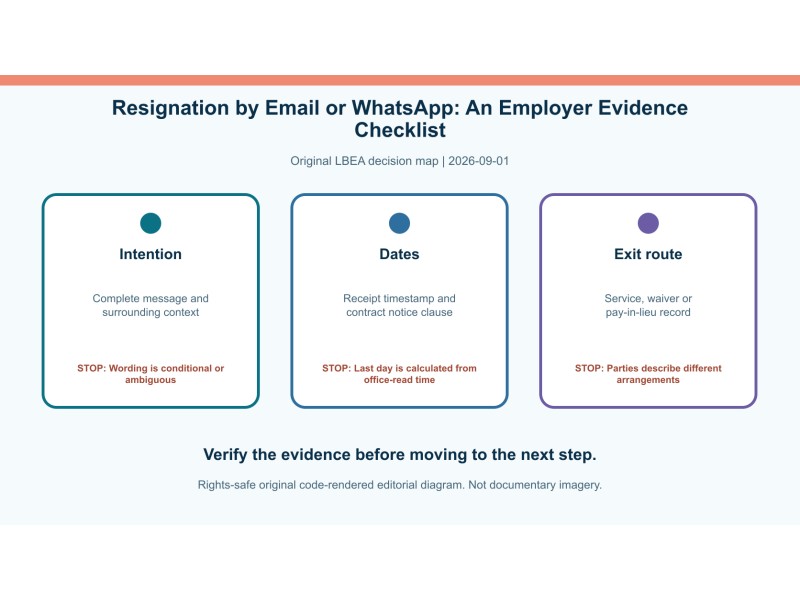
Answer first. A resignation notice must be in writing; when it arrives by email or message, the employer should acknowledge it, confirm dates and preserve the complete record.
Related reading: employment contract clauses and salary deduction guide.
Treat the message as potential notice
Do not reject a clear resignation merely because it was sent through an informal channel. MOM requires written notice and gives an email as an example. A messaging-app record can also raise a real written-notice issue, depending on its words, sender and context. Preserve the full thread, sender details, timestamp and attachments. Do not crop the message so tightly that surrounding ambiguity disappears.
Confirm intention without rewriting it
Read whether the employee actually communicates a final decision to resign or is only asking about consequences. A message saying I resign today is different from I may have to resign. If wording is unclear, ask a neutral question and avoid pressuring the employee to use an employer-drafted reason. Record any phone call in a factual follow-up email and invite corrections.
Acknowledge and calculate the notice period
Send a written acknowledgement that states the notice receipt date, contractual notice period and provisional last day. MOM says the day notice is given counts, and weekends, rest days and public holidays are included. Check the actual contract before calculating. If the contract has no notice term, MOM’s statutory scale depends on length of service. Do not substitute a calendar-month assumption for the wording agreed.
Separate service, pay in lieu and waiver
An employee may serve notice or pay salary in lieu, while both parties may agree in writing to waive notice. These are different routes. Record who proposed any early departure, what amount is payable and whether the parties agreed to waive all or part of notice. Do not describe the employer’s release from duties as automatic mutual waiver. Check leave, garden leave, access and handover terms separately.
Worked scenario
At 11:40 pm on Sunday, an employee sends a WhatsApp message stating that she resigns with one month’s notice. HR reads it Monday morning. The team preserves the timestamp and contract, acknowledges that the notice was given Sunday, calculates the provisional last day using the contractual wording, and asks the employee to confirm handover details. It does not change the receipt date to Monday merely because HR’s office was closed.
Protect final-pay and pass steps
Create a closure list for salary, approved expenses, deductions, leave, property return, confidentiality reminders and work-pass cancellation if applicable. Final salary timing depends on who terminated and whether notice was served, so reopen the controlling MOM guidance. Do not withhold earned salary as leverage for property or disputed compensation unless an authorised deduction rule applies. Keep payroll calculations tied to source documents.
Preserve a defensible file
Retain the original notice, metadata, acknowledgement, contract, calculation, waiver or pay-in-lieu agreement, handover record and final payslip. Limit access to those who need it. If the employee later disputes authenticity or alleges pressure, the complete chronology matters more than a neat HR-system label. This article provides issue spotting and process design, not a conclusion on a contested resignation.
How to use this guide
Start with the reader, decision and evidence identified above. Write the next action and owner beside every unresolved point, then set a review date. Keep authority-issued records unchanged and preserve earlier versions when a correction is made. If a fact, document or deadline does not fit the matrix, pause instead of forcing it into the nearest category. Official guidance can change, and a checklist cannot decide disputed facts or replace advice on a specific case. The strongest file shows what was known, when it was known, which source controlled the step and why the chosen action followed. Record every unresolved assumption, identify who can verify it, and never treat silence or a pending application as approval.
Decision and evidence matrix
| Checkpoint | Evidence to verify | Stop condition |
|---|---|---|
| Intention | Complete message and surrounding context | Wording is conditional or ambiguous |
| Dates | Receipt timestamp and contract notice clause | Last day is calculated from office-read time |
| Exit route | Service, waiver or pay-in-lieu record | Parties describe different arrangements |
Primary sources checked for this guide
Source status was checked on 1 September 2026. Reopen the controlling page before acting because procedures and legal status can change.
- Ministry of Manpower: Termination with notice, supporting Termination notice must be in writing, the day notice is given counts, and weekends, rest days and public holidays are included.
- Ministry of Manpower: Is a termination letter always required?, supporting Written notice should identify the termination date, last day and notice duration, and acknowledgement is good practice.
Real people. Right here in Singapore.