
Insights for work and life.
IHRP Certification Requirement from 1 July 2028: A Readiness Guide for Employers
Quick answer: The IHRP certification requirement means that from 1 July 2028, every organisation in Singapore with more than 200 employees must have at least one HR professional certified by the Institute for Human Resource Professionals (IHRP) at the IHRP Certified Professional (IHRP-CP) level or higher. In a written answer to Parliament on 3 November 2026, the Ministry of Manpower (MOM) said the requirement will be implemented administratively through its work pass framework, and that cases of persistent non-compliance can result in curtailment of access to foreign workers.
Key takeaways
- The start date is fixed. The requirement applies from 1 July 2028 to organisations with more than 200 employees.
- The bar is IHRP-CP or higher. An IHRP Certified Associate (IHRP-CA) does not meet it. IHRP-CP calls for at least three years of HR experience and 150 hours of HR training or an HR education qualification.
- Headcount is counted per UEN. MOM has said it will count all employees employed under a contract of service by each organisation under its Unique Entity Number.
- Enforcement runs through work passes. MOM has said it will match IHRP’s records against its own, place non-compliant companies on notice and give them reasonable time to comply. Persistent non-compliance can result in curtailment of access to foreign workers.
- Foreign HR credentials need a bridge. Holders of SHRM, AHRI and CIPD certifications will still need to complete a bridging assessment on Singapore’s employment legislation and practices.
- Funding is time-limited. At the time of writing, an extra S$100 subsidy for Singapore Citizens and Permanent Residents runs from 1 October 2026 to 30 June 2028, bringing the IHRP-CP fee down to S$163.50.
Contents
- What is the IHRP certification requirement?
- When does it start, and how much time do employers have?
- Which organisations does it cover?
- Who counts as a certified HR professional?
- What are the IHRP certification levels?
- What if our HR lead holds SHRM, CIPD or AHRI certification?
- How will MOM enforce the requirement?
- What does certification cost, and what support is there?
- What does the IHRP-CP assessment involve?
- Employer readiness checklist
- What about organisations with 200 or fewer employees?
- Frequently asked questions
What is the IHRP certification requirement?
A rule that larger employers must have at least one HR professional certified at IHRP-CP level or higher from 1 July 2028.
MOM set out the requirement in its written answer to Parliamentary Questions on the IHRP certification requirement on 3 November 2026. The answer states that from 1 July 2028, organisations with more than 200 employees will be required to have at least one HR professional who is certified by IHRP, at the IHRP-CP level or higher. MOM gave the purpose as helping to raise HR standards and enabling businesses and workers to better navigate workplace and technology shifts.
The requirement did not appear from nowhere. It was recommended by the Tripartite Workgroup on Human Capital Capability Development (TWG-HC), which released its report on 24 September 2026. In its press release on the TWG-HC recommendations, MOM said the Government accepts all five recommendations and that the requirement will help firms prepare for the roll-out of the Workplace Fairness Act and changes to the Employment Act. MOM’s IHRP certification page adds that the requirement builds on a 2020 recommendation by the NTUC-SNEF PME Taskforce.
When does it start, and how much time do employers have?
It starts on 1 July 2028. That leaves roughly 19 months from today, and the extra subsidy ends the day before.
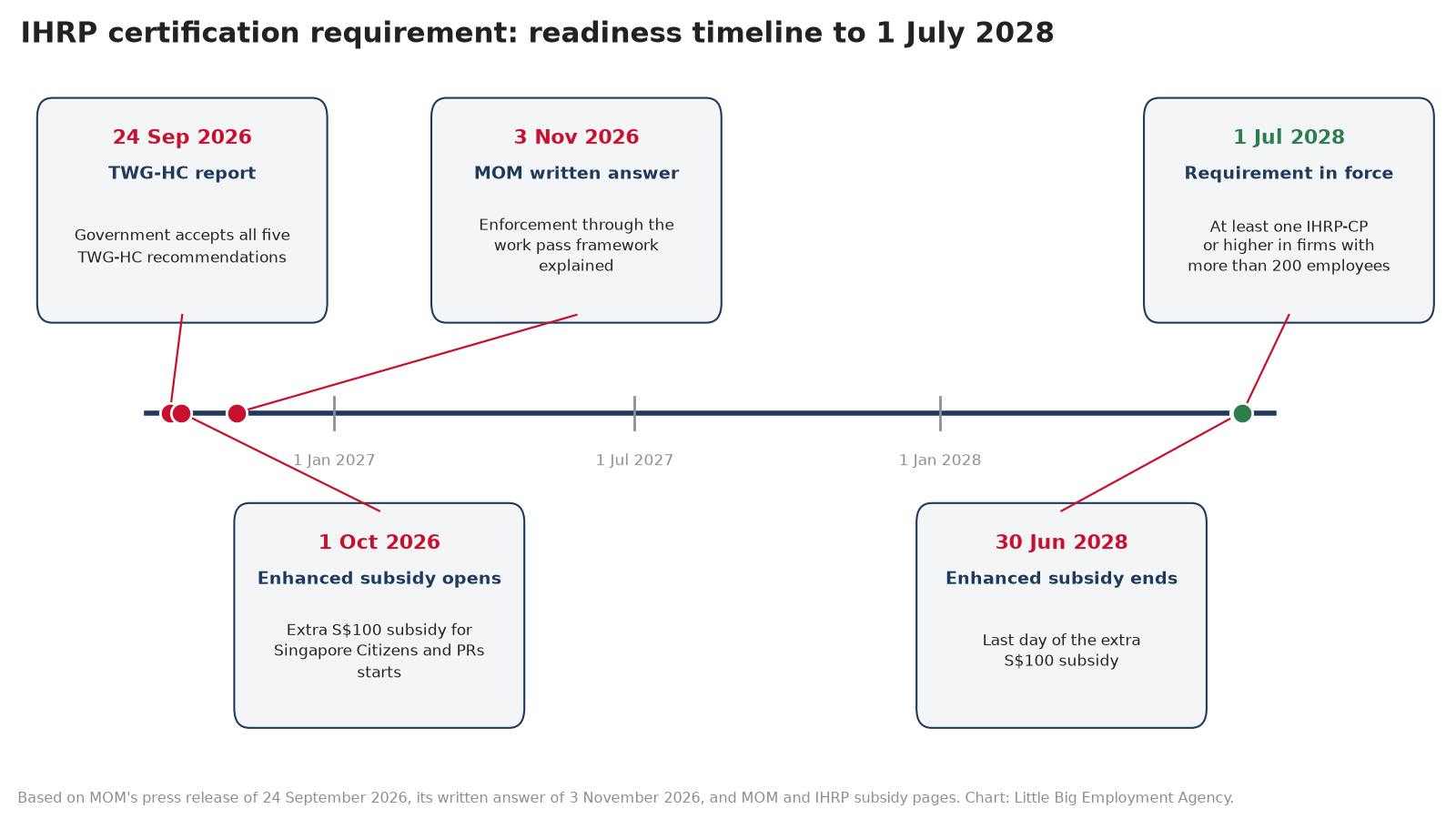
The chart above sets out the five dates. The two that employers control are the end of the subsidy window on 30 June 2028 and the start of the requirement on 1 July 2028.
Certification is not instant. A candidate has to apply, be accepted, sit the assessment on a scheduled date and pass. IHRP publishes its assessment dates by quarter, so an employer that leaves the decision until mid-2028 may find the timetable tight, especially if a candidate needs a second attempt. IHRP’s own figures suggest many larger organisations are not starting from zero: it says more than 9,000 HR professionals are certified and around 45% of larger organisations already have at least one certified HR professional.
Which organisations does it cover?
Every organisation with more than 200 employees, counted per UEN and including all employees under a contract of service.
In a separate written answer on the same day, MOM explained how the threshold will be computed. It will count the number of employees employed by each organisation under its Unique Entity Number (UEN), and this includes all employees employed under a contract of service.
- “More than 200” means 201 or more. An organisation with exactly 200 employees is not caught by the threshold.
- Each UEN is counted separately. MOM’s wording counts employees by each organisation under its own UEN. MOM did not discuss corporate groups as such, but on that wording each company in a group appears to be assessed on its own headcount, so a group with several entities above 200 employees should plan for each of them.
- Contract of service. The count covers all employees employed under a contract of service. The MP asked whether foreign, part-time and fixed-term employees count. MOM’s answer does not list or exclude any category, so employers should assume that everyone employed under a contract of service counts.
The Member of Parliament also asked how organisations whose headcount fluctuates around 200 will be treated. MOM’s published answer does not address that point directly. It says MOM will monitor compliance by matching records, that non-compliant companies will be placed on notice and that companies will be given reasonable time to comply. An organisation that hovers near the line would be prudent to plan as if it is covered.
Who counts as a certified HR professional?
An HR professional certified at IHRP-CP or IHRP-SP level, chosen by the organisation and able to contribute meaningfully to its employment practices.
MOM’s IHRP page says an organisation with more than 200 employees needs at least one suitable HR professional who either is certified as IHRP-CP or higher, or holds an equivalent or higher accreditation that is cross-recognised by IHRP with bridging requirements. Beyond that, MOM has left the choice to employers.
- The employer picks the person. MOM says organisations may decide which HR professional should be certified, based on their own needs and HR structure, and that it will not prescribe the person’s seniority, job title or specific responsibilities.
- The person should have real influence. In the 3 November 2026 answer, MOM said that, in keeping with the spirit of the requirement, the certified professionals should be in a position to make meaningful contributions to their organisations’ employment practices and decisions.
- Employment arrangement. Asked whether an outsourced or part-time certified HR professional would satisfy the requirement, MOM said it has no plans to make additional specifications on the employment modality of the certified professionals at this point, but will review this as needed.
The safest reading for an employer is to certify someone who actually shapes hiring, pay, performance and grievance decisions, rather than someone whose role is purely administrative.
What are the IHRP certification levels?
There are three tiers. Only the top two, IHRP-CP and IHRP-SP, satisfy the requirement.
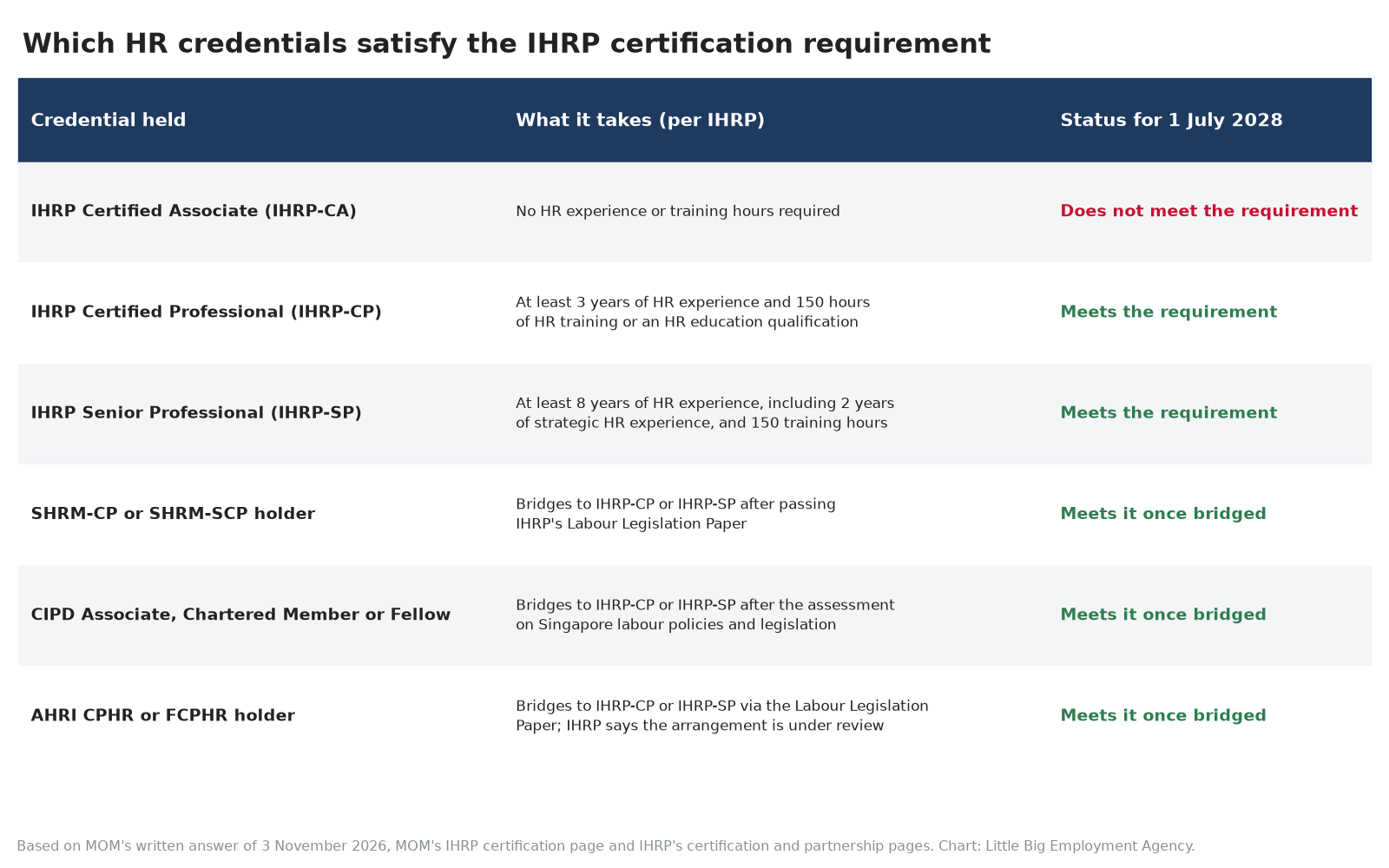
The three tiers published by IHRP are:
- IHRP Certified Associate (IHRP-CA). For new HR professionals and career switchers with under three years of experience. No HR experience or training hours are required. It does not meet the requirement.
- IHRP Certified Professional (IHRP-CP). For HR professionals with at least three years of total relevant HR experience at the CP level, plus 150 hours of HR-related training or an HR education qualification. This is the minimum level for the requirement.
- IHRP Senior Professional (IHRP-SP). For HR professionals with at least eight years of HR-related experience, including at least two years of recent and consistent strategic experience, plus 150 training hours or an HR education qualification. It also meets the requirement.
MOM has said alternative pathways that could broaden the pool of qualifying HR professionals will be explored. IHRP already lists one route to IHRP-SP, through HCLI’s HR Leaders Programme plus an alternative HR assessment and the Labour Legislation assessment. IHRP notes that the years of experience are minimums and that the scope of a candidate’s experience is also considered when an application is reviewed. An employer whose HR lead holds IHRP-CA can plan an upgrade to IHRP-CP once the person meets the experience and training thresholds.
What if our HR lead holds SHRM, CIPD or AHRI certification?
The person will still need to pass a bridging assessment on Singapore’s employment legislation and practices.
MOM’s 3 November 2026 answer states that IHRP has mutual recognition arrangements with certain overseas HR professional bodies, including the Society for Human Resource Management (SHRM) in the United States, the Australian Human Resources Institute (AHRI) and the Chartered Institute of Personnel and Development (CIPD) in the United Kingdom. It then says that HR professionals holding such recognised foreign certifications will still need to complete a bridging assessment on Singapore’s employment legislation and practices in order to be recognised under the requirement.
MOM’s IHRP page explains the mechanics: these arrangements qualify applicants for a waiver from the HR Assessment paper, but applicants must still complete the Labour Legislation paper to attain IHRP certification. IHRP’s partnership pages map each credential as follows.
- SHRM. SHRM-CP bridges to IHRP-CP (three years of HR-related experience at CP level) and SHRM-SCP bridges to IHRP-SP (eight years at SP level). The application requirement is the Labour Legislation Paper, and IHRP says applicants must hold a current and valid SHRM certification and professional membership.
- CIPD. Associate Member maps to IHRP-CP, Chartered Member to IHRP-CP or IHRP-SP, and Chartered Fellow to IHRP-SP. IHRP lists the experience thresholds, an assessment on Singapore’s labour policies and legislation, and a minimum of 150 hours of HR-related training or education.
- AHRI. Certified Practitioner HR (CPHR) bridges to IHRP-CP and Fellow (FCPHR) to IHRP-SP through the Labour Legislation Paper. IHRP states that it and AHRI are currently reviewing and refreshing the arrangement, with updates to follow.
Candidates must also meet IHRP’s eligibility requirements for the corresponding level, so an HR director with a strong overseas credential should not be assumed to count until the bridge is complete. AHRI holders should check the current position with IHRP before applying.
How will MOM enforce the requirement?
Through the work pass framework: MOM has said it will match records, place non-compliant companies on notice, allow reasonable time and, for persistent non-compliance, curtail access to foreign workers.
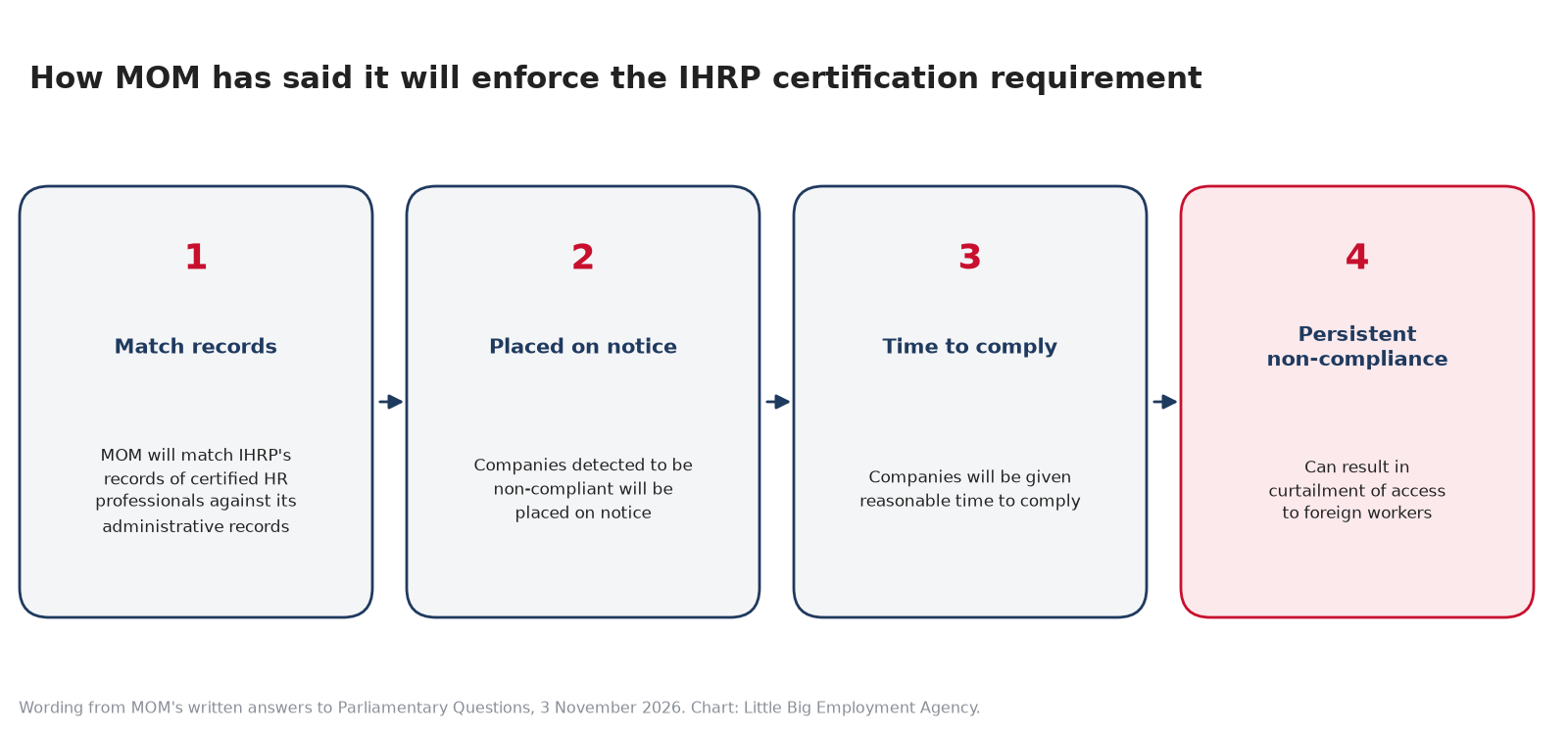
The Member of Parliament asked about the legal basis, monitoring and consequences, including financial penalties. MOM’s reply, in summary:
- The requirement will be implemented administratively through MOM’s work pass framework.
- MOM will monitor compliance by matching IHRP’s records of certified HR professionals against MOM’s administrative records.
- Companies which are detected to be non-compliant will be placed on notice.
- Companies will be given reasonable time to comply.
- Cases of persistent non-compliance can result in curtailment of access to foreign workers.
Two points are worth drawing out. First, MOM describes the requirement as administrative, implemented through its work pass framework, and its answer does not mention a fine or a new offence. The consequence MOM has named is curtailment of access to foreign workers, which could affect an employer’s Employment Pass, S Pass and Work Permit applications. MOM has not published detail of what curtailment will involve, so employers should not assume any particular form.
Second, because MOM will be matching records, the certified HR professional needs to be visible in both systems. In practice, that means keeping the person’s certification current with IHRP and making sure the organisation’s records with MOM are accurate. MOM was also asked about grace periods when a certified professional leaves. Its published answer speaks of reasonable time to comply but does not set a specific grace period, which is a good reason to have more than one certified person where the budget allows.
What does certification cost, and what support is there?
For Singapore Citizens and Permanent Residents, S$163.50 for IHRP-CP and S$272.50 for IHRP-SP with the enhanced subsidy, until 30 June 2028.
MOM says the Government already provides significant subsidies for Singapore Citizens and Permanent Residents to take up IHRP certification. On top of those, it will provide an additional S$100 subsidy from 1 October 2026 until 30 June 2028, which MOM says brings the certification fee down to S$163.50 for IHRP-CP and S$272.50 for IHRP-SP. MOM says these certifications are valid for three years.
At the time of writing, IHRP’s fee tables, which include GST, show the following for working professionals.
- IHRP-CP. Singapore Citizens and Permanent Residents pay S$272.50 with the existing government subsidies and S$163.50 with the enhanced subsidy. Other applicants pay S$654.00, and the enhanced subsidy does not apply.
- IHRP-SP. Singapore Citizens and Permanent Residents pay S$381.50, or S$272.50 with the enhanced subsidy. Other applicants pay S$991.90.
- Extras. An on-site assessment adds S$43.60. A reassessment costs S$163.50.
According to IHRP’s enhanced subsidy page, the extra S$100 is a one-time flat-rate subsidy for first-time new, upgrade and bridging applications, and it is applied automatically when the application is submitted. A lapsed certification that is applied for again counts as a recertification and does not qualify. The subsidy does not apply to recertification, reassessment, rescheduling or on-site fees. Employers cannot apply on their staff’s behalf: each HR professional applies directly, although an employer can be invoiced for the balance. Fees and subsidy terms may change, so check IHRP’s pages before you budget.
Other support named by MOM and IHRP:
- SkillsFuture Enterprise Credit. MOM says organisations will be allowed to use their SkillsFuture Enterprise Credit to offset remaining out-of-pocket fees for their HR professionals, with implementation details to be announced.
- SkillsFuture Credit. IHRP says Singaporeans can use SkillsFuture Credit for IHRP certifications, recertification fees and upgrades.
- Preparation resources. MOM points to SNEF’s IHRP Assessment Tutorial programmes, sample questions and guides on IHRP’s LearnWorld platform, and IHRP’s monthly preparatory tutorials for IHRP-CP and IHRP-SP candidates.
The enhanced subsidy is limited to Singapore Citizens and Permanent Residents. An employer whose HR lead is not a Singapore Citizen or Permanent Resident should budget for the unsubsidised fee shown above.
What does the IHRP-CP assessment involve?
IHRP lists two papers for IHRP-CP: a 90-minute open-book Labour Legislation Paper and a 120-minute closed-book HR paper.
According to IHRP’s IHRP-CP page:
- Labour Legislation Paper (LLP2). 90 minutes, 30 multiple-choice questions, open book. It covers the Employment Act, the Employment of Foreign Manpower Act, the Work Pass Regulations, the Tripartite Guidelines on Fair Employment Practices (including the Fair Consideration Framework), the CPF, the Industrial Relations Act, the Retirement and Re-employment Act, the Work Injury Compensation Act and the Tripartite Alliance for Dispute Management. Questions are application-based situational judgement tests, so memorising legislation is not necessary.
- HR Paper Level 2 (HRL2). 120 minutes, 30 multiple-choice questions based on six scenarios, closed book, focused on foundational and functional competencies, mindsets and behaviours.
IHRP says assessments are scheduled on weekdays between 9am and 6pm, with remote candidates logging in at 9am or 2pm. Rescheduling is free up to 30 calendar days before the assessment date, is not allowed within five days of it, and costs S$109 in between. A no-show forfeits the assessment fees.
The syllabus overlaps with compliance work larger employers already handle, from the Fair Consideration Framework to accurate work pass declarations, which our guide to false declarations in work pass applications covers.
Employer readiness checklist
Use this list now, and review it every six months until 1 July 2028.
- Count your employees per UEN. List every entity in your group and its headcount of employees under a contract of service. Flag any entity above 200, or close to it.
- Map your current HR credentials. For each covered entity, record who in HR holds IHRP-CA, IHRP-CP, IHRP-SP, or a SHRM, CIPD or AHRI certification, and when each IHRP certification expires.
- Choose your certified professional. Pick someone in a position to make meaningful contributions to employment practices and decisions, as MOM has put it.
- Check eligibility early. Confirm the person meets the IHRP-CP experience and training thresholds. If not, plan an upgrade path from IHRP-CA or build the training hours.
- Start bridging for foreign credentials. If your HR lead holds SHRM, CIPD or AHRI certification, plan the Labour Legislation Paper now. AHRI holders should check the current status of that arrangement with IHRP.
- Use the subsidy window. At the time of writing, eligible Singapore Citizens and Permanent Residents get the extra S$100 only on applications made by 30 June 2028. Each HR professional applies directly, so tell your candidates early.
- Build in a buffer. Book an assessment date well before mid-2028 so there is time for a reassessment if needed.
- Plan for departures. MOM has not set a specific grace period for replacing a certified professional who leaves. Consider certifying a second person in each covered entity.
- Track recertification. Certifications are valid for three years, so diarise renewal dates for every certified professional.
- Keep both sets of records in order. MOM will match IHRP’s records of certified HR professionals against its own administrative records, so keep each certification current with IHRP and your employee records with MOM accurate. Explain to your leadership that persistent non-compliance can result in curtailment of access to foreign workers.
Our Workplace Fairness Act compliance checklist covers the related obligations MOM links to this requirement.
What about organisations with 200 or fewer employees?
They are not required to comply, but MOM is encouraging them to certify HR staff too.
MOM’s 24 September 2026 release said the Government will support all organisations, including those with 200 or fewer employees, to get their HR professionals certified, and the enhanced subsidy is open to them. The same release describes a pilot by IHRP and the start-up co:grow that matches participating SMEs with experienced HR leaders on a part-time, embedded basis, for SMEs without dedicated strategic HR expertise in-house.
A smaller firm that expects to grow past 200 employees by mid-2028 should treat the requirement as if it already applies, since its headcount on MOM’s records will decide when it is covered.
Need help with work passes while you prepare?
Little Big Employment Agency Pte Ltd is an employment agency licensed by the Ministry of Manpower (EA Licence 19C9790), supporting employers with work passes and employment matters. We prepare and submit Employment Pass and S Pass applications, check salary, occupation and supporting documents against MOM’s rules before filing, and offer work pass administration support for employers who want a second pair of eyes on renewals and records. Our published fee for a new EP or S Pass is S$1,400, which includes the fees payable to MOM and one appeal if the application is rejected. Disbursements such as translation or certification are extra, and we confirm the scope and total before you proceed. IHRP certification itself is applied for directly with IHRP. Contact us to discuss your hiring plans.
Frequently asked questions
What is the IHRP certification requirement?
From 1 July 2028, organisations in Singapore with more than 200 employees must have at least one HR professional certified by the Institute for Human Resource Professionals (IHRP) at the IHRP Certified Professional (IHRP-CP) level or higher. MOM will implement it administratively through its work pass framework.
How does MOM count the 200-employee threshold?
MOM has said it will count the employees employed by each organisation under its Unique Entity Number (UEN), including all employees employed under a contract of service. On that wording, each company in a group appears to be assessed on its own headcount.
What happens if a company does not comply?
MOM has said it will match IHRP’s records of certified HR professionals against its own administrative records. Companies detected to be non-compliant will be placed on notice and given reasonable time to comply. Cases of persistent non-compliance can result in curtailment of access to foreign workers.
Does an IHRP Certified Associate (IHRP-CA) meet the requirement?
No. The requirement is for an HR professional certified at IHRP-CP level or higher, so the HR professional needs IHRP-CP or IHRP Senior Professional (IHRP-SP) certification.
Our HR manager holds SHRM, CIPD or AHRI certification. Is that enough?
Not on its own. MOM has said HR professionals holding these recognised foreign certifications will still need to complete a bridging assessment on Singapore’s employment legislation and practices. IHRP’s bridging pathways use its Labour Legislation Paper for this.
Can the certified HR professional be part-time or outsourced?
MOM has said it has no plans at this point to make additional specifications on the employment modality of the certified professional, but will review this as needed. It has also said the certified professional should be in a position to make meaningful contributions to the organisation’s employment practices and decisions.
How much does IHRP-CP certification cost?
At the time of writing, for Singapore Citizens and Permanent Residents, MOM says an additional S$100 subsidy from 1 October 2026 to 30 June 2028 brings the IHRP-CP certification fee down to S$163.50, and IHRP-SP to S$272.50. MOM says these certifications are valid for three years.
Last updated 27 November 2026. This guide is general information based on MOM’s and IHRP’s published materials and is not legal advice. Fees, subsidies and other details are as published at the time of writing and may be updated by MOM or IHRP before 1 July 2028.
Real people. Right here in Singapore.