
Insights for work and life.
False Declarations in Work Pass Applications: Penalties, Recent MOM Cases and an Employer Checklist
Quick answer: A false declaration in a work pass application is any statement or information given to the Ministry of Manpower (MOM) that the person knows, or ought reasonably to know, is false or misleading in a material particular. Under section 22(1)(d) of the Employment of Foreign Manpower Act 1990 (EFMA), it carries a fine of up to S$20,000, jail of up to two years, or both, for each charge. MOM has also said it will bar entities and individuals convicted of such offences from employing foreign workers.
Key takeaways
- The test is knowledge, not intent to cheat. The offence covers information the person knows, or ought reasonably to know, is false or misleading. Carelessness about the facts is not a safe defence.
- Each false application can be a separate charge. Prosecutors can also combine several incidents into one amalgamated charge, for which the court may impose up to twice the usual maximum.
- Directors and managers are exposed personally. Where a company commits an EFMA offence with an officer’s consent, connivance or neglect, the officer is also guilty of the offence.
- Phantom workers count as false declarations. Paying CPF contributions to people who do not work for the company, to raise its foreign worker quota, is treated as a false declaration. People who lend their names for this can be charged with abetment.
- Salary and occupation must match reality. The fixed monthly salary excludes overtime, and the worker must do the job declared in the application.
- MOM is actively enforcing. Between 29 October and 19 November 2026, 20 individuals and one company were charged in cases MOM has announced, and on 2 November 2026 MOM said it was investigating around 45 companies involved in airport operations at Changi Airport. All of these cases are pending.
Contents
- What counts as a false declaration in a work pass application?
- What are the penalties under the EFMA?
- What has MOM announced in October and November 2026?
- What is a phantom-worker CPF scheme?
- Why does the declared salary matter so much?
- What if the worker does a different job from the one declared?
- How can the Training Employment Pass be misused?
- Can directors, managers and agents be held personally liable?
- Employer compliance checklist
- What should an employer do if it finds a problem in a past application?
- Frequently asked questions
What counts as a false declaration in a work pass application?
Any material statement to MOM that is untrue or misleading, made by someone who knows or ought reasonably to know it.
Section 22(1)(d) of the Employment of Foreign Manpower Act 1990 makes it an offence for any person, in connection with an application for or to renew a work pass, or for any other purpose under the Act, to make a statement or provide information to the Controller of Work Passes, an authorised officer or an employment inspector which the person knows, or ought reasonably to know, is false in any material particular. Information that is misleading because something material has been left out is caught too.
Three features of the wording matter in practice.
- It applies to “any person”. That includes the employer, its directors and staff, employment agents, the foreign employee and anyone else who supplies information to MOM.
- It is not limited to the application form. The same section covers renewals and statements made to employment inspectors during an investigation. One of the people charged on 19 November 2026 faces a charge for allegedly giving a false statement to an MOM employment inspector.
- Omissions count. Leaving out a material fact so that the overall picture is misleading falls within the offence.
The declarations at issue in MOM’s recent cases are the worker’s salary, the worker’s occupation and duties, the employer’s local workforce (which drives quota) and, for the Training Employment Pass, the purpose of the pass. The Act also has a specific offence for foreign employees who give false information about their qualifications. MOM’s 19 November 2026 release put it plainly: all employers and employment agencies are required to make accurate, complete and truthful declarations to the Controller of Work Passes.
What are the penalties under the EFMA?
Up to S$20,000, up to two years’ jail, or both, for each charge, plus a bar on hiring foreign workers after conviction.
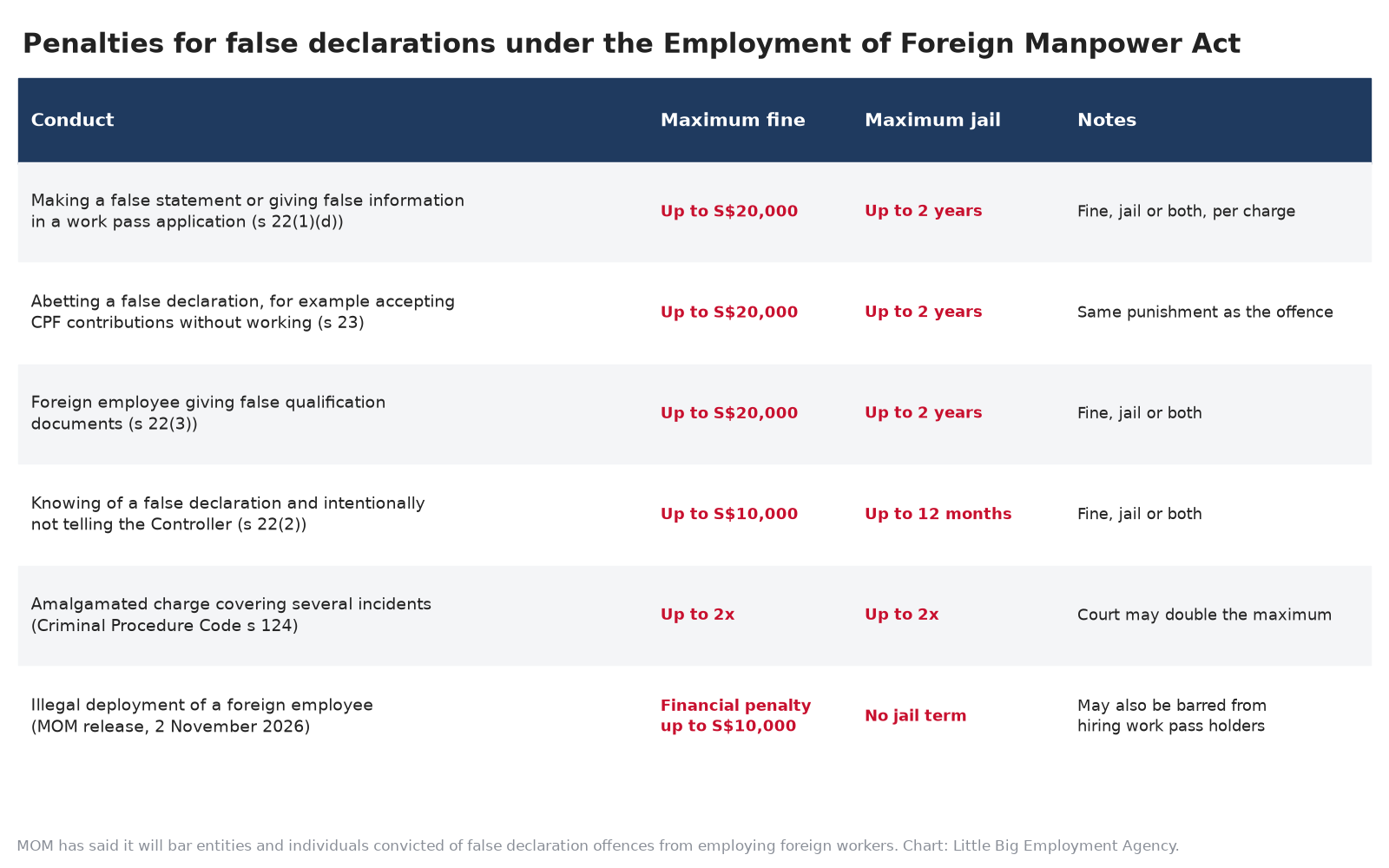
These limits are set by the Act itself. Section 22 does not set a higher maximum for a second or subsequent false declaration conviction. The Act also gives the Controller of Work Passes power to impose financial penalties without a prosecution. Under section 25, an employer whose act or omission inflates its foreign worker entitlement, which expressly includes CPF records that do not reflect only its genuine local employees, can face a financial penalty of up to S$20,000. An employer that gives inaccurate or erroneous information inadvertently, or without intent to mislead or defraud, can also face a financial penalty of up to S$20,000.
The amalgamated charge explains why some figures in MOM’s charge sheets look higher than S$20,000. In its 19 November 2026 annex, MOM listed a maximum fine of S$40,000 for the company’s single amalgamated charge covering 20 instances, and a maximum of S$40,000, four years’ jail, or both, for amalgamated charges against one individual.
The administrative consequences can hurt a business as much as the fine. MOM’s 17 November 2026 release states that it will bar entities or individuals convicted of false declaration offences from employing foreign workers. For a business that relies on Work Permit, S Pass or Employment Pass holders, a hiring bar can affect renewals as well as new hires.
What has MOM announced in October and November 2026?
Four separate enforcement actions in under four weeks, covering phantom workers, airport deployment, inflated salaries and Training Employment Passes.
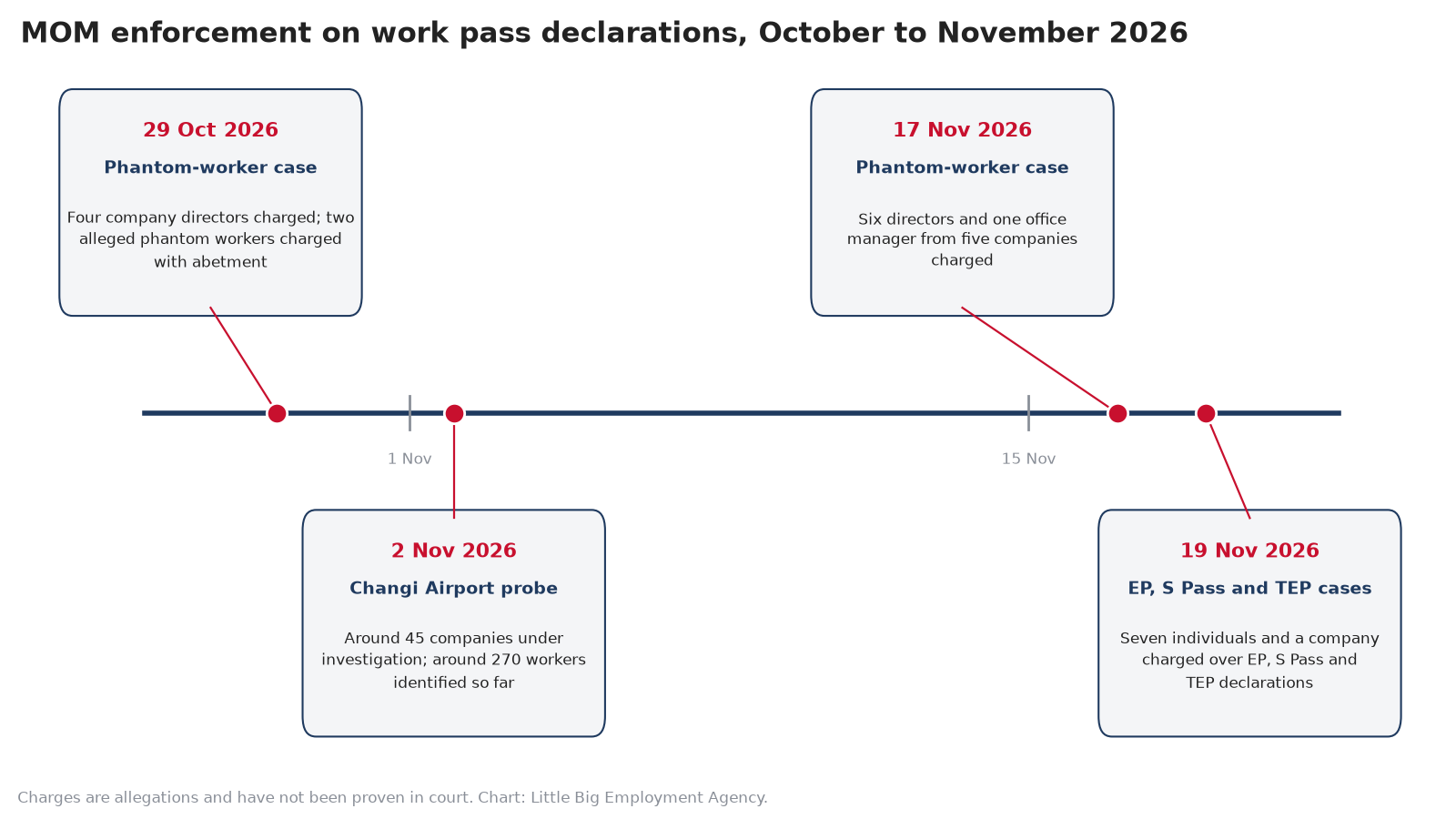
All of the cases below are pending. The charges are allegations and none of the people or companies involved has been convicted. We set out what MOM has announced only to show the type of conduct MOM is investigating.
2 November 2026: around 45 companies in airport operations under investigation
MOM announced that it is investigating around 45 companies involved in airport operations at Changi Airport for suspected offences under the EFMA, including false declarations and illegal deployment. During an inspection, MOM found EP holders deployed to perform baggage handling. MOM said preliminary investigations suggest that the salaries and occupations declared for these EP holders were false. Other work pass holders were also found doing baggage handling work that differed from their declared occupations. MOM said around 270 workers had been identified so far, employed by contractors and sub-contractors. It has directed the main contracting company to strengthen its oversight of the companies it contracts and has issued an advisory to other companies in the operation. Investigations are ongoing.
17 November 2026: MOM reports 13 individuals charged in phantom-worker cases
MOM reported charges against 13 individuals linked to construction companies. On 17 November 2026, six company directors and one office manager from five companies were charged with falsely declaring that CPF contributions were for local employees, when MOM alleges those people did not work for the companies. On 29 October 2026, four other company directors were charged with similar offences, and two individuals were charged with abetment because they allegedly received CPF contributions without being genuine employees. MOM added that it may impose financial penalties on 21 other alleged phantom workers linked to the two cases.
19 November 2026: seven individuals and a company charged
MOM said that seven individuals and a company were charged in court over three sets of alleged conduct:
- a company director charged with allegedly making false declarations about the occupations of four EP holders, who MOM says were supplied to another company and deployed to aircraft cleaning and baggage handling at Changi Airport, and with allegedly giving a false statement to an employment inspector;
- Re Sustainability Cleantech Pte Ltd, a cleaning and facilities management company, charged with making false salary declarations in the work pass applications of 20 foreign employees, having allegedly included overtime payments in the fixed monthly salaries it declared; and
- six individuals, one of whom MOM describes as an employment agent, charged with making false declarations in Training Employment Pass applications.
What is a phantom-worker CPF scheme?
It is an arrangement in which a company pays CPF contributions to people who do not actually work for it, so that they appear as local employees and raise the company’s foreign worker quota.
Work Permit and S Pass quotas are set as a ratio of the company’s total workforce. In the services sector, for example, Work Permit and S Pass holders together cannot exceed 35% of the total workforce, and S Pass holders are capped at 10%. MOM’s quota rules use information from the company’s CPF account to count its local employees, averaged over the last three months.
The Local Qualifying Salary (LQS) then decides how much each local employee counts. A Singapore Citizen or Permanent Resident employed under a contract of service counts as one local worker if they earn at least S$1,800 a month, and as half a local worker if they earn from S$900 to below S$1,800. Our guide to the Local Qualifying Salary and quota explains the calculation in more detail.
Because every genuine local hire increases the quota, the system depends on CPF records reflecting real employment. Paying contributions to a relative, a friend or a paid name-lender who does no work inflates the local headcount and, with it, the number of foreign workers the company may hire. In the cases in which charges were brought on 29 October and 17 November 2026, MOM has charged company personnel with falsely declaring that such CPF contributions were for genuine local employees.
The risk does not stop at the company. MOM’s 17 November 2026 release warns members of the public not to accept CPF contributions from companies they are not working for, because doing so may amount to abetting false declaration offences. People who provide their personal particulars to enable such contributions may be prosecuted and face the same penalties. MOM’s Report an Infringement eService has a specific category for the use of locals as phantom workers.
Why does the declared salary matter so much?
Salary decides eligibility, so an overstated salary can turn an ineligible candidate into an apparently eligible one.
The EP and S Pass qualifying salaries, COMPASS salary points and the Training Employment Pass threshold are all based on the fixed monthly salary. MOM defines fixed monthly salary as the basic monthly salary plus fixed monthly allowances. It does not include:
- variable allowances;
- overtime payments, bonuses, commissions or annual wage supplements;
- board fees, stock options or dividends;
- in-kind payments and reimbursements;
- productivity incentive payments;
- employer contributions to any pension or provident fund; and
- gratuities on discharge, retrenchment or retirement.
MOM’s November 2026 releases point to two salary problems. The first is folding variable pay into the declared figure, for example by adding expected overtime to the basic salary so that the total clears a threshold. That is the conduct alleged in the 19 November 2026 charge against Re Sustainability Cleantech Pte Ltd. The second is declaring a salary the employer never intends to pay. In the Training Employment Pass cases announced the same day, MOM alleges that companies declared fixed monthly salaries of S$3,000 when the workers were paid S$1,300 a month.
The declared salary is also a continuing commitment. If a pass holder’s pay is later cut, or the employee is paid less than the amount on record, the information MOM holds is no longer accurate. Employers should check MOM’s current rules on updating salary details before making any change.
What if the worker does a different job from the one declared?
A mismatch between the declared occupation and the real job can be both a false declaration and an illegal deployment.
Each pass is approved on the basis of the employer, occupation and salary declared in the application. Declaring a manager or specialist role while intending to deploy the person to manual work is one of the patterns MOM described in its airport releases. In the 2 November 2026 release, MOM said EP holders had been found doing baggage handling and that preliminary investigations suggested their declared occupations and salaries were false.
Occupation also affects other parts of the assessment. Under COMPASS, for example, the Shortage Occupation List bonus depends on the declared occupation, so a wrong job title can change the score. MOM’s 2 November 2026 release notes that employers who illegally deploy a foreign employee may face a financial penalty of up to S$10,000 and may be barred from hiring work pass holders.
Supply arrangements need particular care. When a pass holder is sent to work at a client’s site, the employer should confirm that the work there is the job declared and that the arrangement fits the pass conditions. The 2 November 2026 release shows that MOM looks at the whole contracting chain, including the obligations of the company at the top.
How can the Training Employment Pass be misused?
By using it to bring in workers for ordinary jobs rather than genuine training.
MOM says the Training Employment Pass (TEP) is meant for eligible foreign students or foreign trainees who want to undergo training in Singapore, in professional, managerial, executive or specialist jobs. The main rules are:
- a foreign student’s attachment must be part of their course of study, and they must study at an acceptable institution or earn a fixed monthly salary of at least S$3,000;
- a trainee from the employer’s foreign office or subsidiary must earn a fixed monthly salary of at least S$3,000;
- the pass is valid for up to three months and cannot be renewed;
- a candidate who has held a TEP before is not eligible for another one for the same type of training; and
- MOM may reject applications from a company with a high number or proportion of TEP applications or holders compared with similar companies.
In the cases announced on 19 November 2026, MOM alleges that companies declared the workers were employed by overseas companies and sent to Singapore for training, when they had been recruited for cleaning, dishwashing and food packing in food and beverage and other service businesses. Each of those declarations, if false, would go to the purpose of the pass, the employment relationship and the salary. For a plain explanation of the scheme, see our guide What is a Training Employment Pass?
Can directors, managers and agents be held personally liable?
Yes. The EFMA reaches past the company to the people who run it and the people who help.
- Officers of a company (s 20). If a company commits an EFMA offence with the consent or connivance of an officer, or the offence is attributable to the officer’s neglect, the officer is also guilty. “Officer” includes directors, managers, secretaries and anyone purporting to act in such a role. Section 20(5) presumes, until the contrary is proved, that the offence is attributable to the neglect of an officer who is primarily responsible for the act or omission and who failed to exercise reasonable supervision.
- Abettors (s 23). Anyone who abets an EFMA offence faces the same punishment as for the offence itself. In the phantom-worker cases, MOM has charged two people with abetment on the basis that they allegedly received CPF contributions without working.
- Agents and employees who stay silent (s 22(2)). An employer, foreign employee or agent involved in the employment who knows, or has reason to believe, that a false declaration was made and intentionally omits to tell the Controller commits a separate offence.
The section 20(5) presumption is the practical point for directors. A director who signs off applications without checking the facts may find it hard to show that they exercised reasonable supervision.
Employer compliance checklist
Use this list before each new application and renewal, and again at least once a year across the whole workforce.
- Match the salary to the contract and payroll. The declared fixed monthly salary should equal basic pay plus fixed allowances on the employment contract and in payroll. Leave out overtime, bonuses, commissions and variable allowances.
- Pay what you declared, every month. Keep payslips and bank transfer records that show the declared salary was actually paid.
- Describe the real job. The occupation and duties in the application should be what the person will do day to day. Check again whenever the role changes.
- Check deployment at client sites. If staff work at a client’s premises, confirm in writing what they will do there and visit or audit periodically.
- Audit your CPF list against your actual staff. Every local employee on the CPF account should be a genuine employee under a contract of service, with attendance or work records to prove it. Remove anyone who is not.
- Do not accept offers to “top up” your local headcount. Any proposal to add names to the CPF account to raise quota is a phantom-worker arrangement.
- Use the Training Employment Pass only for training. Keep the training plan, the trainee’s link to the overseas office or institution, and evidence that the declared salary was paid.
- Verify qualifications. Check certificates with the issuing institution or a verification service before relying on them.
- Control who submits applications. Limit access to MOM’s online systems, keep a record of who prepared and approved each application, and require a second person to review salary, occupation and headcount figures.
- Brief your agent and check their work. If you use an employment agency, give it accurate information and review the final application before submission. Responsibility for the declarations stays with your company.
- Keep records together. Store the submitted application, contract, payslips, CPF records and job description for each pass holder so you can answer an employment inspector quickly and accurately.
- Answer inspectors truthfully. Statements to employment inspectors are covered by the same false information offence.
Our guide to MOM inspections after a tip-off covers what to expect if an inspector contacts your company.
What should an employer do if it finds a problem in a past application?
Act promptly, preserve the records and take legal advice before deciding how to approach MOM.
Section 22(2) of the EFMA makes it an offence for an employer, foreign employee or agent who knows, or has reason to believe, that a false declaration was made to intentionally omit to tell the Controller. Leaving a known problem on the record is therefore a risk in itself. Even a genuine mistake is not risk-free: under section 25(3), the Controller may impose a financial penalty of up to S$20,000 on an employer that provides inaccurate or erroneous information inadvertently or without intent to mislead or defraud. An employer that discovers a wrong salary, occupation or headcount figure should stop the inaccurate practice, keep all relevant documents, and get advice from a Singapore lawyer on correcting the record with MOM.
Need help keeping work pass applications accurate?
Little Big Employment Agency Pte Ltd is an employment agency licensed by the Ministry of Manpower (EA Licence 19C9790), supporting employers with work passes and employment matters. We prepare and submit Employment Pass and S Pass applications, check salary, occupation and supporting documents against MOM’s rules before filing, and offer work pass administration support for employers who want a second pair of eyes on renewals and records. Our published fee for a new EP or S Pass is S$1,400, which includes the fees payable to MOM and one appeal if the application is rejected. Disbursements such as translation or certification are extra, and we confirm the scope and total before you proceed. Contact us to discuss your hiring plans.
Frequently asked questions
What is the penalty for a false declaration in a work pass application?
A fine of up to S$20,000, jail of up to two years, or both, for each charge under section 22(1)(d) of the EFMA. MOM has also said it will bar entities and individuals convicted of such offences from employing foreign workers.
Can an employee be charged for receiving CPF contributions from a company they do not work for?
Yes. MOM warns that accepting CPF contributions from a company you do not work for may amount to abetting a false declaration, which carries the same penalties as the offence itself.
Does overtime count towards the fixed monthly salary declared to MOM?
No. MOM defines the fixed monthly salary as basic monthly salary plus fixed monthly allowances. Overtime, bonuses, commissions and variable allowances are excluded.
Are directors personally liable for false declarations made by their company?
They can be. Under section 20 of the EFMA, an officer is also guilty if the company’s offence was committed with their consent or connivance or is attributable to their neglect.
What is the Training Employment Pass meant for?
It is for foreign students or trainees from an overseas office or subsidiary to undergo practical training in Singapore. It lasts up to three months, cannot be renewed and, for trainees, requires a fixed monthly salary of at least S$3,000.
Is my company responsible if an employment agency submitted the false information?
The EFMA offence applies to any person who makes the false statement, so the agent can be liable. The employer’s own declarations remain its responsibility, and its officers may be liable if the offence involved their consent, connivance or neglect.
How do I report a suspected false declaration or phantom worker arrangement?
Use MOM’s Report an Infringement eService, which has a category for the use of locals as phantom workers. MOM says the information provided will be kept strictly confidential.
Last updated 26 November 2026. This guide is general information based on MOM’s published rules and announcements and is not legal advice. The cases described are pending and the charges are allegations.
Real people. Right here in Singapore.