
Insights for work and life.
The New SFO Exemption Does Not Replace 13O, 13U, GIP or a VCC: Singapore’s 2026 Wealth-Migration Stack
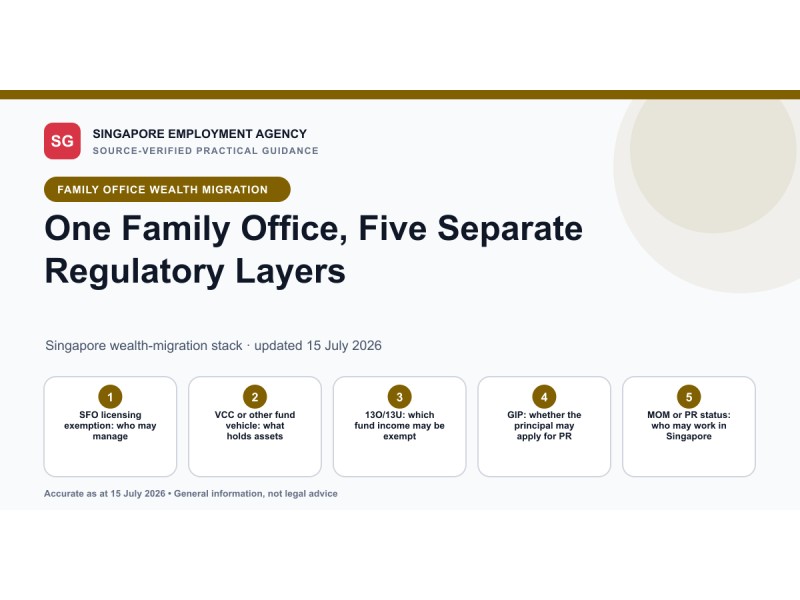
Legal status: Technical general guidance on current statutory and administrative frameworks. The new single-family-office licensing exemption took effect on 15 June 2026. Tax awards, GIP and immigration outcomes remain fact-specific. Information checked on 15 July 2026.
Answer first: Singapore does not offer one combined “family office visa”. A wealthy family may need to solve at least five separate questions: who may conduct fund management; which entity holds the investments; whether qualifying fund income receives a tax exemption; whether a principal qualifies for permanent residence or another immigration status; and who is authorised to work in Singapore. Each layer has separate eligibility, ownership, valuation, deployment, maintenance and evidence tests. Similar assets may be relevant to more than one file, but there is no automatic double-counting, cross-approval or permission to reuse one valuation.
This distinction became more important on 15 June 2026, when a dedicated, notification-based licensing exemption for qualifying single family offices (SFOs) took effect. Under MAS’s current public guidance, an SFO relying on the exemption must notify MAS, maintain the required bank accounts and file annual returns. That is a fund-management licensing framework. It is not a Section 13O or 13U tax award, a Global Investor Programme (GIP) approval, a Variable Capital Company (VCC) registration or permission for a foreign principal to work. MAS, licensing exemption for SFOs; MAS, revised SFO framework announcement.
Original value unit: the five-layer architecture map
| Layer | What it answers | What it does not answer |
|---|---|---|
| SFO licensing exemption | Whether a qualifying Singapore SFO may manage one family’s assets without a capital-markets-services licence for fund management, subject to the new exemption conditions, notification and reporting. | Tax exemption, PR, citizenship, work authorisation or fund-vehicle registration. |
| Section 13O / 13U | Whether specified income from designated investments of an approved fund can be exempt from Singapore income tax, subject to legislation and the MAS approval letter. | A personal tax exemption, a residence right, a fund-management licence or a company incorporation. |
| VCC | The legal investment-fund vehicle: single fund or umbrella with segregated sub-funds, flexible share issuance/redemption and corporate governance. | An automatic 13O/13U award or GIP eligibility. |
| GIP | A route under which an eligible global investor may apply for Singapore permanent residence through one of EDB’s investment options. | Automatic PR, an automatic Re-Entry Permit renewal, a fund tax exemption or a waiver of other regulatory conditions. |
| Work and operating status | Whether a principal or executive may personally work in Singapore, and which entity employs that person before any PR is formalised. | Determined neither by share ownership nor by simply registering an SFO or VCC. |
Layer 1: the new SFO licensing exemption
The exemption is not a general licence to serve third parties. Under S 373/2026, a Singapore-incorporated SFO may manage assets for one family and defined connected persons, including eligible entities and qualifying charitable organisations. A narrow key-employee class, chief executive and financial officers, executive directors and investment professionals, including specified recent former employees, may participate. However, not more than 10% in value of the SFO’s assets under management may originate from key employees. Separately, the total direct and indirect shareholding in the SFO of key employees who are not also family members must not exceed 10%.
This is a class exemption, not an approval application. The SFO must notify MAS no later than 14 days after starting business and file its annual return within four months after each financial year-end. At all times it must keep an employee ordinarily resident in Singapore as MAS’s designated contact. The SFO and its Singapore fund vehicles must maintain accounts with a MAS-licensed bank; a foreign fund vehicle may instead use a foreign bank in a jurisdiction that applies FATF-consistent standards. Existing SFOs using former routes have a transition ending 15 June 2027. MAS official FAQ, updated June 2026.
Layer 2: 13O and 13U are fund-income tax incentives
Section 13O applies to an approved Singapore-incorporated and resident company. Its regulations exempt specified income derived from funds managed in Singapore in respect of designated investments, subject to prescribed conditions and conditions in the MAS approval letter. Section 13U is the enhanced-tier framework for an approved person or approved fund structure and is likewise conditional. Singapore Statutes Online, Section 13O regulations; Income Tax Act 1947, section 13U.
For SFO-managed funds, do not rely on a generic fund-manager table: MAS says economic and qualifying-investment-professional conditions differ from licensed-FMC-managed funds. Its FAQ refers to S$20 million as the annual minimum for the relevant 13O award and says the exemption is unavailable for a basis period in which that condition is missed. S$20 million for 13O and S$50 million for 13U are planning benchmarks; the framework and award letter control. MAS, SFO scheme FAQs.
That last point prevents a costly category error: a family can have a VCC without a 13O/13U award, a 13O/13U fund without GIP PR, or GIP Option C without using the same legal vehicle for every tax purpose. Our existing 13O versus 13U comparison should be read together with the June 2026 SFO-licensing change, not as a substitute for the award terms.
Layer 3: a VCC is the container
A VCC is an investment-fund vehicle, not an ordinary operating company. It can be standalone or an umbrella with segregated sub-funds and flexible capital. It is a separate legal person; 13O/13U treatment requires separate approval. ACRA, VCC features.
Current VCC Act section 46 controls the manager test. The manager must be a holder of a capital markets services licence for fund management; an institution exempt under SFA section 99(1)(a)–(d); or a prescribed person or class. The former registered-fund-manager limb was deleted from 6 May 2026. VCC Act, section 46. The 15 June SFO class exemption is instead in SFR Second Schedule paragraph 5(1)(ba). Because section 46(2)(c) names only SFA section 99(1)(a)–(d), that SFO exemption does not on its face itself establish permissible-VCC-manager eligibility. Confirm the exact section 46 limb before using a VCC. ACRA’s 29 January 2026 guidance predates the amendment and is not relied on for manager eligibility. For statutory commentary, see Variable Capital Companies Act, an associated friendly site; it is not official.
Layer 4: GIP is the PR route
EDB’s current factsheet says the GIP accords PR status to eligible global investors with a substantial track record; approval is discretionary and due diligence applies. Option A requires at least S$10 million in a new Singapore business or expansion of an existing operation. Option B requires S$25 million in a GIP-select fund. Option C requires a Singapore-based SFO with at least S$200 million AUM, with at least S$50 million transferred into Singapore and deployed in specified investments. EDB GIP Factsheet, updated 5 May 2025.
Option C also requires the listed applicant profile: at least five years of entrepreneurial, investment or management track record and S$200 million of net investible assets. EDB estimates about 12 months to process a complete application, subject to due diligence, and states a S$20,000 application fee from 5 May 2025. GIP approval and Re-Entry Permit renewal are not guaranteed. See our GIP applicant guide.
Layer 5: who may actually work?
ACRA’s VCC guidance says that a foreigner who plans to move to Singapore to run the VCC must seek MOM approval. The same separation applies to an SFO operating company. A pending GIP application is not PR, and ownership of the entities is not work authorisation. Before a principal’s PR is formalised, identify which company employs the person, which pass is relied on, what duties will be performed and when those duties can lawfully begin. ACRA, foreigner requirements for a VCC.
Original value unit: the dependency and failure register
| Dependency | Failure signal | Board control |
|---|---|---|
| SFO exemption | The office treats notification as prior approval, misses the 14-day post-start deadline or overlooks scope, bank, contact or reporting conditions. | Fix the actual commencement date, file by day 14 and maintain a conditions-and-evidence register. |
| 13O/13U | AUM, designated investments, staffing or spending is tracked only at application. | Create a quarterly covenant dashboard tied to the actual award letter. |
| VCC | The group assumes an umbrella automatically ring-fences operational-company liabilities. | Keep operating businesses outside the fund and test every contract against the correct sub-fund. |
| GIP | The family models investment but not the applicant profile, job creation, deployment timing or REP renewal conditions. | Maintain a separate EDB evidence room and five-year implementation plan. |
| Immigration/work | The principal begins directing Singapore employees while describing the move as merely preparatory. | Adopt a written pre-authorisation activity protocol and appoint lawful interim decision-makers. |
Start with an architecture memo identifying beneficial owners, asset sources, mandate, residence goal, working principals and tax jurisdictions. Assign each layer to its regulator and adviser, then maintain five distinct compliance files.
Primary sources
- MAS , Revised framework for SFOs (12 June 2026; effective 15 June 2026).
- MAS , Licensing exemption FAQ for SFOs (updated June 2026).
- Singapore Statutes Online , S 373/2026 (published 12 June 2026; commenced 15 June 2026).
- Singapore Statutes Online , Section 13O regulations (current version checked 15 July 2026).
- Singapore Statutes Online , Income Tax Act, section 13U (current version checked 15 July 2026).
- Singapore Statutes Online , VCC Act, section 46 (current manager categories from 6 May 2026).
- ACRA , VCC features (29 January 2026; not relied on for manager eligibility).
- EDB , GIP Factsheet (updated 5 May 2025).
Real people. Right here in Singapore.