
Insights for work and life.
Singapore Construction Sector Work Permits 2026: Dependency Ratio, Levy and the MOM Safety Framework
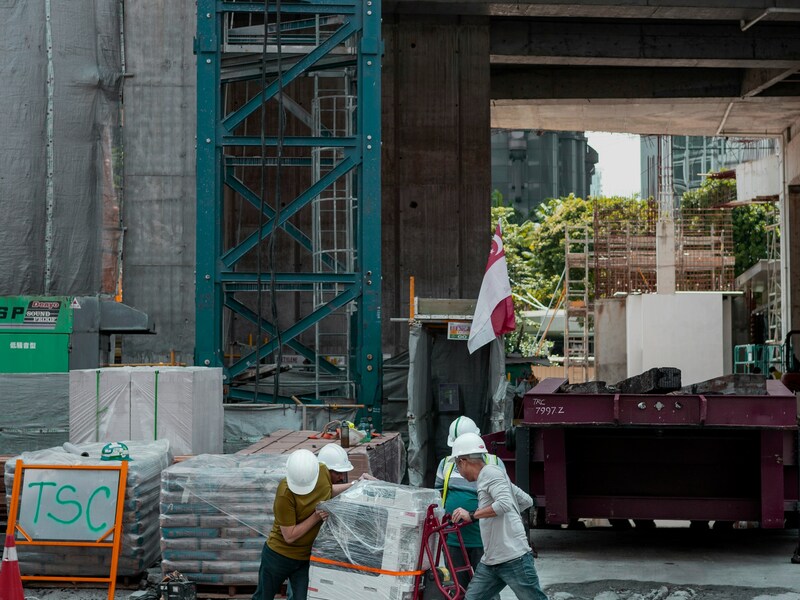
Singapore’s construction sector is one of the most foreign-worker-intensive in the economy, and also one of the most tightly regulated. Contractors who fail to stay current with MOM’s Singapore construction sector work permit 2026 rules face quota breaches, levy penalties, and , in serious cases , suspension of work pass privileges. This guide sets out the key compliance requirements for 2026: how the dependency ratio ceiling works, what the levy structure looks like, how Man-Year Entitlement operates, what the 2026 NTS source expansion added to your hiring pool, and what MOM’s safety framework demands of employers in the sector.
Who Qualifies for a Work Permit in Construction?
Construction Work Permits (WP) are issued by MOM to semi-skilled or unskilled foreign workers from approved source countries hired to perform construction-related work in Singapore. The occupations covered include general construction workers, concrete workers, shuttering carpenters, rod benders, scaffolders, tilers, painters, glaziers and related trades. Higher-skilled roles , such as specialist technicians or engineers , are generally covered by the Employment Pass or S Pass rather than the Work Permit.
Approved source countries for construction WP as at August 2026 include the traditional Non-Traditional Sources (NTS): Bangladesh, Myanmar, India, Sri Lanka, Thailand, the Philippines, and , following the September 2026 NTS Occupation List expansion , Bhutan, Cambodia and Laos. Malaysia is a separate Traditional Source with no levy applicable to Malaysian WP holders (though this is a diminishing category in construction as Malaysian workers increasingly take up higher-skill roles). Workers from China may be employed in the construction sector under specific conditions and are classified separately.
Dependency Ratio Ceiling: How Many Foreign Workers Can You Hire?
The Dependency Ratio Ceiling (DRC) determines how many Work Permit holders a construction company may employ relative to its local workforce. Per MOM, the construction sector operates under one of the most generous DRCs in Singapore’s economy, reflecting the sector’s structural reliance on foreign manpower and the relative scarcity of local construction workers.
The DRC is calculated against the company’s full-time local employees , Singapore Citizens and PRs who earn at least the Local Qualifying Salary (LQS). From 1 July 2026, the LQS increased from SGD 1,600 to SGD 1,800 per month. This means that a local construction company worker earning below SGD 1,800 per month no longer counts towards the quota headcount, which effectively reduces the number of WP holders you are entitled to hire unless you adjust local salaries accordingly. Every contractor should rerun their quota calculation against the new LQS to avoid an inadvertent quota breach.
Separately, the S Pass sub-quota for the construction sector is capped at 15% of total workforce. S Pass holders are mid-skill workers (minimum qualifying salary: SGD 3,600 per month from 1 July 2026 for most sectors) and are more common in supervisory, technical and skilled-trade roles in construction than in basic labouring tasks covered by WP.
For the broader HR compliance calendar , including when to audit quotas, file IR21 and renew passes , the Singapore HR Manager’s MOM Compliance Calendar 2026 is an essential reference.
Man-Year Entitlement: The Construction-Specific Layer
Unlike most other sectors, construction employers must manage a second quota layer on top of the DRC: the Man-Year Entitlement (MYE). The MYE is a project-specific allocation of foreign worker slots that BCA (Building and Construction Authority) grants per project, based on the contract value and the type of works involved. A contractor’s total WP entitlement in construction is capped at the lower of the DRC-derived company quota or the MYE available for active projects.
Contractors who exhaust their MYE on a project cannot simply transfer those workers to a new project without a fresh MYE application. This creates a sequencing challenge on multi-project companies: you must plan your MYE consumption across projects, re-deploy workers from completed projects where MYE has been used up, and apply for supplementary MYE when project variations increase labour requirements. BCA administers MYE via the CORENET system.
The interaction between DRC and MYE means that construction HR managers effectively maintain two running totals. Missing either limit triggers a quota breach, and MOM treats quota breaches seriously , penalties can include a two-year debarment from hiring foreign workers.
Work Permit Levy: Rates and the Higher-Skilled Tier
All construction WP holders attract a foreign worker levy, paid monthly by the employer. Per MOM’s levy framework, the construction sector does not use the same tiered levy structure as the services or manufacturing sectors. Instead, a “higher-skilled” designation applies to construction workers who hold certain Skills Evaluation Certificates (SECs) issued by BCA or equivalent qualifications from accredited overseas training institutions. Higher-skilled workers attract a lower levy rate , an incentive for employers to hire and retain more qualified workers, and for workers to upskill.
Levy payments are collected via GIRO on the 17th of each month for the preceding month. Missing a levy payment triggers late payment charges at 2% per month on the outstanding amount, plus potential suspension of new WP applications until arrears are cleared. For a sector-by-sector breakdown of levy rates across construction, manufacturing and services, the Singapore Progressive Wage Model 2026 guide covers how levy and quota compliance interact for covered sectors.
Safety Framework: MOM and WSH Council Requirements
MOM and the Workplace Safety and Health (WSH) Council enforce a safety framework for construction worksites that directly affects your ability to hold and renew Work Permits. The key requirements include:
Safety Orientation Course (SOC)
Every new construction WP holder must complete the Safety Orientation Course (SOC) , a one-day programme , before starting work on a Singapore construction site. The SOC covers site safety rules, fall prevention, electrical safety and emergency procedures. It is the employer’s obligation to ensure the worker completes the SOC; workers who start site work without it expose the employer to MOM enforcement action.
WICA Insurance
The Work Injury Compensation Act (WICA) requires employers to maintain approved work injury compensation insurance for all WP holders. Coverage must be in place from the first day of employment. The minimum benefit is SGD 340,000 per worker for permanent total incapacity or death, indexed to a schedule. WICA coverage is verified by MOM at the point of WP issuance , no policy means no pass.
Medical Insurance
All WP holders must be covered by medical insurance with a minimum annual premium and hospitalisation coverage. The employer bears this cost. The policy must cover inpatient care and day surgery at Class B2 or above wards in a public hospital, and must be maintained continuously throughout the pass validity.
Security Bond
Non-Malaysian WP holders require a security bond of SGD 5,000 per worker, which MOM can forfeit if the worker overstays, absconds or breaches their WP conditions. The bond is typically arranged through an insurance product or banker’s guarantee. MOM holds the employer financially responsible for ensuring workers are repatriated at the end of their pass.
Key Changes in 2026 Affecting Construction Employers
Two regulatory changes took effect in 2026 with direct impact on construction hiring capacity:
First, the Local Qualifying Salary (LQS) increase to SGD 1,800 from 1 July 2026 tightened the effective quota for contractors with a significant proportion of lower-paid local workers. Any local employee earning between SGD 1,600 and SGD 1,799 per month no longer counted as a quota-eligible local employee after the LQS change. Contractors should review their payroll data to ensure local workers are paid at or above the new LQS.
Second, the NTS Occupation List (NTS-OL) expansion in September 2026 added Bhutan, Cambodia and Laos as approved NTS source countries for construction and marine shipyard WP. This broadens the hiring pool for basic-skilled roles, though employers must still comply with MOM’s country-specific levy rates and source country rules. The full expansion details are at the Work Permit Renewal 2026 guide.
Renewal, Cancellation and Repatriation
Construction WPs are typically valid for one to two years and can be renewed if the worker remains eligible and the employer remains in quota compliance. Renewal applications should be submitted via WP Online at least one month before expiry. Late renewal applications are accepted but may leave a gap during which the worker cannot legally work , a particularly costly disruption on time-sensitive project milestones.
When a worker’s engagement ends , whether by project completion, termination or resignation , the employer must cancel the WP within seven days and arrange repatriation. Failure to cancel promptly is an offence under the Employment of Foreign Manpower Act (EFMA). The employer also remains liable for levy payments until the pass is cancelled, even if the worker has already left Singapore.
For the full MOM compliance picture on pass cancellation, notice periods and tax clearance obligations for departing foreign workers, the IR21 Tax Clearance guide and the HR Compliance Calendar cover the full employer checklist.
Getting Your Construction HR Compliance Right
Construction HR compliance in Singapore is quota-heavy, documentation-intensive and zero-tolerance. A single missed levy payment, an overrun DRC or a worker without WICA coverage can trigger enforcement action that disrupts project delivery far more than any subcontractor delay.
Getting the construction foreign worker quota Singapore calculation right the first time avoids most enforcement exposure: track construction work permit levy 2026 payments against the GIRO schedule, and treat MOM construction hiring compliance as a standing monthly checklist item rather than an annual review.
Singapore Employment Agency, MOM-licensed (Licence 19C9790), provides end-to-end work pass management for construction employers: WP applications, quota monitoring, levy tracking and renewal scheduling. For construction companies that are also incorporating in Singapore or need corporate-secretarial support for their project entities, Raffles Corporate Services handles the full corporate compliance stack alongside the employment agency function.
, The Editorial Team, Little Big Employment Agency
Real people. Right here in Singapore.