
Insights for work and life.
Paid Sick Leave in Singapore: Your MC Rights
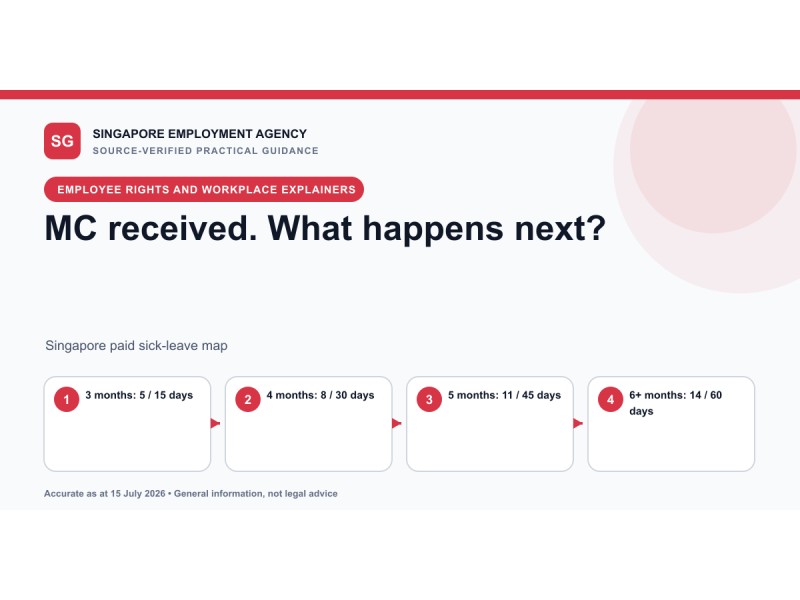
Short answer: if you are covered by Singapore’s Employment Act, have served your employer for at least three months, notify or try to notify the employer within 48 hours, and obtain a valid medical certificate, you may be entitled to paid sick leave. After six months of service, the statutory maximum is 14 days of paid outpatient sick leave and 60 days of paid hospitalisation leave per year, the 60 days include those 14 outpatient days.
Probation does not postpone this entitlement. Work Permit holders can qualify too. But a valid MC, payment for the day and reimbursement of the doctor’s consultation fee are three different questions, so it helps to examine each separately.
Your entitlement by completed service
Section 89 of the Employment Act 1968 and MOM’s updated sick-leave table set out the statutory scale:
| Completed service | Paid outpatient sick leave | Paid hospitalisation leave |
|---|---|---|
| Less than 3 months | No statutory entitlement yet | No statutory entitlement yet |
| 3 months | 5 days | 15 days |
| 4 months | 8 days | 30 days |
| 5 months | 11 days | 45 days |
| 6 months or more | 14 days | 60 days |
The hospitalisation allowance is not another 60 days on top of 14. If an employee with full entitlement has already used all 14 outpatient days, up to 46 days remain within the 60-day hospitalisation ceiling.
What counts as hospitalisation leave?
You do not always need to spend the night in a ward. MOM says hospitalisation leave can cover inpatient admission, day surgery, a quarantine required by written law, and certified rest or further treatment after discharge. It may also cover a period when a doctor who can admit patients certifies that hospital care or bed rest is required, including some pregnancy-related complications. Public, private and community hospitals are included.
The certification requirements are more specific than for ordinary outpatient leave. If the issuer’s hospital admitting rights are unclear, ask the clinic or practitioner rather than assuming an ordinary MC is hospitalisation leave.
The MC, pay and consultation-fee matrix
The distinctions below follow MOM’s official guidance on medical reimbursements and salary during sick leave, together with its separate MC and reimbursement FAQs.
| Question | General statutory position | Practical check |
|---|---|---|
| Must the employer recognise the MC? | For paid outpatient sick leave, the employee must be certified unfit for work by a medical practitioner registered under the Medical Registration Act or Dental Registration Act. | Check that it is a valid doctor- or dentist-issued MC and that the service and notification conditions are met. |
| Does teleconsultation count? | Yes. MOM’s teleconsultation-MC FAQ says employers must recognise an MC issued through teleconsultation by a practitioner registered under the Medical Registration Act or Dental Registration Act. | Recognition of the MC and reimbursement of the consultation fee remain separate. MOM’s private-clinic reimbursement FAQ applies its qualifying rules to both in-person consultations and teleconsultations. |
| Must the day be paid? | Yes, within the employee’s statutory entitlement and where the conditions are satisfied. | Hospitalisation leave is paid at gross rate of pay. Outpatient sick leave is paid at gross rate excluding shift allowance. |
| Must the consultation fee be reimbursed? | After three months’ service, the statutory reimbursement applies where the MC gives at least one day of paid sick leave and is issued by a practitioner at a public medical institution or one appointed by the company. | A valid private-clinic MC may support leave even where the private consultation fee is not statutorily reimbursable. Check whether the clinic is company-approved or the contract is more generous. |
| Can the employer ask for the diagnosis? | MOM stated in November 2025 that valid MCs for physical or mental-health conditions must be accepted for statutory leave, and that MCs should not identify the condition without the patient’s consent. | Provide the certification needed for leave; handle any separate medical-information request carefully and proportionately. |
Five situations employees commonly misunderstand
1. “I am still on probation”
Probation and statutory sick leave run on different clocks. MOM’s probation FAQ confirms that probation does not affect the entitlement once an Employment Act-covered employee has at least three months’ service. A six-month probation clause cannot postpone the statutory five-, eight- or eleven-day scale.
2. “The company only accepts its panel clinic”
Do not confuse accepting an MC with reimbursing the fee. MOM’s eligibility page uses the broader requirement of certification by a registered medical or dental practitioner. The statutory duty to reimburse consultation fees is narrower: it concerns qualifying MCs from a public medical institution or company-appointed practitioner. A company can offer better medical benefits by contract or policy.
3. “I was sick on a public holiday”
MOM’s sick-leave guidance for special situations says you are not eligible to apply for paid sick leave for a rest day, public holiday, non-working day, annual-leave day or unpaid-leave day on which you were not required to work. Its example treats an MC for 8 and 9 August as only one sick-leave day where one date is a public holiday. If you fall sick during annual leave, you can discuss changing the leave type, but the conversion is not automatic.
4. “I am serving notice, so sick leave no longer applies”
An otherwise eligible employee remains entitled while serving resignation notice. The same MOM special-situations page says sick leave, paid or unpaid, is treated as part of the notice period rather than extending it. Preserve the MC and send notice promptly, particularly where the final working date is close.
5. “My MC is for anxiety, so HR can reject it”
MOM’s November 2025 parliamentary answer states that employers must accept and grant statutory sick leave for all valid MCs, whether they concern physical or mental-health conditions. As at 15 July 2026, Singapore Statutes Online’s current register of uncommenced Acts lists both Workplace Fairness Acts, while MOM’s implementation announcement says the framework is intended to take effect at end-2027. The present MC position therefore rests on the Employment Act entitlement; do not treat the future Workplace Fairness framework as operative law yet.
A same-day action timeline
- Before or shortly after your start time: tell your supervisor or the designated HR channel that you are unable to work. Keep proof of the attempt.
- Within 48 hours: ensure the employer has been informed or that you can show a genuine attempt to inform it.
- At the consultation: obtain a valid MC if the practitioner certifies you unfit for work. Check whether it is ordinary or hospitalisation leave.
- After the consultation: send the MC through the company’s stated channel. If the original is required, retain a copy.
- When payroll closes: check the payslip, leave balance and any excluded shift allowance. Submit the consultation receipt if reimbursement may apply.
Can an employer terminate someone who takes sick leave?
Sick leave is a statutory entitlement. MOM says employers should not terminate employment merely because an employee takes sick leave and should rely on relevant, objective criteria. There can nevertheless be cases where a person is medically unable to perform the role, or repeated absence materially affects the work; termination with contractual notice or payment in lieu may then be considered on the facts.
The reason and evidence matter. If an Employment Act-covered employee believes the real reason was punishment for exercising the sick-leave right, MOM’s current guidance says a wrongful-dismissal claim may be filed at TADM within one month from the last day of employment. A manager or executive dismissed with notice generally needs at least six months’ service to bring that claim. These deadlines are short; do not wait for an internal appeal to finish without checking them.
If pay or leave is wrongly refused
- Keep the MC, consultation receipt, leave application, messages, contract, leave policy and payslip.
- Ask HR which eligibility condition it says was not met: service, notice, certification, annual balance or reimbursement source.
- Separate the disputed items. “MC accepted, day unpaid” and “day paid, fee not reimbursed” are different issues.
- Use the internal grievance channel or union assistance where available.
- For unpaid statutory sick-leave salary, review TADM’s salary-claim process. A serving employee generally has one year from the dispute; a former employee generally has six months from the last day of employment, subject to the one-year claim period.
You can also read our broader Employment Act rights guide and our practical explanation of the Employment Claims Tribunals.
Bottom line
Three months’ service is the key entry point, not the end of probation. Notify the employer within 48 hours, obtain a valid MC and distinguish leave entitlement from medical-fee reimbursement. Employers should administer physical and mental-health MCs consistently; employees should preserve records and act quickly if pay, leave or employment is affected.
Real people. Right here in Singapore.