Insights for work and life.
Main Contractor Work Pass Checks After MOM’s Changi Airport Probe
Quick answer: Main contractor work pass checks confirm that every worker a subcontractor or manpower supplier sends to your site holds a valid pass, is employed by the company named on that pass and is doing the work the pass allows. They are meant to catch illegal deployment of foreign workers, which means using a work pass holder in a way the pass does not allow, most often in an occupation or sector other than the one declared to the Ministry of Manpower (MOM), or for a company that is not the employer named on the pass. On 2 November 2026, MOM said it is investigating around 45 companies involved in airport operations at Changi Airport, covering around 270 workers employed by SATS’ contractors and sub-contractors. Employers who illegally deploy a foreign employee may face a financial penalty of up to S$10,000 and may be barred from hiring work pass holders.
Key takeaways
- The probe is large. MOM is investigating around 45 companies and has identified around 270 workers whose deployment may not have complied with work pass regulations.
- The principal was told to act. MOM directed SATS to strengthen its oversight of the companies it contracted, including verifying that foreign workers are deployed in accordance with their work passes.
- Separate charges were announced on 19 November 2026. MOM announced charges against a company director and a cleaning company over alleged false declarations involving workers deployed at Changi Airport. MOM’s release does not say whether these charges are connected to the 2 November probe. They are allegations, not findings.
- The rules are in the pass conditions. Work Permit and S Pass holders may work only for their employer and only in the occupation and sector on their pass. For employers, these are regulatory conditions backed by a financial penalty of up to S$10,000.
- Oversight has to reach down the chain. A main contractor that relies on subcontractors and manpower suppliers should check who is on site, who employs them and what they are actually doing.
For the background to the investigation itself, read our guide to MOM’s airport probe. This article focuses on the work pass checks a main contractor should run on its subcontractors and manpower suppliers.
Contents
- Main contractor work pass checks: what illegal deployment means
- Work pass checks and the Changi Airport probe: what MOM announced
- Work pass charges on 19 November 2026: a separate announcement
- Work pass rules behind the checks: what the EFMA says
- Main contractor responsibility for subcontractor work passes
- How to run main contractor work pass checks on subcontractors
- Main contractor work pass checklist
- Work pass check finds a mismatch: what to do next
- Help with work pass checks and records
- Main contractor work pass checks: frequently asked questions
Main contractor work pass checks: what illegal deployment means
Putting a work pass holder to work outside what the pass allows: a different job, a different sector or a different employer.
Every work pass is issued for a specific employer and, for most passes, a declared occupation. Illegal deployment happens when the real work drifts away from those terms. In its 2 November 2026 press release, MOM described work pass holders found “performing baggage handling work, which was different from their declared occupations”. That is the core pattern: the pass says one thing, and the roster says another.
The detailed rules sit in the Employment of Foreign Manpower (Work Passes) Regulations 2012. For a Work Permit holder who is not a domestic worker, the Fourth Schedule sets out regulatory conditions for the employer, including that:
- the employer must control and supervise the worker, and the worker must be under the employer’s direct employment;
- the employer must not permit the worker to be employed by or contracted to any other person or business to do work for that person or business; and
- the employer must not employ the worker in an occupation or a sector which is different from that specified in the Work Permit.
The Fifth Schedule sets out the same three regulatory conditions for employers of S Pass holders. The worker has matching obligations: Work Permit and S Pass holders must work only for the employer and in the occupation and sector specified in their pass. MOM’s Work Permit conditions page puts the worker’s side in plain terms.
The Employment of Foreign Manpower Act 1990 (EFMA) also defines “employ” widely. Under section 2, it means to engage or use the service of any person for any work, whether under a contract of service or otherwise, and with or without salary. A company can therefore be using a worker’s services even if it never signed an employment contract with that worker. For Employment Pass holders, the issue at Changi Airport was framed mainly as false declaration, which is covered below.
Work pass checks and the Changi Airport probe: what MOM announced
An investigation into around 45 airport operations companies and around 270 workers, with a direction to SATS to tighten oversight.
MOM’s 2 November 2026 release sets out the following points.
- MOM is investigating around 45 companies involved in airport operations at Changi Airport for suspected offences and infringements under the EFMA, including false declarations and illegal deployment of foreign workers.
- During a recent inspection at Changi Airport, MOM found Employment Pass holders deployed to perform baggage handling services. Preliminary investigations suggest that the salaries and occupations declared to MOM for these Employment Pass holders were false.
- Other work pass holders were also found performing baggage handling work that was different from their declared occupations.
- Investigations have so far identified around 270 workers whose deployment may not have been in compliance with work pass regulations. These workers were employed by SATS’ contractors and sub-contractors.
- MOM has directed SATS to strengthen its oversight of the companies it has contracted, including verifying that foreign workers are deployed in accordance with their work passes and rectifying any compliance deficiencies.
- MOM has also issued an advisory to other companies involved in SATS’ operations, underscoring their obligation to comply with the EFMA and applicable work pass requirements.
MOM said investigations are ongoing and that it will take enforcement action if breaches of the EFMA are established. The release does not say that any company has broken the law, and it does not name the contractors or sub-contractors. We have covered the first stage of this case in our earlier article on MOM’s Changi Airport probe. This guide looks at what the case means for companies that sit at the top of a contracting chain.
Work pass charges on 19 November 2026: a separate announcement
Charges against a director and a company over alleged false declarations involving workers deployed at Changi Airport, alongside separate Training Employment Pass cases.
In a press release dated 19 November 2026, MOM said seven individuals and a company were charged in court that day for offences under the EFMA. Two of the cases involve work at Changi Airport.
- Ng Leong Huat, director of Double Huat Pte Ltd. MOM said Ng was charged for making false declarations in Employment Pass applications and for providing a false statement to an MOM employment inspector. MOM said investigations began after a report received in June 2025. It is alleged that Ng made false declarations on the occupations of four foreign employees, with no intention of employing them in their declared roles, and supplied the workers to another company, which deployed them to perform aircraft cleaning and baggage handling duties at Changi Airport.
- Re Sustainability Cleantech Pte Ltd. MOM said the company, which provides cleaning and facilities management services, was charged for making false salary declarations in the work pass applications of 20 foreign employees. It is alleged that 19 of them, who were Employment Pass and S Pass holders, were deployed to perform cleaning duties at Changi Airport, and that the company inflated fixed monthly salaries in their applications by including overtime payments.
The same release covers six individuals charged over false declarations in Training Employment Pass applications in the food and beverage and other service sectors. Those cases are not about airport work.
These are charges, not convictions. Each person and company charged is presumed innocent unless proven guilty, and nothing in this guide suggests otherwise. MOM’s 19 November release also does not say whether these cases form part of the investigation it announced on 2 November. They are worth studying for a different reason: the Double Huat allegations describe exactly the arrangement that main contractors need to watch for, in which workers are brought in by one company and put to work by another. Our guide to false declarations in work pass applications covers the declaration side in more depth.
Work pass rules behind the checks: what the EFMA says
Several provisions can apply, from a financial penalty for breaching a regulatory condition to fines and jail for false statements.
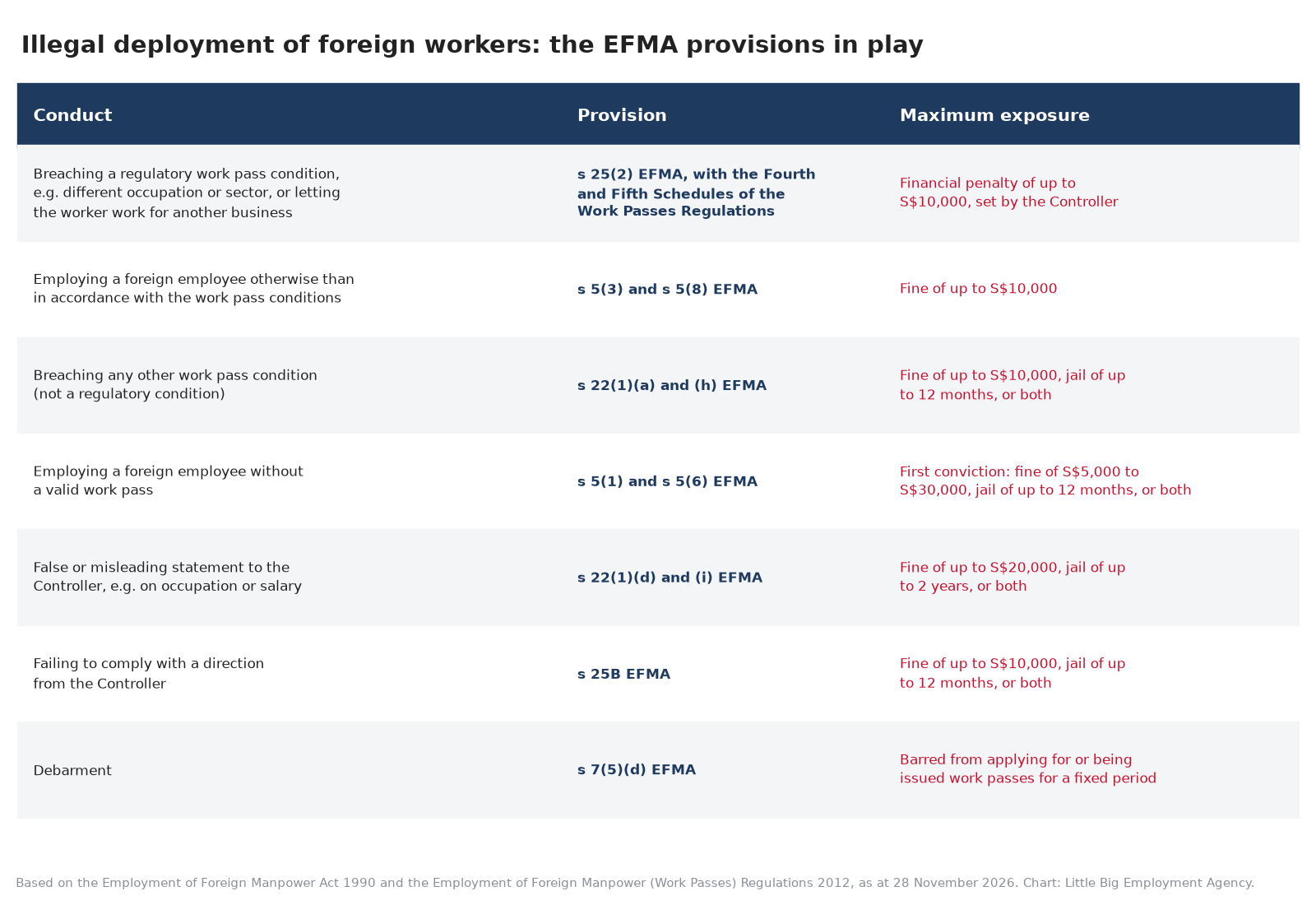
The provisions below are taken from the current version of the Employment of Foreign Manpower Act 1990 on Singapore Statutes Online.
- Breach of a regulatory condition, section 25(2). Where an employer fails to comply with a regulatory condition of a work pass, the Controller of Work Passes may impose a financial penalty of up to S$10,000. The occupation, sector and direct employment conditions for Work Permit and S Pass holders are listed as regulatory conditions in the Work Passes Regulations. This lines up with the penalty MOM quoted for illegal deployment. Read section 25.
- Employment outside the pass conditions, section 5(3). A person must not employ a foreign employee otherwise than in accordance with the conditions of the worker’s work pass. Under section 5(8), the offence carries a fine of up to S$10,000. Read section 5.
- Employment without a valid work pass, section 5(1). On a first conviction, section 5(6) provides for a fine of at least S$5,000 and up to S$30,000, imprisonment of up to 12 months, or both. Repeat offenders face higher minimum penalties.
- Other pass conditions, section 22(1)(a). Contravening a condition of a work pass that is not a regulatory condition is an offence with a fine of up to S$10,000, imprisonment of up to 12 months, or both. Read section 22.
- False statements, section 22(1)(d). Making a statement to the Controller, an authorised officer or an employment inspector that the person knows, or ought reasonably to know, is false in any material particular carries a fine of up to S$20,000, imprisonment of up to two years, or both. This is the provision under which the 19 November charges were brought, according to MOM’s annex.
- Directions, section 25B. The Controller may give directions to bring a prescribed infringement to an end and prevent it happening again. Failing to comply without reasonable excuse is an offence with a fine of up to S$10,000, imprisonment of up to 12 months, or both. Read section 25B.
- Debarment, section 7(5)(d). The Controller may debar any person from applying for or being issued with a work pass for a fixed period. Read section 7.
For many businesses, the hiring bar matters more than the fine. MOM’s FAQ on how long employers are debarred lists illegally employing or deploying migrant workers among the offences for which an employer will generally be debarred, with each case assessed on its merits. MOM also says that if an employer is under investigation for such offences, it will take this into consideration when the employer applies for or renews a work pass. For a wider view of the Act, see our guide to EFMA penalties for Singapore employers.
Main contractor responsibility for subcontractor work passes
The employer named on the pass carries the pass conditions, but company officers, abettors and principals can all be drawn in.
Under section 2 of the EFMA, “employer” includes, where a foreign employee has a valid work pass, any person specified in the work pass as the employer. That company holds the pass conditions. Handing a worker to someone else does not move those obligations across. The Fourth Schedule says the employer must not permit the worker to be employed by or contracted to any other person or business.
Other parties can still be exposed.
- Directors and managers. Under section 20, where a company commits an offence with the consent or connivance of an officer, or the offence is attributable to the officer’s neglect, the officer is also guilty. The Act presumes, until the contrary is proved, that the offence is attributable to the neglect of an officer who is primarily responsible for the act or omission and who failed to exercise reasonable supervision or oversight. Section 25E applies a similar rule to prescribed infringements.
- Anyone who abets. Under section 23, a person who abets an offence under the Act is guilty of that offence and liable to the same punishment. Section 23(2) adds that where an occupier is charged with abetting another person who employed a foreign employee without a valid work pass, it is not enough for the occupier to show that it told the other person not to do so, or obtained an undertaking. A contract clause alone is not a defence in that situation.
- The principal. MOM’s direction to SATS shows what MOM expects of the company at the top of the chain: oversight of its contractors, verification that workers are deployed in line with their passes, and rectification of deficiencies. MOM issued that direction in one investigation, and it is not a general statement of legal liability. It is still a clear signal of where MOM looks.
There are lawful ways to share workers, but they are narrow. In the construction sector, Part V of the Fourth Schedule allows an employer, with the worker’s consent, to enter into a written contract for the supply of labour with an eligible third party in the construction industry. The employer must verify the third party’s eligibility with the Controller first. The contract must require the third party to supervise the worker, keep the worker to the specified activities, tell the employer the activities and worksite address, and not send the worker to work for anyone else. A copy must be kept for at least two years. Separately, MOM’s cross-deployment page explains that construction and process sector employers can temporarily post workers to another company in the same industry during lull periods, after checking the receiving company’s eligibility on WP Online. The original employer remains responsible for salaries, levies, housing and insurance. Outside these routes, lending a Work Permit or S Pass holder to another business is not allowed. Our article on sending pass holders to a client’s premises looks at service arrangements in more detail.
How to run main contractor work pass checks on subcontractors
Know who is on site, who employs them, what their pass allows and what they are actually doing, and check again whenever any of those change.
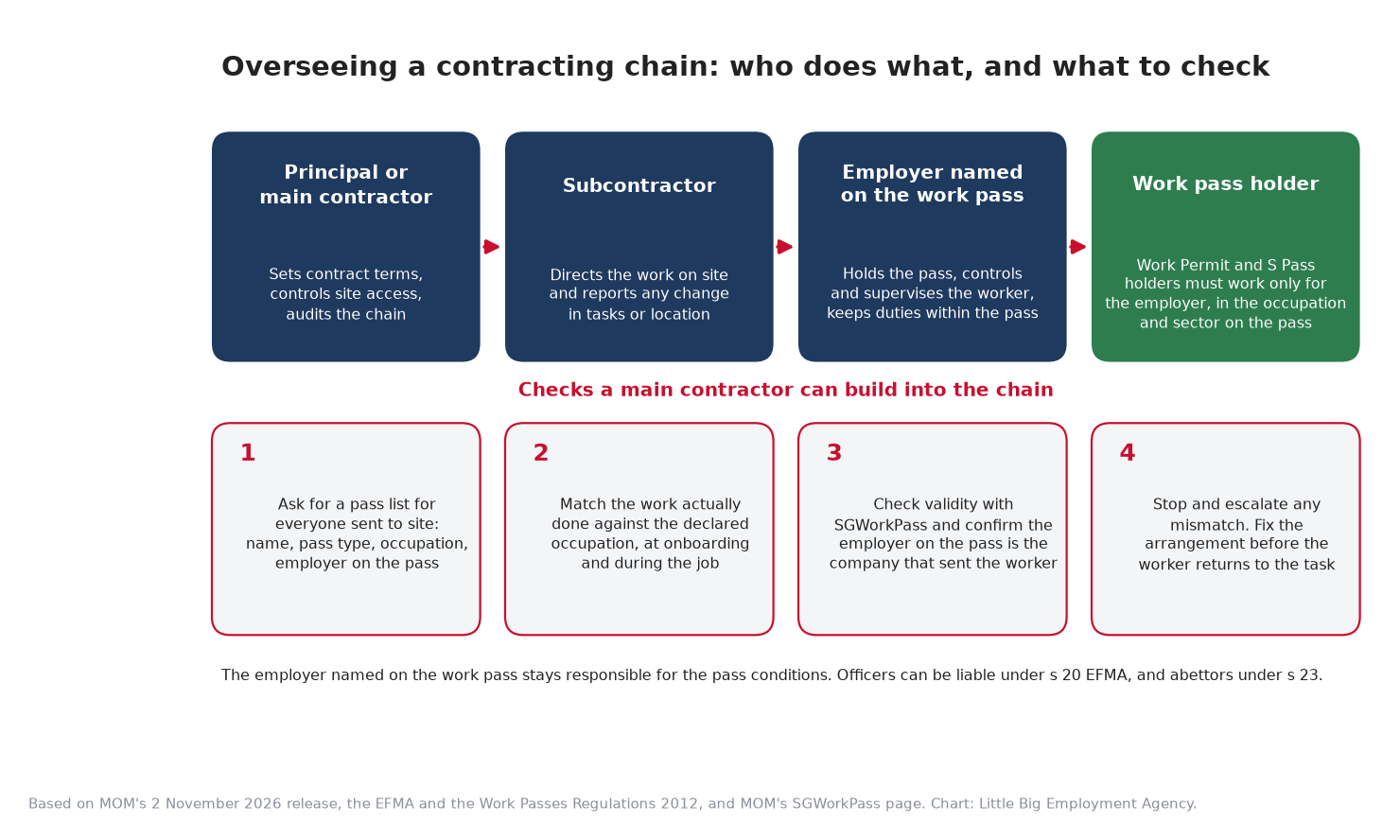
MOM’s direction to SATS gives a practical template: verify that foreign workers are deployed in accordance with their work passes, and fix any gaps. In practice, main contractor work pass checks break down into five controls.
1. Make the pass list a condition of entry
Before any subcontractor or manpower supplier sends a worker to your site, ask for a list showing each worker’s name, pass type, declared occupation and the employer named on the pass. No list, no site access. Update the list whenever a worker joins or leaves.
2. Check that the employer on the pass is the company that sent the worker
This is the check that would surface a supply arrangement of the kind alleged in the Double Huat case. If the company named on the pass is not the company you contracted with, ask why. Unless a lawful route such as a construction supply of labour contract or cross-deployment applies, the worker should not be on your site for that company. MOM’s SGWorkPass app lets you verify the validity of an MOM-issued pass by viewing the pass holder’s digital work pass or scanning the QR code on it.
3. Match the real work to the declared occupation
Compare the tasks in your scope of work with the occupations on the pass list. Employment Pass holders doing baggage handling was the first mismatch MOM described at Changi Airport, so a pass list that shows an Employment Pass holder on a manual handling or cleaning roster needs an explanation. A Work Permit or S Pass holder approved for one occupation or sector should not be working in another. Check this at onboarding, then again during the job, because duties drift when sites are busy.
4. Write oversight into your contracts
Your subcontracts and manpower supply agreements should require compliance with the EFMA and every work pass condition, give you the right to audit pass records and site deployment, require prompt notice of any change in workers, tasks or work location, require notice of any MOM inspection or enquiry, and let you remove workers and terminate the contract for a breach. Remember section 23(2): a clause does not protect an occupier on its own. Use it as the basis for checks you actually carry out.
5. Audit, record and escalate
Run spot checks of site access records against the pass list. Keep dated records of what you checked and what you found. Give site supervisors a clear route to escalate a mismatch, and make sure someone senior owns the issue. Section 20 presumes neglect by an officer who is primarily responsible and fails to exercise reasonable supervision or oversight, so documented oversight matters for directors as well as for the company.
If a manpower supplier presents itself as an employment agency, check that it holds a valid licence. Our guide on how to check an employment agency licence on MOM’s EA Directory explains how.
Main contractor work pass checklist
Use this list for your own workforce and for every company that sends workers to your sites. It turns main contractor work pass checks into a routine rather than a one-off audit.
- Keep a live pass register. For every pass holder, record pass type, declared occupation, sector, employer named on the pass and expiry date.
- Compare duties with declared occupations. Check job descriptions, rosters and supervisors’ accounts of daily tasks against the occupation on each pass.
- Confirm the employer on each pass. The company named on the pass should be the company that directs and pays the worker, unless a lawful exception applies.
- Do not lend or borrow workers informally. Use only the construction supply of labour route or cross-deployment, where they apply, and meet their conditions.
- Obtain a pass list from every subcontractor and supplier. Make it a condition of site access and refresh it when the workforce changes.
- Verify passes on site. Use SGWorkPass to confirm validity when onboarding workers.
- Put compliance terms in every contract. Include audit rights, notification duties, removal rights and termination for breach.
- Check declared salaries are the salaries paid. The Re Sustainability charge concerns alleged inflation of fixed monthly salaries with overtime, which is a declaration risk rather than a deployment risk. MOM’s Changi Airport release cites both.
- Train site supervisors. They should know not to assign pass holders to tasks outside their declared occupation, even for a single shift.
- Record your oversight. Keep dated audit notes, escalations and fixes, and have a named director or manager responsible.
For a broader set of routine checks, see our Singapore employer compliance guide and our MOM compliance calendar for HR managers.
Work pass check finds a mismatch: what to do next
Stop the out-of-scope work first, then work out what happened, then decide on next steps with proper advice.
- Stop the deployment. Take the worker off the task or site that does not match the pass.
- Establish the facts. List the workers affected, the dates, the tasks performed and which company named on each pass sent them.
- Tell the employer named on the pass. If you are the main contractor, require the subcontractor or supplier to explain and correct the position in writing.
- Use the right MOM channel. If a worker’s role has genuinely changed, the employer should make the appropriate change request or new application. Our guide to updating work pass holder details with MOM covers the common requests.
- Be careful with false declarations. Under section 22(2) of the EFMA, an employer, foreign employee or agent involved in the employment who knows or has reason to believe that a false declaration offence has been committed, and intentionally omits to provide information to the Controller about it, commits an offence. If what you find looks like a false declaration, get legal advice promptly.
Members of the public who are aware of suspected work pass infringements can report them through MOM’s Report an Infringement eService. MOM says all information provided will be kept strictly confidential. If MOM contacts you first, our walkthrough of an MOM inspection explains what to expect.
Help with work pass checks and records
Little Big Employment Agency Pte Ltd is an employment agency licensed by the Ministry of Manpower (EA Licence 19C9790). We help employers set up and keep accurate work pass records, prepare Employment Pass, S Pass and Work Permit applications with occupations and salaries that match the real job, and handle occupation changes and other MOM updates when roles change. Our work pass administration service keeps a pass register and renewal calendar for companies with several pass holders, which makes it easier to answer a principal’s audit request. If your business supplies workers to principals, or relies on subcontractors who do, contact us to talk through your set-up.
Main contractor work pass checks: frequently asked questions
What are main contractor work pass checks?
They are the checks a main contractor or principal runs to confirm that each worker sent to its site by a subcontractor or manpower supplier holds a valid work pass, is employed by the company named on the pass, and is doing work that matches the declared occupation and sector. In the Changi Airport probe, MOM directed SATS to strengthen its oversight of the companies it contracted, including verifying that foreign workers are deployed in accordance with their work passes.
What should a main contractor check for each subcontractor worker?
Ask for a pass list showing each worker’s name, pass type, declared occupation and the employer named on the pass. Check that the employer on the pass is the company that sent the worker, compare the tasks actually done with the declared occupation, and verify the pass with MOM’s SGWorkPass app. Repeat the checks whenever workers, tasks or work locations change.
Is a main contractor responsible for its subcontractors’ foreign workers?
The employer named on the work pass is responsible for the pass conditions. A main contractor is not automatically that employer, but MOM directed SATS to strengthen its oversight of the companies it contracted, including verifying that foreign workers are deployed in accordance with their work passes. The EFMA also makes abettors liable to the same punishment as the offence, and company officers can be liable for offences committed with their consent, connivance or neglect.
Can a Work Permit holder be lent to another company?
Generally no. The Work Permit conditions say the employer must not permit the worker to be employed by or contracted to any other person or business. There are limited exceptions in the construction and process sectors, such as a contract for the supply of labour with an eligible third party in construction and cross-deployment during lull periods, each with its own conditions.
What is illegal deployment of foreign workers?
It means putting a work pass holder to work in a way their pass does not allow, such as in an occupation or sector different from the one on the pass, or for a business other than the employer named on the pass. For Work Permit and S Pass holders, the Employment of Foreign Manpower (Work Passes) Regulations 2012 set these limits as regulatory conditions of the pass.
What is the penalty for illegal deployment of foreign workers?
MOM’s 2 November 2026 release says employers who illegally deploy a foreign employee may face a financial penalty of up to S$10,000 and may be barred from hiring work pass holders. Section 25(2) of the Employment of Foreign Manpower Act 1990 lets the Controller of Work Passes impose a financial penalty of up to S$10,000 for breaching a regulatory condition of a work pass.
What did MOM announce about Changi Airport?
On 2 November 2026, MOM said it is investigating around 45 companies involved in airport operations at Changi Airport for suspected EFMA offences and infringements, including false declarations and illegal deployment of foreign workers. It identified around 270 workers whose deployment may not have complied with work pass regulations. The workers were employed by SATS’ contractors and sub-contractors.
Are the charges announced on 19 November 2026 part of the airport probe?
On 19 November 2026, MOM announced that seven individuals and a company had been charged under the EFMA over false declarations. They include Ng Leong Huat, director of Double Huat Pte Ltd, and Re Sustainability Cleantech Pte Ltd, whose cases involve workers allegedly deployed at Changi Airport. These are allegations that have not been proven in court. MOM’s release does not say whether these charges arise from the investigation it announced on 2 November.
How can I report a suspected work pass infringement?
MOM asks members of the public to use its Report an Infringement eService. MOM says the information provided will be kept strictly confidential.
Last updated 28 November 2026. This guide is general information based on MOM’s published releases and guidance and the Employment of Foreign Manpower Act 1990 and its regulations, and is not legal advice. The charges described are allegations that have not been proven in court. Investigations MOM has announced may still be ongoing.
Real people. Right here in Singapore.