
Insights for work and life.
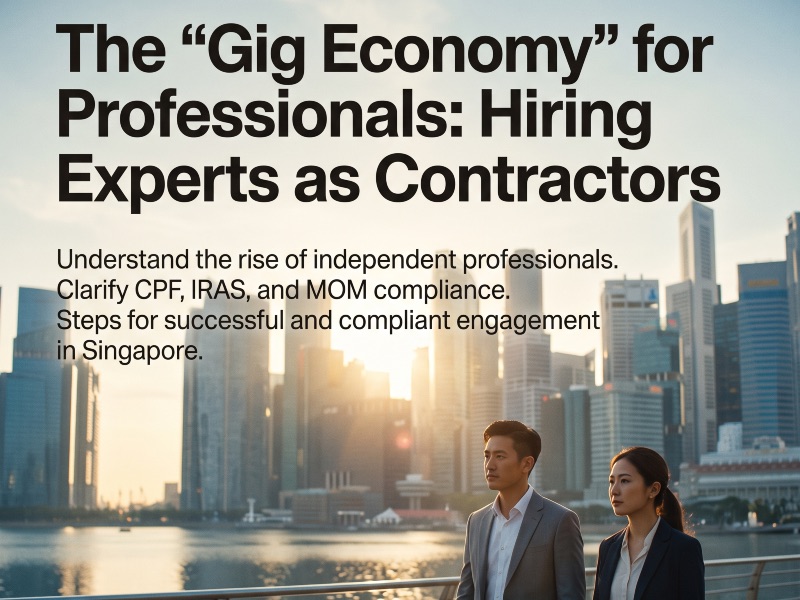
The “Gig Economy” for Professionals: Hiring Experts as Contractors
Introduction
The rise of the gig economy has prompted many Singapore companies to engage highly skilled professionals as contractors rather than as employees. This raises important questions about legal classification, CPF and IRAS obligations, and compliance with MOM and other agencies.
This article, The “Gig Economy” for Professionals: Hiring Experts as Contractors, explains the core issues employers should consider when engaging contractors in Singapore and outlines practical steps for compliant arrangements.
Who this applies to
This guidance is intended for Singapore-based employers, HR teams, hiring managers and small business owners who are considering engaging professionals , such as consultants, software developers, designers, accountants or project managers , on a contractor basis rather than as employees.
It also applies to overseas firms with a local presence (ACRA-registered entities) that engage contractors in Singapore, and to in-house teams assessing status and employment model risk under the CPF Act, Employment Act, and Employment of Foreign Manpower Act.
Key rules and requirements in Singapore
The legal distinction between a contractor and an employee is critical. Misclassification can lead to liabilities under multiple statutes including the CPF Act, Employment Act, IRAS tax rules, and the Employment of Foreign Manpower Act.
- Employment status: Look to the substance of the relationship (control, integration, provision of tools, hours, exclusivity) rather than just the contract label. Courts and MOM will consider how the working relationship operates in practice.
- CPF obligations: Contractors who are genuinely self-employed may not attract mandatory CPF contributions from the hiring company, but those classed as employees do. Check the CPF Act and seek clarity where status is uncertain.
- IRAS considerations: Contractors may be engaged under a contract for services (business-to-business) and taxed differently. IRAS expects accurate reporting via the myTax Portal and correct withholding where applicable (e.g. for non-resident professionals).
- Foreign manpower: If hiring foreign contractors who will work physically in Singapore, ensure proper immigration authorisations (Employment Pass, S Pass, Work Permit or short-term work passes) under the Employment of Foreign Manpower Act and MOM’s guidelines.
- Employment Act and benefits: Many protections under the Employment Act apply only to employees. Ensure clarity on entitlements such as leave, notice periods, salary protection and staff benefits to avoid disputes.
- Other statutes: Consider obligations under the Workplace Safety and Health Act, Work Injury Compensation Act and statutory levies such as Skills Development Levy (SDL) where applicable.
- Data and confidentiality: Contracts should account for PDPA privacy obligations and POHA where relevant for handling personal data and preventing harassment or misuse.
Step-by-step process
Follow these steps to engage contractors with appropriate compliance and risk controls.
- Define the business need and scope. Draft a clear description of deliverables, duration, milestones, reporting lines and expected outcomes.
- Assess employment status. Use a documented status review that examines control, integration, tools, exclusivity and ability to subcontract. Keep records in case of audit or dispute.
- Draft a robust contract for services. Include scope, fees, invoicing, IP assignment, confidentiality, PDPA clauses, indemnities, termination, and dispute resolution. Make payment terms clear (GST considerations may apply).
- Check tax and CPF implications. Verify whether the contractor is GST-registered, how IRAS tax treatment applies, and whether CPF contributions or SDL apply. Record payments appropriately in your financial year end processes and ACRA/IRAS filings.
- Verify immigration status for foreign contractors. If the contractor will perform work in Singapore, confirm the correct pass type (Employment Pass, S Pass, Work Permit or relevant short-term work pass) before engagement.
- Implement onboarding and compliance checks. Collect company/individual business registration details (ACRA BizFile+ for local entities), verify insurance where necessary (WICA and professional indemnity), and set up secure data access in line with PDPA.
- Monitor and review. Periodically reassess contractor arrangements, especially if the working relationship evolves towards integration or longer-term dependency.
Common mistakes to avoid
Mitigate risk by avoiding these common errors when hiring contractors.
- Relying on labels: A written agreement calling someone a “contractor” does not determine legal status.
- Insufficient contracts: Vague scope or absence of IP assignment and confidentiality clauses can cause disputes and data breaches (PDPA risks).
- Ignoring immigration rules: Allowing a foreign contractor to work in Singapore without the correct pass can result in penalties under MOM rules.
- Overlooking payroll and tax: Failing to account for IRAS reporting, GST or withholding obligations for non-residents.
- Neglecting statutory levies: SDL and contributions under CPF may be triggered in some circumstances , do not assume they never apply.
Practical examples
Example 1 , Short-term project consultant: A UK-based digital marketing expert is engaged for a 3-month campaign, invoices as a limited company, provides own tools and works offsite. This arrangement can be structured as a contract for services, but the company should confirm tax residency, GST status, and ensure no implied exclusivity.
Example 2 , Long-term on-site specialist: A data analyst works on-site for 18 months, has fixed hours and is integrated into weekday team meetings. This arrangement may look more like employment , consider employment terms, CPF and Employment Act protections, and whether an Employment Pass or S Pass is required.
How an experienced consultant can help
Engaging a specialist adviser can reduce compliance risk and administrative burden. An experienced consultant will help with status assessments, contract drafting, CPF and IRAS clarifications, and immigration checks for foreign contractors.
Little Big Employment Agency can provide advisory support, assist with applications, and help design compliant contractor arrangements that align with the company’s operational needs while observing ACRA, IRAS, MOM and CPF obligations.
Frequently Asked Questions
Q: How do I know if someone is a contractor or an employee?
A: It depends on the substance of the working relationship. Consider control, integration, provision of tools, ability to subcontract, and payment structure. Maintain a documented assessment and review if the relationship changes.
Q: Do I need to pay CPF for contractors?
A: CPF obligations generally apply to employees who are Singapore citizens or permanent residents. Genuine independent contractors typically manage their own CPF through self-employment rules, but this can be complex , seek clarity early.
Q: What if a foreign expert needs to work in Singapore for a short period?
A: Even short-term work may require a relevant work pass (Employment Pass, S Pass, Work Permit or short-term work pass). Check MOM’s latest guidance and secure the correct authorisation before work begins.
Q: Are contractors entitled to Employment Act benefits?
A: Generally not. The Employment Act covers employees. Misclassification, however, can lead to retrospective claims for entitlements. Proper assessment and documentation are essential.
Key takeaways
- Classification matters: Substance over form determines whether someone is a contractor or employee.
- Check multi-agency obligations: Consider CPF Act, IRAS, MOM, Employment Act and ACRA requirements.
- Use strong contracts: Address IP, confidentiality (PDPA), fees, termination and indemnities.
- Verify immigration: Foreign contractors working in Singapore need the correct pass.
- Review regularly: Reassess arrangements if the working relationship changes.
Call to action
If you are considering engaging professionals as contractors, it is sensible to review your arrangements against Singapore law and MOM guidelines. Little Big Employment Agency can provide practical reviews, contract drafting and application support to help you stay compliant.
Requirements may change, so always check the latest guidance from MOM, or consult a professional adviser.
If you would like to find out more about how Little Big Employment Agency can assist with your employment and immigration requirements, please get in touch with the team at [email protected].
Yours sincerely,
The editorial team at Little Big Employment Agency
Disclaimer: This does not constitute legal advice. If you require legal advice, please contact a lawyer.
Real people. Right here in Singapore.