
Insights for work and life.
Final Salary and Unreturned Property: Keep the Claims Separate
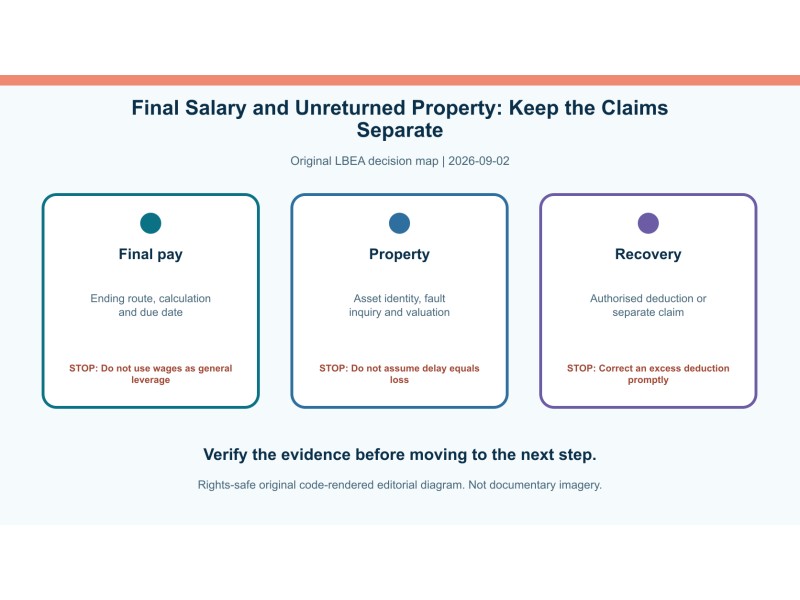
Answer first. An employer should calculate final salary on the applicable timetable and assess missing company property through the separate lawful deduction and recovery process, not use final wages as general leverage.
Related reading: salary deduction guide and final salary timeline.
Create two ledgers
Open a final-pay ledger and a property-recovery ledger. The final-pay ledger contains salary period, ordinary wages, overtime, leave treatment, authorised deductions, tax-clearance status where relevant and the statutory or contractual due date. The property ledger lists each asset, serial number, issue record, return instruction, condition, current location and evidence of loss. Linking the two ledgers does not turn every property dispute into a lawful salary deduction.
Fix the salary deadline first
MOM’s current table distinguishes resignation with notice, resignation without notice, dismissal for misconduct and employer termination. Identify the actual ending route and date before computing the deadline. A handover clause or asset return policy should not silently replace that timetable. If foreign-employee tax clearance applies, document it as a separate statutory withholding ground. Payroll should record which amount is undisputed and why any deduction is authorised.
Test the damage or loss ground
MOM says a deduction for damage or loss of money or goods requires responsibility, direct fault, an inquiry and an opportunity for the employee to explain. The deduction may not exceed 25 percent of one month’s salary and must be a one-time lump sum. This is narrower than an employer saying a laptop has not yet been returned. Determine whether the asset is delayed, disputed, damaged, lost or held pending collection, and obtain advice on the exact facts.
Do not substitute replacement price for proof
The purchase price, depreciated accounting value, repair quote and actual loss can differ materially. Preserve the asset register, assignment form, photographs, service history, recovery attempts and current valuation basis. Do not issue an invoice for a new premium device merely because an older used device is missing. If the employment contract contains an asset clause, test its enforceability and interaction with the Employment Act rather than treating the clause as automatic payroll authority.
Worked scenario
An employee resigns after serving notice but does not return a three-year-old laptop on the last day because the courier collection failed. HR records the undisputed final salary due that day and schedules a documented pickup. It does not deduct the original purchase price. When the laptop is returned with damage, the employer investigates responsibility, invites the employee’s explanation, obtains a repair assessment and separately decides whether a lawful deduction or civil recovery route exists.
Build the decision record
The reviewer should sign off four questions: what final pay is due and when, what property is actually missing or damaged, whether the statutory deduction ground and safeguards are met, and what separate recovery route remains. Record the evidence reviewed and any employee response. Avoid threatening police action merely to secure agreement to a payroll deduction. A genuine suspected offence, civil loss and salary entitlement each has its own facts, threshold and process.
Correction and dispute handling
If payroll has already withheld too much, calculate the correction, pay it promptly and issue a corrected payslip with an explanation. Preserve the original record rather than overwriting history. If the employee disputes responsibility or value, use the grievance process and obtain legal advice before further action. This issue-spotting framework does not determine fault, ownership, set-off rights, tax clearance or the competent forum for a particular recovery claim.
How to use this guide
Start with the reader, decision and evidence identified above. Write the next action and owner beside every unresolved point, then set a review date. Keep authority-issued records unchanged and preserve earlier versions when a correction is made. If a fact, document or deadline does not fit the matrix, pause instead of forcing it into the nearest category. Official guidance can change, and a checklist cannot decide disputed facts or replace advice on a specific case. The strongest file shows what was known, when it was known, which source controlled the step and why the chosen action followed. Record every unresolved assumption, identify who can verify it, and never treat silence or a pending application as approval.
Decision and evidence matrix
| Checkpoint | Evidence to verify | Stop condition |
|---|---|---|
| Final pay | Ending route, calculation and due date | Do not use wages as general leverage |
| Property | Asset identity, fault inquiry and valuation | Do not assume delay equals loss |
| Recovery | Authorised deduction or separate claim | Correct an excess deduction promptly |
Primary sources checked for this guide
Source status was checked on 2 September 2026. Reopen the controlling page before acting because procedures and legal status can change.
- Ministry of Manpower: Paying salary, supporting Final-salary deadlines differ by the way employment ends, including last-day payment or specified short periods after termination.
- Ministry of Manpower: Allowable salary deductions, supporting Damage or loss deductions require direct fault, an inquiry, an opportunity to explain and a one-time cap of 25 percent of one month’s salary.
Real people. Right here in Singapore.