
Insights for work and life.
No Automatic Retrenchment Benefit After Two Years: What JIF v JIG [2026] SGECT 3 Decided
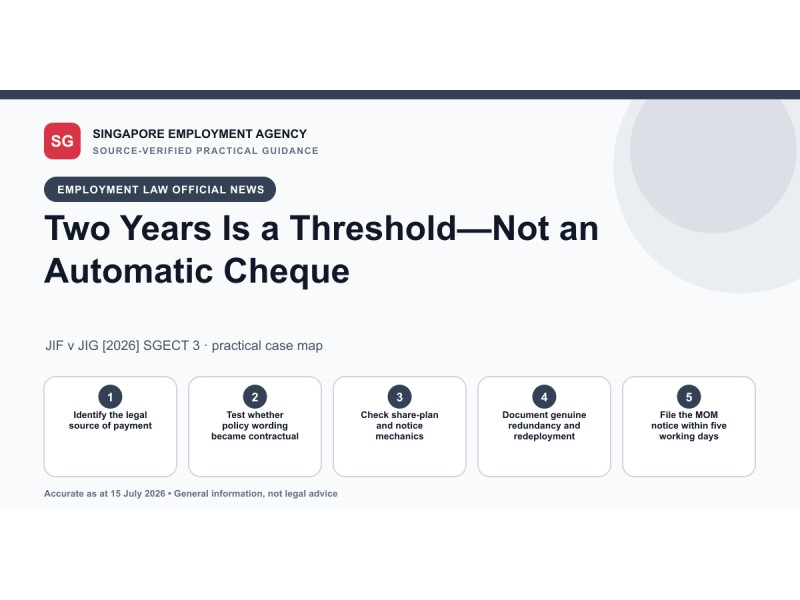
Legal status: Case note on JIF v JIG [2026] SGECT 3, Employment Claims Tribunals, Version No. 1 dated 1 July 2026. All claims were dismissed and no costs were awarded. This is a tribunal decision, not an appellate judgment. No appellate disposition was identified in the official materials checked on 15 July 2026.
Answer first: two years’ service does not automatically give every retrenched employee a statutory right to a cash retrenchment benefit. In JIF v JIG, the Employment Claims Tribunal held that section 45 of the Employment Act does not create a general statutory entitlement for employees with at least two years’ continuous service. An enforceable payment right must instead be found in the employment contract, a collective agreement or another properly established contractual promise. The Tripartite Advisory guides responsible practice and negotiation, but does not itself create a private cause of action. Judgment at [46]–[61].
The tribunal also rejected claims that the redundancy was retaliatory and that a share-option tranche had to vest. Yet the employer did not emerge with an unqualified victory: the tribunal refused costs because the employer missed the statutory retrenchment-reporting deadline and because its redeployment and communications process deserved criticism. The decision is therefore a drafting case, an evidence case and a process case, not a licence to treat retrenchment benefits or consultation casually.
The three holdings in one minute
- No implied statutory cash entitlement: section 45 is framed negatively for employees with less than two years’ service; it does not imply a positive benefit for everyone above the threshold. [2026] SGECT 3 at [47]–[55].
- Policy is not automatically contract: an internal redundancy standard labelled non-contractual, past payments to another employee and usual practice did not bridge the gap to an enforceable promise. Judgment at [56]–[61].
- ESOP documents controlled: the employment contract and plan rules made variable compensation discretionary and addressed notice status. The employer had exercised its discretion against vesting; irrationality or bad faith was not proved. Judgment at [62]–[71].
Original value unit: the entitlement-source matrix
| Possible source | What must be shown | What failed in this case |
|---|---|---|
| Employment Act section 45 | A statutory provision that actually confers and quantifies the right. | The tribunal held section 45 does not create a general entitlement for employees with at least two years’ service. |
| Employment contract | An express benefit clause, incorporated policy or other binding term. | No clause imported the redundancy standard or promised one month’s salary per year. |
| Collective agreement | A benefit applicable to the employee under the agreement. | No applicable collective-agreement right was established. |
| Policy or handbook | Clear contractual incorporation or an unequivocal assurance that creates legal obligation. | The standard expressly said it was non-contractual and could change. |
| Representation / estoppel | A sufficiently clear representation plus reliance and detriment, properly pleaded and proved. | No complete representation, reliance and detriment case was articulated. |
| Past practice | Evidence that practice became a contractual promise, not merely repeated discretion or generosity. | Another employee’s more generous payment did not bind the employer to all employees. |
| Tripartite Advisory | A negotiation norm and responsible-practice benchmark. | The advisory did not itself create a private right; the employee had in any event received the bottom of its two-weeks-to-one-month norm. |
What happened
The claimant was an HR Lead employed from November 2022. His contract provided two months’ notice and discretionary variable compensation subject to plan rules. In December 2023, he received 7,335 nil-cost share options scheduled to vest in three annual tranches beginning on 31 December 2024. A redundancy business case was dated 23 September 2024; he received an “at risk” letter on 9 October and made a formal Speak Up report on 10 October. Notice of redundancy followed on 23 October. His last day was later extended to 31 December 2024, and he received S$16,560 severance, two weeks’ salary per year of service. Judgment at [2]–[16].
He claimed an additional retrenchment payment, ESOP vesting or its cash value, and reinstatement or compensation for dismissal without just cause or excuse. The tribunal dismissed all three limbs. On retaliation, the business case and at-risk step pre-dated the formal Speak Up filing, and the earlier August emails were found to be routine HR escalation rather than a protected report of wrongdoing. Continued HR work did not by itself prove that the redesigned role was a sham. Judgment at [36]–[45].
Why section 45 caused confusion
Section 45 says that an employee with less than two years’ continuous service is not entitled to a retrenchment benefit upon dismissal for redundancy or reorganisation. The claimant argued, in substance, that excluding one group implies entitlement for the group above the line. The tribunal rejected that implication. It reasoned that a silent general entitlement would leave courts with no statutory method to quantify the benefit and would depart from the long-understood contract-and-negotiation model. It concluded that section 45 does not generate a general statutory entitlement, while candidly observing that the provision’s remaining function is not entirely satisfactory. Employment Act 1968, section 45; judgment at [47]–[55].
MOM’s public page, updated 14 July 2026, says employees with at least two years’ service are “eligible” for retrenchment benefit. Read the next lines as well: the amount depends on the contract or collective agreement and, if neither provides for it, must be negotiated. MOM gives a prevailing norm of two weeks to one month’s salary per year of service, depending on company finances and industry. After JIF v JIG, “eligible” should not be presented as a self-executing statutory debt. MOM, Responsible retrenchment.
Why “non-contractual” worked, and when it may not
The internal redundancy standard said on its first page that it was non-contractual and could be changed. The tribunal treated that as a strong obstacle, but not an incantation. It explained that a document labelled non-contractual could still become binding through clear incorporation or unequivocal assurances. Employers should therefore audit not only the label but also offer letters, handbook acknowledgements, intranet wording, manager scripts and repeated promises. Employees should preserve those materials before access ends.
This is the practical lesson behind our responsible retrenchment guide: consistency matters, but consistency alone is not the same as contractual obligation. If a company wants discretion, its contract, policy and communications must say the same thing. If it wants a fixed benefit, state the formula, eligible service, salary definition, treatment of partial years, CPF treatment and payment date.
The ESOP lesson: read the notice-date mechanics
The claimant remained employed on the scheduled vesting date, but he was serving notice. His contract made variable compensation discretionary and subject to plan rules; it also addressed the position where either party had given notice. The plan gave the employer discretion over eligible-leaver treatment, and the redundancy letter stated that no 2024 variable compensation would be awarded. Once the tribunal found that discretion had been exercised, the claimant had to prove irrationality or bad faith. He did not. Judgment at [63]–[71].
Drafting teams should align six documents: offer letter, bonus clause, grant letter, plan rules, leaver definition and termination letter. A scheduled vesting date is not enough if another provision makes active employment, notice status or employer discretion decisive. For a broader disputes overview, see our Employment Claims Tribunal guide.
Original value unit: the pre-retrenchment evidence pack
Before notice is issued, the decision owner should assemble a dated pack containing:
- the business case and approval trail created before the selected employee is told;
- the old and proposed organisation charts, with a task-and-competency comparison rather than a changed job title alone;
- objective selection criteria and a discrimination check;
- redeployment vacancies considered, why each was unsuitable, and whether realistic training was assessed;
- the contract, collective agreement, handbook and every benefit communication used to compute severance;
- the ESOP, bonus and deferred-compensation documents tested against notice and last-day dates;
- the employee communication, minutes and access plan; and
- the MOM notification owner and five-working-day deadline.
That final item is mandatory for a Singapore-registered employer with at least 10 employees that notifies any employee of retrenchment. MOM’s current rule is notification within five working days after the affected employee is notified. MOM, Mandatory Retrenchment Notifications. In JIF v JIG, the late filing did not turn a genuine redundancy into retaliation, but it contributed to the refusal of costs.
Do not overread the outcome
The tribunal expressly described the employer’s redeployment lapse, delayed MOM notification and handling of email access as poor execution. It said those were criticisms of managerial practice, not findings of legal impropriety. Different contractual wording, a collective agreement, a clear promise, a better-supported estoppel case or evidence connecting a protected complaint to dismissal could produce a different result. Employers should not use this case to reduce benefits without reviewing existing obligations; employees should not assume that two years’ service alone proves a debt.
Primary sources
- JIF v JIG [2026] SGECT 3 (Employment Claims Tribunals, Version No. 1, 1 July 2026).
- Employment Act 1968, section 45 (current version checked 15 July 2026).
- MOM , Responsible retrenchment (last updated 14 July 2026).
- MOM , Mandatory Retrenchment Notifications (last updated 14 July 2026).
Real people. Right here in Singapore.