
Insights for work and life.
Probation Extended? What an Employee Should Ask for in Writing
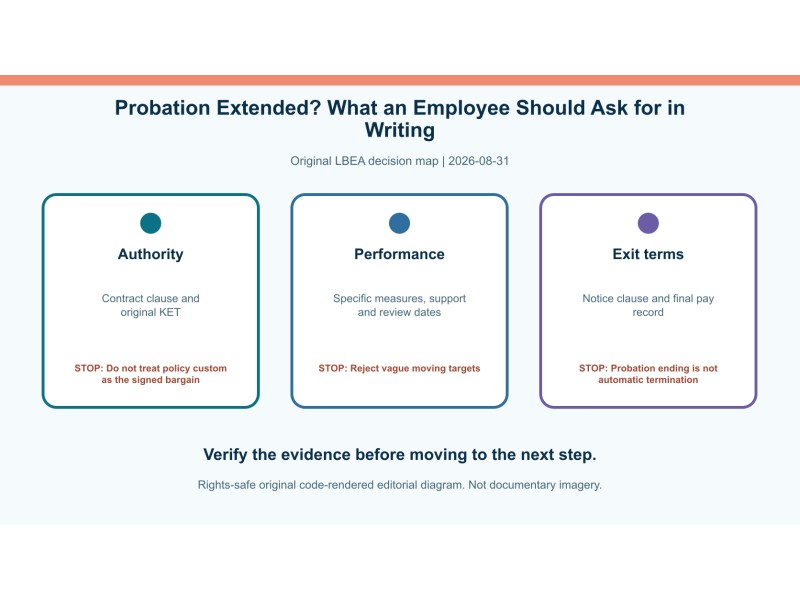
Quick answer. A probation extension should be checked against the contract and clarified in writing, including the reason, new end date, performance measures and notice position.
Related reading: employment contract clauses and changing employment terms.
Ask what has legally and practically changed
A manager saying ‘probation is extended’ can mean several different things. It may be an agreed extension under an express contract clause, a proposed variation needing agreement, a delayed internal confirmation decision, or advance notice that employment may be ended. Ask HR to identify the contractual basis, original end date, new end date and the terms that apply during the extension. Do not assume that benefits, notice or employment status automatically change merely because a performance system uses a new label.
Read the probation and notice clauses together
Check the signed contract, written Key Employment Terms and any accepted variation. Identify the stated probation length, any extension power, maximum extension, confirmation mechanism and notice periods. MOM says that if the contract does not state a different notice period during probation, the notice period is the same during probation and after confirmation. This makes the actual wording more important than a general HR custom. Record any conflict between the contract, KETs, handbook and HR system rather than choosing one silently.
Request a measurable improvement plan
Ask for the performance areas said to require more observation, the expected standard, support available, review dates and decision-maker. Replace labels such as ‘not ready’ with observable tasks, deadlines and quality measures. If concerns were never previously raised, note that fact without assuming it invalidates the decision. A useful plan distinguishes conduct, capability, attendance and role-fit issues because each calls for different evidence and support.
Worked scenario
An employee’s three-month probation ends on 30 September. On 28 September, a manager says it will continue for two months because communication must improve. The employee emails a calm summary asking for the contractual clause, new end date, two concrete communication outcomes, fortnightly feedback and confirmation of the notice and benefit terms. HR discovers that the contract permits only a one-month extension. The written check prevents the payroll and HR systems from drifting away from the actual contract.
Do not sign a backdated record
If HR asks for an acknowledgement, read whether it merely records receipt or seeks agreement to new terms. Ask for time to consider a genuine variation. Do not sign a document dated earlier than it was presented, and do not alter an original email or contract to make the extension appear pre-agreed. If the employer corrects an administrative error, retain both the original and corrected version with an explanation. A clean chronology is more useful than a falsely tidy file.
If employment may end
MOM states that either party may terminate at the end of probation by giving written notice and serving the contractual period or paying salary in lieu. The contract may allow termination earlier as well. Preserve any notice, reason given, performance material and salary calculation. Do not assume that the end of probation itself ends employment. If dismissal is said to be for misconduct or a prohibited reason, separate that issue and obtain advice promptly.
Your one-page extension record
Create a page showing the original clause, original end date, proposed basis, new end date, performance measures, review meetings, support, notice terms and final decision date. Attach the underlying documents. After each review, send a factual summary and invite corrections. This record helps the employee act on feedback and helps HR decide consistently. It does not guarantee confirmation or turn ordinary feedback into a legal claim.
How to use this guide
Start with the reader, decision and evidence identified above. Write the next action and owner beside every unresolved point, then set a review date. Keep authority-issued records unchanged and preserve earlier versions when a correction is made. If a fact, document or deadline does not fit the matrix, pause instead of forcing it into the nearest category. Official guidance can change, and a checklist cannot decide disputed facts or replace advice on a specific case. The strongest file shows what was known, when it was known, which source controlled the step and why the chosen action followed.
Decision and evidence matrix
| Checkpoint | Evidence to verify | Stop condition |
|---|---|---|
| Authority | Contract clause and original KET | Do not treat policy custom as the signed bargain |
| Performance | Specific measures, support and review dates | Reject vague moving targets |
| Exit terms | Notice clause and final pay record | Probation ending is not automatic termination |
Primary sources checked for this guide
Source status was checked on 31 August 2026. Reopen the controlling page before acting because procedures and legal status can change.
- Ministry of Manpower: What is my notice period during probation and upon confirmation?, supporting The contract governs probation notice; without a different probation notice term, the same notice period applies during and after probation.
- Ministry of Manpower: Key employment terms, supporting Written Key Employment Terms include the probation period and notice period where applicable.
- Ministry of Manpower: Can I terminate employment at the end of a probation period?, supporting Either party may terminate at the end of probation by written notice and serving the contractual notice period or paying salary in lieu.
Real people. Right here in Singapore.