
Insights for work and life.
How to Spot a Fake Degree: A Guide to MOM’s Stricter Qualification Checks
Introduction
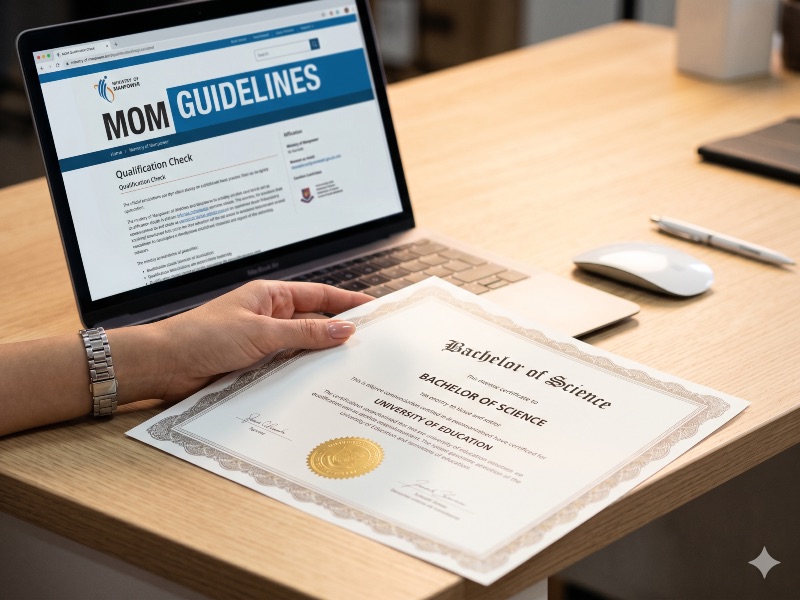
Employers in Singapore are increasingly facing stricter checks from the Ministry of Manpower (MOM) on foreign qualifications. How to Spot a Fake Degree: A Guide to MOM’s Stricter Qualification Checks explains what employers and HR teams should look for when assessing academic credentials, and why accurate verification matters for Employment Pass, S Pass and Work Permit applications.
The article provides a practical overview of MOM’s approach to qualification checks, highlights relevant Singapore legislation such as the Employment of Foreign Manpower Act and Employment Act, and shows how to reduce compliance risk when hiring internationally.
Who this applies to
This guidance is relevant to:
- Employers and HR professionals in Singapore conducting pre-employment checks.
- Organisations sponsoring Employment Pass, S Pass or Work Permit holders.
- Employment agencies and consultants who advise on foreign manpower recruitment under the Employment Agencies Act.
- Individuals responsible for payroll, tax and benefits who need to ensure records used for CPF, IRAS and SDL are correct.
Key rules and requirements in Singapore
MOM requires employers to submit supporting documents for foreign qualifications during pass applications. In recent years MOM has tightened qualification checks to combat falsified academic credentials and protect the local workforce.
Key regulatory points to note:
- MOM requires accurate documentation for Employment Pass and S Pass applications; false or misleading information can lead to pass rejection, revocation or fines under the Employment of Foreign Manpower Act.
- Primary source verification (PV) is increasingly used. MOM may ask for direct confirmation from the issuing institution or require authenticated certificates.
- Employers must maintain proper records in case of MOM audits; errors can affect SDL, CPF and tax reporting (IRAS).
- Other laws can be relevant: the Employment Act (employment terms), PDPA (handling candidate personal data during verification), ACRA (verifying company records), POHA (penalties for false statements), and Work Injury Compensation Act for insured employees.
Step-by-step process
Below is a pragmatic process employers can follow to minimise risk when assessing qualifications.
- Request original documents and certified copies: Ask candidates for original degree certificates, official transcripts and a certified copy if originals cannot be produced. Retain copies in accordance with PDPA.
- Check institutional legitimacy: Verify the university or college on the institution’s official website and established directories. Use recognised lists such as government higher-education regulators in the issuing country.
- Perform primary source verification (PV): Contact the issuing institution directly or use an accredited PV provider. For MOM submissions, be ready to provide PV evidence if requested.
- Validate document features: Look for official seals, signatures, watermarks and consistent font/format. Compare with known authentic samples if possible.
- Review transcript content: Ensure dates, award types and course duration align with the candidate’s stated employment history and CV.
- Cross-check with other sources: Confirm details through referees, LinkedIn profiles, and prior employers. Use ACRA BizFile+ to verify company records when employment history appears inconsistent.
- Log and retain verification steps: Keep a clear audit trail of who conducted checks, dates and the evidence obtained. This supports compliance under MOM audits and PDPA retention rules.
- Respond to MOM queries promptly: If MOM requests additional verification, provide documents and PV outcomes quickly to avoid delays or adverse action.
Common mistakes to avoid
- Relying solely on scanned documents provided by the candidate without further checks.
- Assuming a foreign institution is legitimate without checking the relevant regulator in that country.
- Failing to obtain candidate consent before contacting third parties (PDPA implications).
- Not recording verification steps or losing the audit trail required by MOM.
- Mixing up degree equivalency and course content; assuming similar titles mean the same qualification level.
Practical examples
Example 1: Employment Pass application delayed because of an unverified degree
An employer submitted an EP application with scanned degree certificates. MOM requested PV. The issuing university could not confirm the award due to a typographical inconsistency on the certificate. Because the employer had preserved the original document and had already initiated PV, the discrepancy was resolved quickly by obtaining an authenticated transcript.
Example 2: S Pass rejected for false credential
A candidate claimed a master’s degree from an unfamiliar institution. The employer did not perform PV. MOM discovered the credential was fabricated and rejected the S Pass; the employer faced fines for negligent hiring practices under the Employment of Foreign Manpower Act.
How an experienced consultant can help
Engaging a specialist immigration consultant or an employment agency can reduce risk and administrative burden. Services typically include:
- Co-ordinating primary source verification with universities and third-party providers.
- Preparing complete MOM submissions, including supporting documents aligned with MOM’s current guidelines.
- Maintaining compliant records in line with PDPA and preparing for MOM audits.
- Providing advisory support on related obligations such as CPF contributions, IRAS reporting and contract terms under the Employment Act.
Little Big Employment Agency can assist with application preparation, compliance checks and advisory support to ensure your hiring process meets MOM expectations while protecting your organisation.
Frequently Asked Questions
Do employers need to verify every foreign degree?
Employers should verify qualifications that are material to the role and to MOM pass requirements. MOM may require verification for degrees submitted with pass applications; best practice is to verify any foreign qualification relied upon as part of hiring decisions.
What is primary source verification (PV)?
Primary source verification means obtaining confirmation directly from the issuing institution or through an authorised verification service that the qualification is genuine and was awarded as claimed.
Can an employer rely on overseas translations of certificates?
Translations must be certified and accompanied by the original document. MOM and other agencies may require the original language certificate and an authorised translation if the qualification is in a language other than English.
What happens if MOM finds a fake degree after a pass is granted?
MOM can revoke the work pass, impose fines or seek further enforcement action. Employers may face penalties if they knowingly submit false information or fail to take reasonable verification steps.
Key takeaways
- MOM’s stricter qualification checks mean employers should perform robust verification for foreign degrees, especially for Employment Pass and S Pass applicants.
- Use primary source verification and retain a clear audit trail to reduce compliance risk.
- Be mindful of PDPA when handling personal data during checks and of other obligations under the Employment Act, CPF Act and IRAS reporting requirements.
- Engaging an experienced consultant can streamline PV, MOM submissions and record-keeping.
- Requirements may change, so always check the latest guidance from MOM, or consult a professional adviser.
If you would like to find out more about how Little Big Employment Agency can assist with your employment and immigration requirements, please get in touch with the team at [email protected].
Yours sincerely,
The editorial team at Little Big Employment Agency
Disclaimer: This does not constitute legal advice. If you require legal advice, please contact a lawyer.
Real people. Right here in Singapore.