
Quick answer: An Employment Pass (EP) candidate must first earn at least the EP qualifying salary for their age (Stage 1), then score 40 points under COMPASS (Stage 2) unless exempt. COMPASS awards 0, 10 or 20 points for salary, qualifications, diversity and support for local employment, plus bonus points for shortage occupations and strategic economic priorities.
Key takeaways
- Two stages, in order. Salary is checked first. A candidate below the EP qualifying salary is not eligible, however many COMPASS points they would score.
- Salaries rise from 1 January 2027. New applications need at least S$6,000 (S$6,600 in financial services), rising with age to S$11,500 (S$12,700) at 45 and above. Renewals follow for passes expiring from 1 January 2028.
- 40 points passes. Four foundational criteria give 0, 10 or 20 points each. Ten points on every criterion is enough.
- Bonuses can rescue a weak score. A job on the Shortage Occupation List adds 10 or 20 points. The Strategic Economic Priorities bonus adds 10.
- Small firms get a head start. Organisations with fewer than 25 PMETs score 10 points by default on diversity and on local employment.
- Some candidates skip COMPASS. These include those earning at least S$22,500 a month, overseas intra-corporate transferees and roles of one month or less.
Contents
- What is COMPASS and how does it fit into the EP application?
- What salary does a candidate need from 1 January 2027?
- How are COMPASS points scored?
- Who is exempt from COMPASS?
- How do the points work in practice? 10 worked examples
- What changes in 2027?
- How can an employer raise a weak score legitimately?
- What happens if an application is rejected?
- What are the most common COMPASS mistakes?
- Frequently asked questions
What is COMPASS and how does it fit into the EP application?
COMPASS is the points test that most EP candidates must pass after they clear the salary floor.
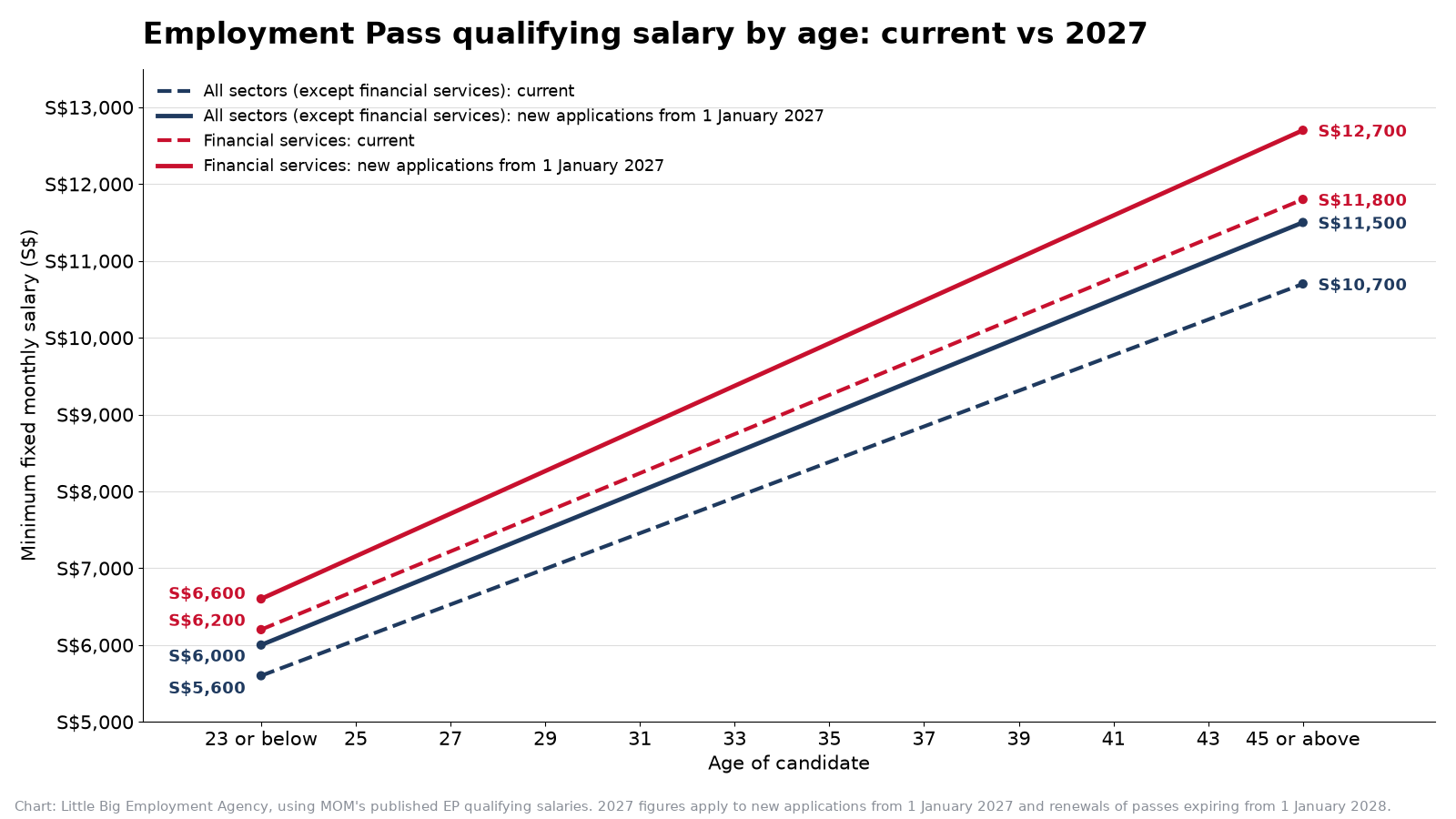
The Ministry of Manpower (MOM) assesses EP applications under a two-stage eligibility framework. Stage 1 asks whether the candidate earns at least the EP qualifying salary, which MOM benchmarks to the top third of local PMET (professional, manager, executive and technician) salaries by age. Stage 2 asks whether the application scores at least 40 points under the Complementarity Assessment Framework, known as COMPASS.
COMPASS looks at both sides: two criteria assess the candidate (salary and qualifications) and two assess the firm (its nationality mix and its share of local PMETs). Employers must also continue to meet the Fair Consideration Framework job advertising requirement before submitting a new EP application.
What salary does a candidate need from 1 January 2027?
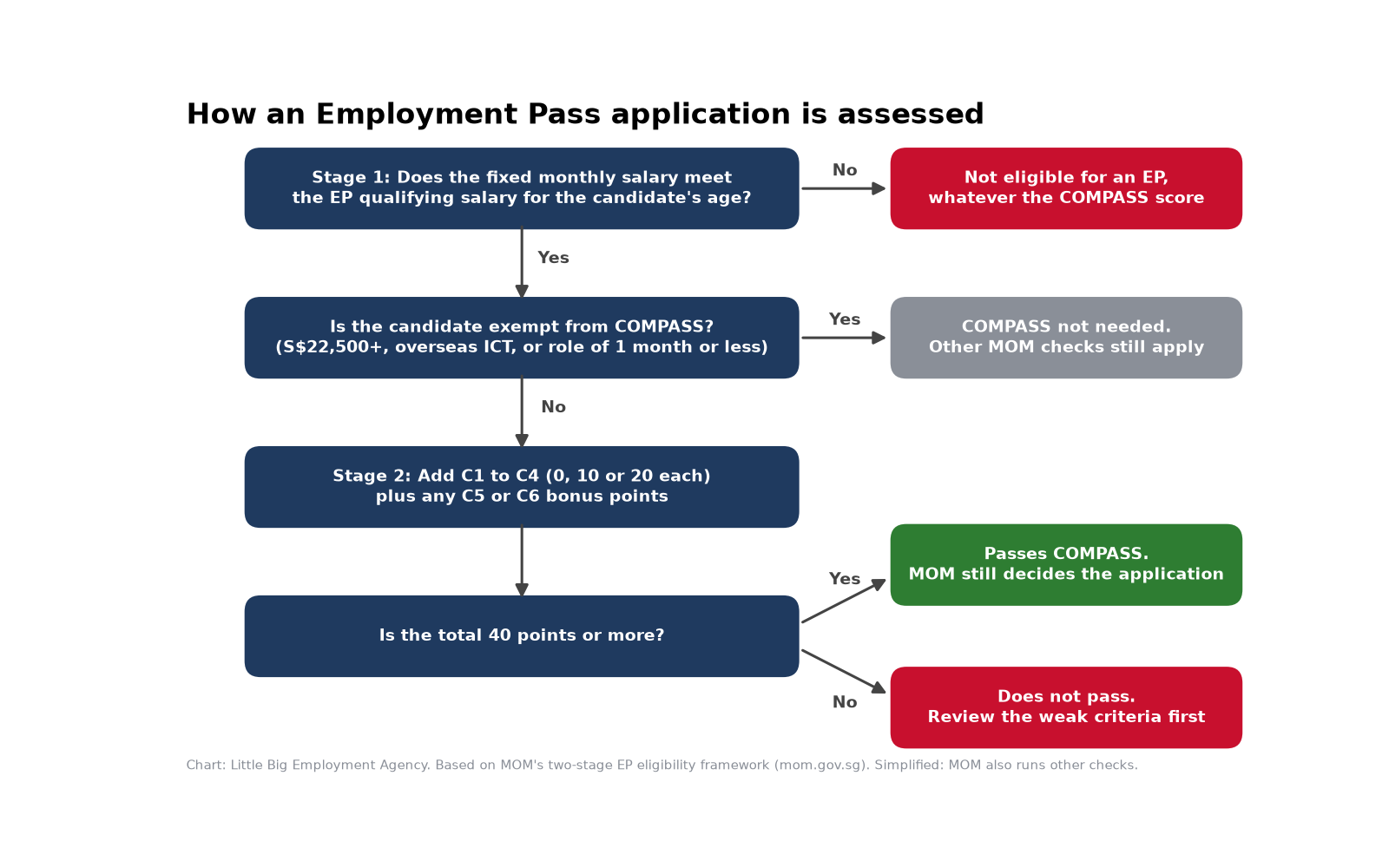
New applications from 1 January 2027 need at least S$6,000 a month, or S$6,600 in financial services, with higher amounts for older candidates.
MOM announced the increase in its Committee of Supply 2026 factsheet and publishes the full age table on its EP eligibility page. Renewals move to the new figures for passes expiring from 1 January 2028.
| Age | All sectors except financial services: current | All sectors except financial services: from 1 January 2027 | Financial services: current | Financial services: from 1 January 2027 |
|---|---|---|---|---|
| 23 or below | S$5,600 | S$6,000 | S$6,200 | S$6,600 |
| 30 | S$7,223 | S$7,750 | S$7,982 | S$8,541 |
| 35 | S$8,382 | S$9,000 | S$9,255 | S$9,927 |
| 40 | S$9,541 | S$10,250 | S$10,527 | S$11,314 |
| 45 or above | S$10,700 | S$11,500 | S$11,800 | S$12,700 |
How are COMPASS points scored?
Each foundational criterion is worth 0, 10 or 20 points, bonuses add up to 30 more, and the pass mark is 40.
| Criterion | 20 points | 10 points | 0 points |
|---|---|---|---|
| C1 Salary (against local PMET salaries in the sector, by age) | 90th percentile and above | 65th to below 90th percentile | Below 65th percentile |
| C2 Qualifications | Degree-equivalent from a top-tier institution on MOM’s list, including Singapore’s autonomous universities | Other degree-equivalent or endorsed professional qualification | No degree-equivalent qualification |
| C3 Diversity (candidate’s nationality share of the firm’s PMETs) | Below 5% | 5% to below 25% | 25% or more |
| C4 Support for local employment (firm’s local PMET share against its sector) | 50th percentile and above | 20th to below 50th percentile | Below 20th percentile |
| C5 Skills bonus | Job on the Shortage Occupation List and nationality share below one third | Job on the list and nationality share of one third or more | Not on the list |
| C6 Strategic Economic Priorities bonus | Firm awarded the bonus through an eligible programme | No bonus awarded |
- C1 is not the same as Stage 1. The C1 salary benchmarks vary by sector and age and are updated every year. The benchmarks released in August 2026 apply to new applications from 1 January 2027 and to renewals of EPs expiring from 1 July 2027.
- Small firms score 10 by default on C3 and C4. This applies where the organisation has fewer than 25 PMETs.
- A safety net exists for C4. A firm whose local PMET share is at least 70% scores at least 10 points on C4, wherever it sits within its sector.
Firms can check their own C3 and C4 scores in the Workforce Insights tool on the myMOM Portal.
Who is exempt from COMPASS?
Candidates earning at least S$22,500 a month, overseas intra-corporate transferees and those filling a role of one month or less are exempt.
An exempt candidate must still meet the Stage 1 qualifying salary, and MOM still carries out its other checks.
How do the points work in practice? 10 worked examples
An application can pass by scoring 10 on every criterion, or by making up a weak area with a strong one or a bonus.
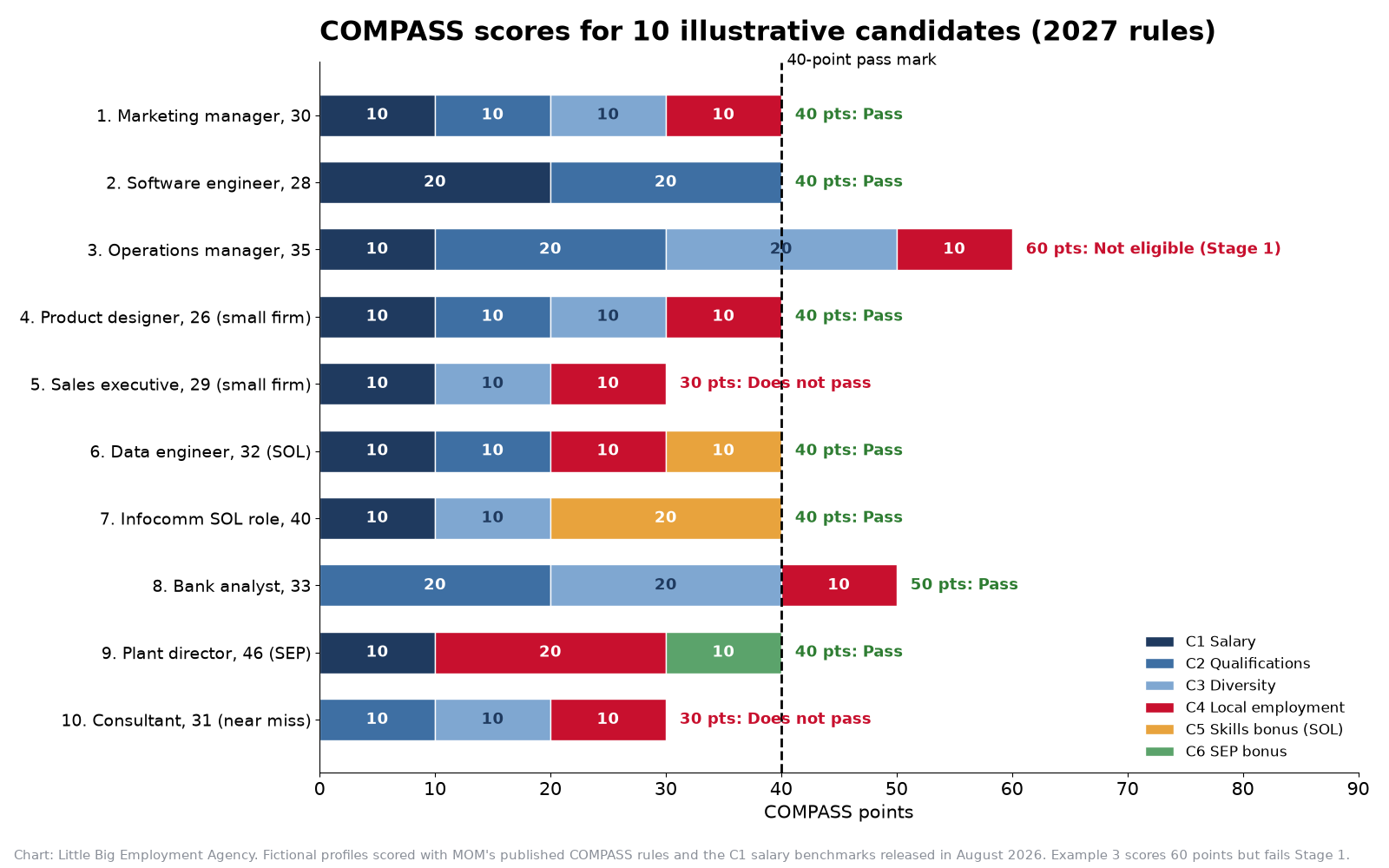
The ten profiles below show how COMPASS Employment Pass scoring works in practice. They are fictional and for illustration only. Each assumes a new application submitted on or after 1 January 2027, using the 2027 qualifying salaries and MOM’s C1 benchmarks released in August 2026.
Example 1: The all-rounder
Aisha, 30, marketing manager at a professional services firm with 60 PMETs. Salary S$9,000 (Stage 1 at 30: S$7,750, met).
| Criterion | Rule applied | Points |
|---|---|---|
| C1 | 65th percentile benchmark at 30 is S$8,283; 90th is S$14,316 | 10 |
| C2 | Bachelor’s degree, not top-tier | 10 |
| C3 | Nationality is 15% of PMETs (5% to below 25%) | 10 |
| C4 | Local PMET share at 40th percentile of sector | 10 |
| Total | 40: passes |
Example 2: Strong candidate, weak firm profile
Ben, 28, software engineer at an infocomm technology firm with 200 PMETs. Salary S$13,500 (Stage 1 at 28: S$7,250, met).
| Criterion | Rule applied | Points |
|---|---|---|
| C1 | At or above the 90th percentile benchmark of S$12,994 | 20 |
| C2 | Degree from a Singapore autonomous university | 20 |
| C3 | Nationality is 30% of PMETs | 0 |
| C4 | Local PMET share at 15th percentile | 0 |
| Total | 40: passes |
Example 3: Plenty of points, but Stage 1 fails
Chen, 35, operations manager at a manufacturer with 120 PMETs. Salary S$8,600. Stage 1 at 35 from 1 January 2027 is S$9,000.
| Criterion | Rule applied | Points |
|---|---|---|
| C1 | Above the 65th percentile benchmark of S$8,481 | 10 |
| C2 | Top-tier degree | 20 |
| C3 | Nationality is 3% of PMETs | 20 |
| C4 | Local PMET share at 30th percentile | 10 |
| Total | 60, but not eligible |
His salary is below the qualifying salary for his age, so the points do not count.
Example 4: The small-firm default
Dina, 26, product designer at a technology start-up with 12 PMETs. Salary S$8,200 (Stage 1 at 26: S$6,750, met).
| Criterion | Rule applied | Points |
|---|---|---|
| C1 | Above the infocomm 65th percentile benchmark of S$7,973 | 10 |
| C2 | Bachelor’s degree, not top-tier | 10 |
| C3 | Fewer than 25 PMETs: default | 10 |
| C4 | Fewer than 25 PMETs: default | 10 |
| Total | 40: passes |
Example 5: Small firm, no degree
Eko, 29, sales executive at a wholesale trading company with 8 PMETs. Salary S$7,600 (Stage 1 at 29: S$7,500, met).
| Criterion | Rule applied | Points |
|---|---|---|
| C1 | Above the 65th percentile benchmark of S$7,387, below the 90th of S$11,997 | 10 |
| C2 | No degree-equivalent qualification | 0 |
| C3 | Default | 10 |
| C4 | Default | 10 |
| Total | 30: does not pass |
Without qualification points, he would need 20 points on salary: S$11,997 or more here.
Example 6: Shortage occupation at the reduced rate
Farah, 32, data engineer in a role on the Shortage Occupation List, at an infocomm firm with 80 PMETs. Salary S$12,000 (Stage 1 at 32: S$8,250, met).
| Criterion | Rule applied | Points |
|---|---|---|
| C1 | Between the 65th (S$9,853) and 90th (S$15,415) percentile benchmarks | 10 |
| C2 | Master’s degree, not top-tier | 10 |
| C3 | Nationality is 35% of PMETs | 0 |
| C4 | Local PMET share at 25th percentile | 10 |
| C5 | SOL role, nationality share one third or more | 10 |
| Total | 40: passes |
Example 7: Shortage occupation at the full rate
George, 40, in an infocomm role on the Shortage Occupation List at a firm with 50 PMETs. He has no degree but meets the occupation’s additional requirements through work experience. Salary S$12,500 (Stage 1 at 40: S$10,250, met).
| Criterion | Rule applied | Points |
|---|---|---|
| C1 | Above the 65th percentile benchmark of S$12,359 | 10 |
| C2 | No degree-equivalent qualification | 0 |
| C3 | Nationality is 10% of PMETs | 10 |
| C4 | Local PMET share at 10th percentile | 0 |
| C5 | SOL role, nationality share below one third | 20 |
| Total | 40: passes |
Because he needed the bonus to pass, he can only be employed in that shortage occupation unless MOM reassesses him for a new job.
Example 8: Financial services, salary below the C1 benchmark
Hana, 33, analyst at a bank with 300 PMETs. Salary S$12,000 (financial services Stage 1 at 33: S$9,373, met).
| Criterion | Rule applied | Points |
|---|---|---|
| C1 | Below the banking 65th percentile benchmark of S$13,136 | 0 |
| C2 | Top-tier degree | 20 |
| C3 | Nationality is 4% of PMETs | 20 |
| C4 | Local PMET share at 35th percentile | 10 |
| Total | 50: passes |
Example 9: Strategic Economic Priorities bonus
Ivan, 46, plant director at a manufacturer taking part in an eligible SEP programme. The firm has 150 PMETs. Salary S$12,000 (Stage 1 at 45 and above: S$11,500, met).
| Criterion | Rule applied | Points |
|---|---|---|
| C1 | Above the 65th percentile benchmark of S$10,721 | 10 |
| C2 | No degree-equivalent qualification | 0 |
| C3 | Nationality is 28% of PMETs | 0 |
| C4 | Local PMET share at 55th percentile | 20 |
| C6 | Firm awarded the SEP bonus | 10 |
| Total | 40: passes |
Example 10: A near miss, fixed properly
Jia, 31, consultant at a professional services firm with 40 PMETs. Salary S$8,300 (Stage 1 at 31: S$8,000, met).
| Criterion | Rule applied | Points |
|---|---|---|
| C1 | Below the 65th percentile benchmark of S$8,537 | 0 |
| C2 | Bachelor’s degree, not top-tier | 10 |
| C3 | Nationality is 20% of PMETs | 10 |
| C4 | Local PMET share at 30th percentile | 10 |
| Total | 30: does not pass |
If the employer genuinely revises the offer to S$8,600 and re-advertises the role at that salary on MyCareersFuture for at least 14 consecutive days, C1 rises to 10 and the total reaches 40.
What changes in 2027?
From 1 January 2027, new applications face higher qualifying salaries, new C1 benchmarks, updated qualification lists and an updated Shortage Occupation List.
- Qualifying salary: S$6,000 minimum (S$6,600 in financial services), up to S$11,500 (S$12,700) at 45 and above. Renewals switch over for passes expiring from 1 January 2028.
- C1 benchmarks: the August 2026 benchmarks apply to new applications from 1 January 2027 and renewals of EPs expiring from 1 July 2027.
- C2 lists: MOM has published updated top-tier institution and professional qualification lists for new and renewal applications from 1 January 2027.
- Shortage Occupation List: an updated SOL employer guide applies to new applications and renewals from 1 January 2027, and MOM updated its Self-Assessment Tool for the new list from 1 November 2026.
The 40-point pass mark stays the same. Renewals need early attention, because a salary that was comfortable at first application may fall below the new floor. See our guide to EP renewals and the salary floor.
How can an employer raise a weak score legitimately?
Fix the facts, not the form: review salary, qualifications evidence, workforce data and SOL eligibility before applying.
- Run the Self-Assessment Tool first. MOM’s Self-Assessment Tool shows COMPASS scores before you apply. MOM says an “eligible” result carries around a 90% chance of approval, but the tool does not guarantee the outcome.
- Check the C1 benchmark for the right sector and age. A modest, genuine salary revision can move a candidate into the next band. Unless the role is exempt from advertising, a changed salary needs a new MyCareersFuture advertisement, open for at least 14 consecutive days.
- Claim qualification points properly. Points need verification proof submitted with the application. If C2 points are not needed, MOM says the qualifications do not have to be submitted.
- Confirm your sector classification. C1 and C4 depend on it, and MOM lets firms check and update it.
- Test SOL eligibility honestly. The candidate must perform the listed duties and meet the additional requirements.
- Build the local core. A higher local PMET share improves C4 for every future application.
What happens if an application is rejected?
The employer or authorised agent can appeal through EP eService within three months, but only if the reasons for rejection can be addressed.
MOM’s appeals page says there will be no change in outcome without new information. Check the rejection advisory in EP eService first. Candidates themselves cannot appeal. Supporting documents are not needed if the candidate now meets the salary and COMPASS criteria, or if outstanding issues such as inconsistent qualification proof have been resolved. MOM processes 85% of appeals within six weeks. After three months, a new application is required.
What are the most common COMPASS mistakes?
Many avoidable problems come from mixing up the two salary tests or relying on outdated data.
- Assuming a high COMPASS score can make up for a salary below Stage 1.
- Using the 2026 benchmarks for an application submitted in 2027.
- Declaring qualifications without verification proof, or with details that do not match it.
- Selecting an SOL job title when the duties do not match.
- Changing the salary after advertising without re-advertising.
Need help with an Employment Pass application?
Little Big Employment Agency Pte Ltd is an employment agency licensed by the Ministry of Manpower (EA Licence 19C9790), supporting employers with work passes and employment matters. We prepare and submit Employment Pass applications, check COMPASS Employment Pass scores before filing and handle appeals. Our published fee for a new EP or S Pass is S$1,400, which includes the fees payable to MOM and one appeal if the application is rejected. Disbursements such as translation or certification are extra, and we confirm the scope and total before you proceed. Contact us to discuss your candidate.
MOM decides every application. Passing COMPASS, or the Self-Assessment Tool, does not guarantee approval.
Frequently asked questions
How many points do I need to pass COMPASS?
You need at least 40 points. Ten points on each of the four foundational criteria gives exactly 40.
What is the EP qualifying salary in 2027?
For new applications from 1 January 2027, it is S$6,000 (S$6,600 in financial services), rising with age to S$11,500 (S$12,700) at 45 and above.
When do the 2027 salaries apply to renewals?
They apply to renewals of passes expiring from 1 January 2028. The new C1 benchmarks apply to renewals of EPs expiring from 1 July 2027.
Can a candidate without a degree get an EP?
Yes. A candidate with no degree-equivalent qualification scores 0 on C2 but can still pass with 40 points from other criteria and bonuses.
How do small companies score on COMPASS?
Organisations with fewer than 25 PMETs score 10 points by default on both the diversity and local employment criteria.
Who is exempt from COMPASS?
Candidates earning at least S$22,500 a month, overseas intra-corporate transferees and those filling a role for one month or less.
How long do I have to appeal a rejected EP?
Three months from the rejection. MOM processes 85% of appeals within six weeks.
Does passing the Self-Assessment Tool guarantee approval?
No. MOM says an eligible result means around a 90% chance, and the actual COMPASS score may differ.
Last updated 25 November 2026. This guide is general information based on MOM’s published rules and is not legal advice.