
Insights for work and life.
Common-Law Spouse of an EP Holder: Build the LTVP Evidence File
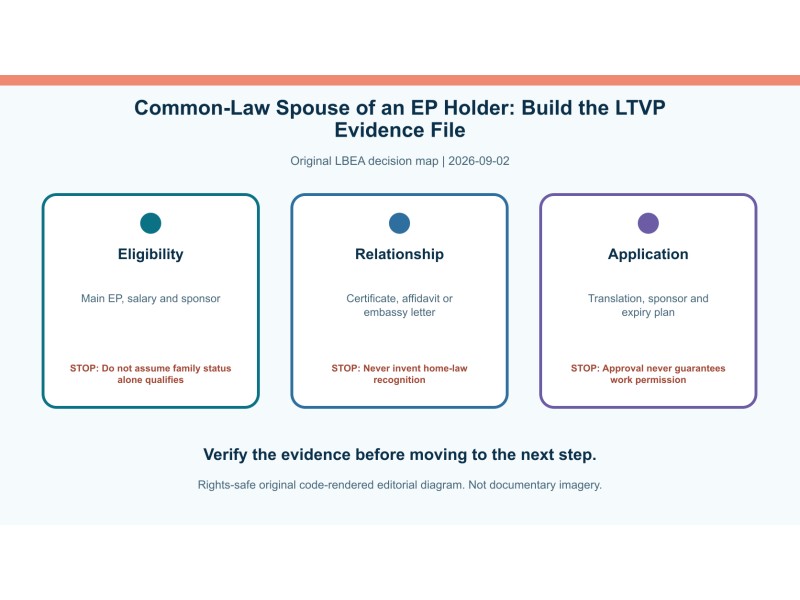
Answer first. A common-law spouse of an eligible EP holder uses the MOM Long-Term Visit Pass route, with one accepted form of relationship evidence and a separate application by the employer or appointed agent.
Related reading: Dependant Pass and LTVP guide and family relocation guide.
Choose the right family-pass branch
MOM’s family table places a legally married spouse under the Dependant’s Pass route and a common-law spouse under the Long-Term Visit Pass route. Use the relationship’s legal status, not a preferred label. Do not upload a wedding photograph and assume it substitutes for accepted evidence. The main pass holder should first confirm current EP status, sponsoring company and salary eligibility before asking the employer to prepare a separate family application.
Select one accepted relationship document
MOM lists three alternatives for a common-law spouse: a common-law marriage certificate; an affidavit by both partners declaring a relationship recognised under home-country or region law and notarised there; or a letter from the relevant embassy acknowledging that recognition. Choose the path the home jurisdiction can lawfully support. Do not write an affidavit claiming legal recognition without verifying that proposition.
Build a consistency table
Compare names, passport numbers, nationalities, addresses, dates and relationship description across passports, affidavit or certificate, embassy letter and main-pass records. Explain genuine transliteration or name changes with supporting documents. For non-English material, MOM requires the original and English translation uploaded as one file. Do not replace the original with a translated re-creation or crop away seals and notarisation details.
Coordinate the sponsor and applicant
For dependants of EP and S Pass holders, the employer or appointed employment agent submits the LTVP application. Agree who collects documents, who checks translations, who receives correspondence and who watches expiry dates. The family member should not assume a personal portal submission has replaced the sponsor’s step. The employer should handle sensitive relationship documents with access controls and retain only what is necessary for the authorised process.
Worked scenario
An EP holder and partner are from a jurisdiction that recognises their common-law relationship but does not issue a certificate. They obtain a joint affidavit in that jurisdiction, have it notarised there, and combine the original non-English document with a certified English translation. The employer checks the EP and salary evidence, submits a separate LTVP application and records the main-pass expiry. The couple does not book relocation on an assumed approval date.
Plan entry and work separately
MOM states that LTVP duration is linked to the main pass or requested period, whichever is shorter. Approval and work permission are separate questions. An MOM-issued family LTVP should not be confused with an ICA-issued LTVP, and the route to work depends on the pass and current rules. Verify the exact work-authorisation process before employment starts. The relationship evidence does not guarantee approval or authorise work.
Avoid false certainty
MOM may ask for further documents during review. Keep a response log, submit genuine records and explain gaps instead of manufacturing joint bills or backdating declarations. Do not predict approval based on another couple’s experience, nationality, salary or length of relationship. This guide is accurate as at the stated date and provides a document framework, not an assessment of a particular relationship or immigration outcome.
How to use this guide
Start with the reader, decision and evidence identified above. Write the next action and owner beside every unresolved point, then set a review date. Keep authority-issued records unchanged and preserve earlier versions when a correction is made. If a fact, document or deadline does not fit the matrix, pause instead of forcing it into the nearest category. Official guidance can change, and a checklist cannot decide disputed facts or replace advice on a specific case. The strongest file shows what was known, when it was known, which source controlled the step and why the chosen action followed. Record every unresolved assumption, identify who can verify it, and never treat silence or a pending application as approval.
Decision and evidence matrix
| Checkpoint | Evidence to verify | Stop condition |
|---|---|---|
| Eligibility | Main EP, salary and sponsor | Do not assume family status alone qualifies |
| Relationship | Certificate, affidavit or embassy letter | Never invent home-law recognition |
| Application | Translation, sponsor and expiry plan | Approval never guarantees work permission |
Primary sources checked for this guide
Source status was checked on 2 September 2026. Reopen the controlling page before acting because procedures and legal status can change.
- Ministry of Manpower: Passes for families of Employment Pass holders, supporting An EP holder meeting the current salary condition may seek an LTVP for a common-law spouse through a separate employer application.
- Ministry of Manpower: Documents required for Long-Term Visit Pass, supporting Accepted common-law evidence includes a certificate, a qualifying notarised affidavit, or an embassy letter recognising the relationship under home-country or region law.
- Ministry of Manpower: Key facts on Long-Term Visit Pass, supporting The LTVP duration is tied to the main work pass or requested duration, whichever is shorter, and the employer or appointed agent applies.
Authority and relationship disclosure. Little Big Employment Agency Pte. Ltd. is not affiliated with or endorsed by MOM, ICA, ACRA, MAS or IRAS. Contacting LBEA does not create a solicitor-client relationship.
Real people. Right here in Singapore.