
Insights for work and life.
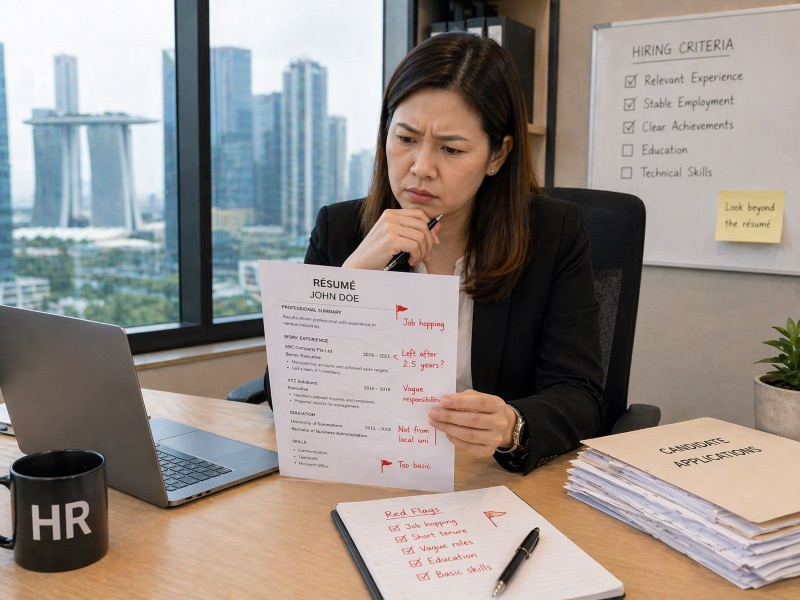
5 Red Flags in a Candidate’s Resume That Most Singapore HR Managers Miss
Introduction
Recruiters and hiring managers in Singapore are under pressure to fill vacancies quickly while maintaining compliance. The article title, 5 Red Flags in a Candidate’s Resume That Most Singapore HR Managers Miss, highlights common issues that can slip through screening and expose employers to reputational, operational or regulatory risk.
This article explains the five most frequently overlooked resume red flags, the Singapore-specific checks you should consider, and a pragmatic screening process you can adopt to reduce hiring risk.
Who this applies to
This guidance is for HR managers, in-house recruiters, small business owners, licensed employment agencies and hiring panels in Singapore. It applies whether you are recruiting local talent or engaging foreign workers under the Employment of Foreign Manpower Act, including Employment Pass, S Pass and Work Permit holders.
Key rules and requirements in Singapore
When screening candidates in Singapore, you must balance thorough verification with statutory obligations under PDPA, the Employment Act, Employment Agencies Act and other laws. Key points include:
- Obtain clear consent before collecting or verifying personal data (PDPA).
- When recruiting foreign workers, observe MOM requirements and verify work pass status; incorrect employment of foreign manpower can lead to penalties.
- Be careful when requesting financial or tax documents, IRAS and CPF matters are sensitive and must be handled appropriately.
- Follow Employment Agencies Act rules if you use or operate an agency for recruitment.
- Retain documentary evidence for checks, but only for as long as necessary and in compliance with data retention rules.
Step-by-step process
Adopt a systematic verification workflow to catch the five red flags described below. The following process blends practical checks with legal compliance in Singapore.
- Step 1 , Initial screen: Confirm dates, roles and contact details on the resume. Flag inconsistencies.
- Step 2 , Consent and documents: Request written consent for checks and ask for supporting documents such as payslips, CPF contribution histories, employment letters and educational certificates.
- Step 3 , Public registry verification: Use ACRA BizFile+ to verify company names, directorships and business history if the resume references directorships or company ownership.
- Step 4 , Work pass verification: For foreign candidates, check MOM’s employer services or public tools to confirm current pass status and past employer relationships as appropriate.
- Step 5 , Reference checks: Contact previous employers using the contact details provided and document the conversation. Keep questions factual to avoid defamation or other liabilities.
- Step 6 , Education and credential checks: Verify degrees or professional qualifications with the issuing institutions where necessary.
- Step 7 , Decision and record-keeping: Make hiring decisions based on documented verification. Keep records in line with PDPA and ACRA best practice.
5 Red Flags most Singapore HR managers miss
Below are common red flags and why they matter from a Singapore compliance and practical perspective.
- Inconsistent dates or overlapping employment periodsSmall inconsistencies can be innocent; sizeable overlaps or numerous short tenures may indicate résumé padding, undisclosed terminations, or side engagements that conflict with non-compete clauses.
- Vague or inflated job descriptions and titlesClaims of “Head of” or “Director” roles without corresponding reporting lines on ACRA or absence of evidence from previous employers should be verified. Inflated titles can distort compensation benchmarking and statutory obligations (e.g., CPF reporting).
- Missing or unverifiable education and professional credentialsDegrees and professional licences that cannot be confirmed with issuing institutions are a serious red flag. For regulated roles, lack of valid certification can be a compliance breach under relevant Acts.
- Unexplained employment gapsWhile gaps may be legitimate (study, caregiving, self-employment), unexplained gaps should prompt respectful probing. For foreign workers, gaps can affect pass eligibility under MOM policies.
- Inconsistent or fabricated referencesReferences that refuse to give details, provide generic praise, or use personal email addresses rather than corporate contact points may indicate fabricated referees. Always verify through official channels where possible.
Common mistakes to avoid
- Failing to obtain written consent before checks , this can breach PDPA.
- Relying solely on LinkedIn or social media without documentary proof.
- Not checking ACRA when a resume claims directorship or company ownership.
- Neglecting to verify work pass status for foreign candidates via MOM’s available services.
- Ignoring cultural differences in CV presentation and immediately assuming dishonesty.
Practical examples
Example 1 , Inflated title discovered via ACRA
A candidate lists “Director of Singapore Operations” at a firm. ACRA BizFile+ reveals they were a consultant with no director appointment. Verification with the former employer clarifies the role and responsibilities, affecting the offered salary band and reporting structure.
Example 2 , Unverified degree
A candidate claims a professional qualification necessary for compliance. Contacting the certifying body shows the qualification lapsed. This prevents regulatory risk and avoids onboarding someone unable to perform a regulated role.
Example 3 , Suspicious references
Two referees provide glowing testimonials but use personal emails and do not answer follow-up questions. Direct verification through previous employer HR uncovers that the referees were not authorised to provide employment verification.
How an experienced consultant can help
Experienced employment consultants can streamline verification, ensure checks are compliant with PDPA and MOM, and advise on how findings impact work pass eligibility and contractual terms. Little Big Employment Agency can assist with screening, document checks, reference verification and tailored compliance advice for Singapore employment laws.
Frequently Asked Questions
Can we ask candidates for CPF contribution statements to verify past salaries?
You can request a candidate’s CPF contribution history or payslips with their consent. Treat these documents as personal data under PDPA and only retain them for legitimate HR purposes. Do not attempt to obtain CPF data directly from CPF Board without appropriate procedures.
Is it acceptable to rely on LinkedIn for verification?
LinkedIn is useful for initial screening but should not be the sole source of truth. Verify critical claims with documentary evidence, ACRA checks, and direct reference calls.
How should we verify foreign qualifications?
Contact the issuing institution or use recognised verification services. For certain regulated professions, confirm recognition with the relevant Singapore regulator.
Can we conduct criminal record checks?
Criminal record checks should be handled sensitively and in compliance with local law. Obtain candidate consent and understand the legal limits and relevance to the role before requesting such checks.
Key takeaways
- Implement a consistent verification workflow that respects PDPA and MOM requirements.
- Use ACRA, MOM and direct employer checks to validate key claims.
- Obtain written consent before carrying out background checks.
- Watch for five common red flags: inconsistent dates, inflated titles, unverifiable credentials, unexplained gaps, and dubious references.
- Keep clear records of verification to support hiring decisions and regulatory compliance.
Requirements may change, so always check the latest guidance from MOM, or consult a professional adviser.
If you would like to find out more about how Little Big Employment Agency can assist with your employment and immigration requirements, please get in touch with the team at [email protected].
Yours sincerely,
The editorial team at Little Big Employment Agency
Disclaimer: This does not constitute legal advice. If you require legal advice, please contact a lawyer.
Real people. Right here in Singapore.