
Insights for work and life.
Mandatory Retrenchment Notification in Singapore: Who Must File and When
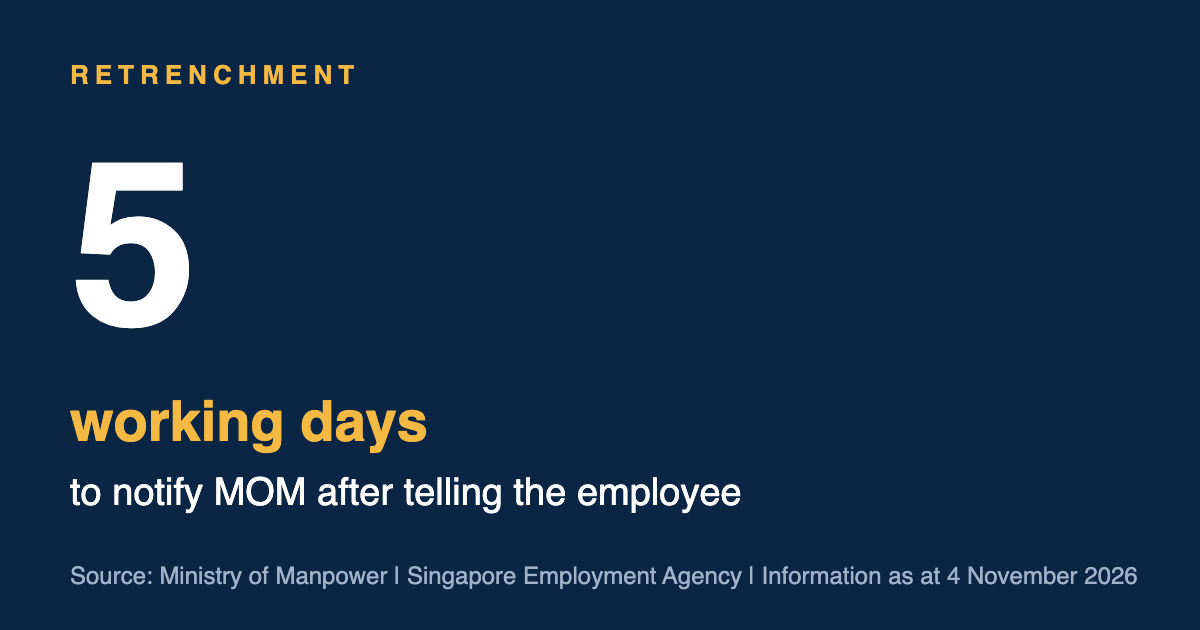
An employer in Singapore with at least 10 employees must file a mandatory retrenchment notification with the Ministry of Manpower (MOM) within 5 working days after telling an employee that they are being retrenched. The duty applies to every retrenchment, even a single one. It sits under the Employment Act and is explained in MOM’s Tripartite Guidelines on Mandatory Retrenchment Notifications, updated on 1 November 2021.
Many older articles still describe a threshold of five retrenched employees within six months. That is no longer the working rule. MOM’s 2021 update extended notification to all retrenchments for employers of this size. This guide sets out who must file, what to submit and how to avoid timing errors. Information is accurate as at 4 November 2026.
Who must file a mandatory retrenchment notification
Per MOM’s retrenchment notification page, last updated on 14 July 2026, the duty falls on employers with businesses registered in Singapore who have at least 10 employees and who notify any employee of their retrenchment.
The headcount is not limited to locals. The guidelines say the number of employees reported on the date of submission includes Singaporeans, Permanent Residents and foreigners. Therefore, a company with six local staff and four work pass holders has reached the 10-employee mark.
Employers below that headcount are outside this notification requirement. Their other obligations, such as contractual notice and any retrenchment benefit, still need to be handled correctly.
What counts as a retrenchment
The guidelines define retrenchment as dismissal on the ground of redundancy or reorganisation of the employer’s business or work. They apply to permanent employees and to contract workers whose full contract term is at least 6 months.
One point catches employers out. The guidelines state that an employer who ends a contract with no plan to fill the vacancy any time soon is presumed to have retrenched the employee. Calling the exit something else does not remove the notification duty.
Related situations deserve care. Our guide on retrenching a foreign employee during probation explains why probation does not automatically avoid the issue. Similarly, no-pay leave used as disguised retrenchment can create the same exposure.
The 5-working-day deadline
The deadline runs from the day the employee is told, not from the last working day. The MOM page states that you must notify MOM of retrenchments within 5 working days after notifying your employee.
| Event | What it means for the notification |
|---|---|
| Employee is told of the retrenchment | The 5-working-day period starts |
| Five working days later | Notification to MOM is due |
| Last day of employment | Does not reset the deadline |
For example, if an employee is told on a Monday, the fifth working day is the following Monday, provided no public holiday falls in between. Check the calendar before you rely on that count.
What information you will need
The guidelines list the details required in the notification. Prepare them before you speak to the employee, so the filing is quick:
- Company name and UEN, and the contact person’s details.
- Name of the union, if the company is unionised, and whether the union was consulted.
- Total number of employees on the date of submission.
- For each affected employee: name, NRIC or FIN, residential status, job title, date of effective retrenchment and date the employee was notified.
- Payment of retrenchment benefit and the quantum.
- Provision of employment facilitation assistance.
How to submit
MOM directs employers to its “Notify for retrenchment exercise” eService. MOM also offers an optional early alert through a government form. That alert is voluntary and does not replace the formal notification.
Penalties for not filing
The guidelines state that failing to comply is a civil contravention under the Employment Act, for which administrative penalties can be imposed. They also warn that strong enforcement action may be taken against employers who wilfully disregard the requirement.
The guidelines do not set out a fixed penalty amount, so we do not quote one. Consult the Employment Act 1968 on Singapore Statutes Online for the operative text.
A practical checklist before you notify
- Confirm your headcount, including foreign employees.
- Record the business reason and why the role is redundant.
- Consult the union first if the company is unionised.
- Work out the retrenchment benefit and its tax treatment. See whether retrenchment benefits are taxable.
- Arrange employment facilitation support through Workforce Singapore or e2i, as the guidelines suggest. The WSG website lists services.
- If the employee holds a work pass, plan the cancellation and the tax clearance steps for foreign employees.
- File within 5 working days and keep the confirmation.
Frequently asked questions
Does the notification replace telling the employee?
No. The employee must be notified first. The MOM notification follows, within 5 working days.
Do foreign employees count for the 10-employee threshold?
Yes. The guidelines say the count includes Singaporeans, Permanent Residents and foreigners.
Is the early alert compulsory?
No. MOM describes it as optional, and it does not replace the formal notification.
A worked example of the 5-working-day count
Consider a Singapore company with eight local staff and three work pass holders. That is 11 employees, so the duty applies. The company decides that one role is redundant and tells the employee on a Tuesday. The employee’s last day is a month later.
The mandatory retrenchment notification is due five working days after that Tuesday, not after the last day. If the company waits until the employee leaves, it is late. This example is illustrative only, and you should count working days against the actual calendar, including public holidays.
Common mistakes employers make
Most late or missing filings come from a handful of errors:
- Counting only local employees when testing the 10-employee threshold.
- Starting the clock at the last day of employment instead of the notification date.
- Describing the exit as a resignation or mutual separation when the vacancy will not be refilled.
- Leaving out the union consultation details in a unionised company.
- Failing to record the retrenchment benefit and the employment facilitation offered.
- Assuming that a small number of retrenchments falls below a notification threshold.
Each of these is avoidable with a simple internal checklist. Assign one person in HR or finance to own the filing, and diarise the deadline on the day the employee is told.
How the notification fits with benefits and support
The notification is separate from the benefit and the notice. The guidelines expect the filing to record the retrenchment benefit paid and its quantum. They also ask whether employment facilitation assistance was provided. Therefore, settle the benefit and support plan before you file, so the form is accurate on the first attempt.
Tripartite partners, including Workforce Singapore, use notifications to help affected employees find alternative employment or relevant training. A prompt, accurate filing therefore helps your own employee as well as meeting the rule.
Next steps
A retrenchment touches notice, benefits, tax and work pass cancellation at the same time. If you want the process mapped out for your headcount and team, speak to the licensed team at Singapore Employment Agency. Where a legal question arises, we can introduce you, with your consent, to an independent law firm.
The Editorial Team, Little Big Employment Agency
${ARTICLE_ENQUIRY_HTML}
Real people. Right here in Singapore.